If You Can Do This Many Lunges After 55, Your Leg Strength Is Stronger Than 90% of Peers


If you’re a fan of performing lunges in your workout routine, you know they can be quite challenging. This single-leg movement involves much coordination, balance, and strength as you use one leg to support all your body weight. In fact, some gym enthusiasts find lunges harder to do than squats because of the one-sided, small muscle demands that lunges require. Unlike squats, lunges are an isolated workout—one leg at a time.
Well, we’re calling all lunge fans for a strength test. According to Joshua King, Personal Training Leader at Life Time Gainesville (Virginia), if you can do this many lunges after 55, your leg strength is stronger than 90% of your peers.
This Benchmark Signals Top-Tier Leg Strength
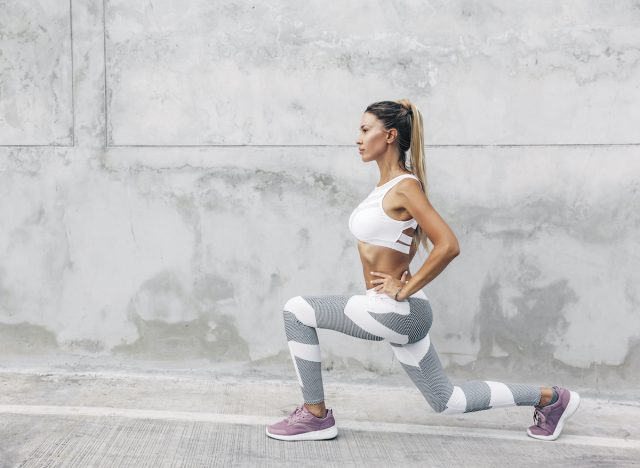
For those 55 and up, King says that if you’re able to perform 50 total reps (one full set or broken up into multiple sets) with solid depth, balance, and posture, you’re stronger than most of your peers.
“The key is quality over quantity. For quality, the knee must stay controlled, full range of motion movement, balance control and keeping the torso upright,” King tells us.
Why Lunges Are an Effective Test of Lower-Body Strength
According to King, lunges are one of the most productive movements for assessing lower-body strength.
“They force the body to control strength one leg at a time, which exposes imbalances immediately. Lunges tell us far more than simple machine-based leg work. Primary muscles used in the lunge: glutes, quadriceps, hamstrings, calves, and core,” King explains.
How Lunges Compare to Squats When Measuring Functional Strength

Lunges challenge your body in a manner squats simply do not. Every rep requires each leg to produce force independently while stabilizing the trunk, hips, and pelvis.
“With squats, both feet stay planted and the body can distribute force evenly, which allows stronger sides to compensate for weaker ones. Lunges remove that advantage and immediately expose weaknesses in balance, coordination, and control,” King tells us. “In relation to functionality, lunges require the body to manage forward and downward movement through space, which is much closer to real-life demands like walking uphill, stepping onto curbs, climbing stairs, or changing direction.”
What This Indicates About Your Stability and Mobility
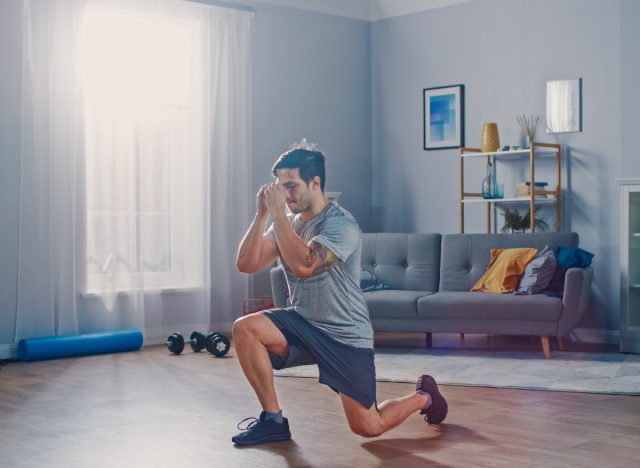
If you’re able to complete high-quality lunges in a repeated fashion, it says you have solid hip mobility, core control, balance, coordination, and stable knee joints on each side.
“It also suggests [you’re] maintaining the type of lower-body function that protects [you] long-term,” King says. “If someone over 55 performs lunges with control, proper depth, and endurance, I’m usually looking at someone who has trained well, moves well, and has a much higher functional capacity than their age suggests.”