The 10-Minute Standing Routine That Rebuilds Lost Arm Muscle After 55, According to a Coach
After 55, arm muscle doesn’t disappear because people stop lifting, it fades because the nervous system stops recruiting the muscle efficiently. Traditional weights rely heavily on momentum, joint tolerance, and grip strength, which often limit how much quality work the arms actually perform. When effort shifts away from the target muscles, progress stalls, no matter how often someone trains.
Standing routines change that equation. They force the arms to work while the body stabilizes itself against gravity, which increases muscle activation without a heavy load. When movements stay controlled and deliberate, the arms experience a longer time under tension, a key driver of muscle rebuilding later in life.
This 10-minute routine focuses on restoring arm strength through posture, controlled range of motion, and sustained engagement. Each two-minute block builds on the last, creating a full upper-arm stimulus that often feels more effective than traditional weight training.
Minutes 1–2: Standing Arm Drive Press
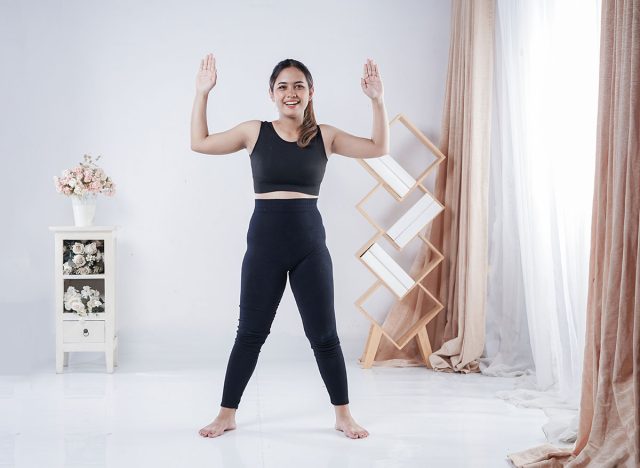
Lost arm muscle often starts with poor shoulder positioning. This movement resets posture and immediately activates the triceps and shoulders without strain. Driving the arms downward engages the back of the arms while the standing position forces the core and upper back to stabilize.
The slow press builds tension without relying on resistance. Over time, this improves muscle endurance and restores firmness through repeated activation rather than fatigue-based failure.
How to Do It
- Stand tall with arms bent at sides
- Drive hands downward as if pressing air
- Fully extend elbows
- Return slowly and repeat.
Minutes 3–4: Standing Reverse Arm Reach
This exercise rebuilds arm muscle by restoring long-range movement, something most weight exercises limit. Reaching the arms behind the body lengthens the biceps and activates the triceps and rear shoulders simultaneously.
Standing upright prevents leaning or momentum, forcing the arms to work through controlled extension. This movement also improves circulation and shoulder mobility, which often decline alongside muscle tone.
Consistent use helps the arms look firmer from multiple angles, not just from the front.
How to Do It
- Stand tall with arms at sides
- Reach hands back behind hips
- Squeeze arms straight briefly
- Relax and repeat.
Minutes 5–6: Standing Elbow Pull-Back Hold
Muscle rebuilding after 55 responds exceptionally well to isometric tension. This exercise holds the arms in a contracted position, forcing sustained engagement without joint stress.
Pulling the elbows back activates the triceps, rear shoulders, and upper back while reinforcing posture. Holding tension teaches the arms to stay engaged longer, which translates directly to improved strength during daily activities.
This block often creates a deep muscle “wake-up” sensation without fatigue.
How to Do It
- Bend elbows and pull them back
- Squeeze arms close to torso
- Hold tension briefly
- Release and repeat.
Minutes 7–8: Standing Arm Extension Pulses
Short-range pulses keep constant tension on the arms, which stimulates muscle fibers that heavier weights often miss. Extending and slightly bending the arms repeatedly forces the triceps to stay active throughout the entire two minutes.
Standing posture matters here. The core stabilizes the body so the arms perform uninterrupted work without compensating through the shoulders or lower back.
This movement builds endurance and visible firmness rather than bulk.
How to Do It
- Extend arms straight down
- Pulse arms slightly backward
- Keep elbows tight
- Continue with control.
Minutes 9–10: Standing Posture Arm Lock

The final block trains the arms to stay engaged during stillness, an underrated but powerful muscle-building strategy after 55. Holding the arms slightly away from the body forces continuous tension through the triceps and shoulders.
Maintaining tall posture ensures the upper back supports the arms properly, preventing collapse or shrugging. This hold reinforces everything trained earlier in the routine and teaches the arms to remain active beyond exercise time.
It’s a quiet finisher that delivers surprisingly strong results.
How to Do It
- Stand tall with arms slightly extended
- Gently tense arms and shoulders
- Hold while breathing steadily
- Relax slowly.