5 Bodyweight Moves That Fix Poor Posture Faster Than Chiropractors After 50

I’ve been in the fitness industry for 40 years, and I’m co-founder of TRAINFITNESS, the UK’s provider of personal training courses. Poor posture in adults over 50 has almost nothing to do with how hard someone tries to sit up straight, and everything to do with which muscles have been asked to work for the last thirty years. Five bodyweight moves, done consistently, undo years of forward slump more reliably than any number of chiropractic adjustments.
What’s Really Causing Your Slump

The picture is depressingly consistent by age 50. The head sits forward of the shoulders, the upper back is rounded, the shoulders have rolled inwards, and the pelvis has usually tipped forward, which pushes the belly out and hollows the lower back. This is what decades of sitting looks like.
The main cause is the seated position, held for six to eight hours a day, five days a week, for thirty years or more. The hip flexors at the front of the hip shorten because they never straighten out. The chest muscles shorten because the arms are always forward. The muscles between the shoulder blades stretch and weaken because they’re never asked to work. The neck creeps forward to see the screen.
Add in the phone and the tablet, which drag the head down and forward for the hours we’re not sitting at desks, and you have a body that’s spent a lot of years being asked to hold one bad shape. Muscles adapt to what they do most. They shorten in the direction of habit and lengthen where they’re not needed.
The other cause is muscle loss. After 50, the deep postural muscles that hold the body upright have been slipping without training. Without them, the body sags into whatever shape gravity pulls it into, and that shape is a slump.
Why Muscle Work Beats Adjustments
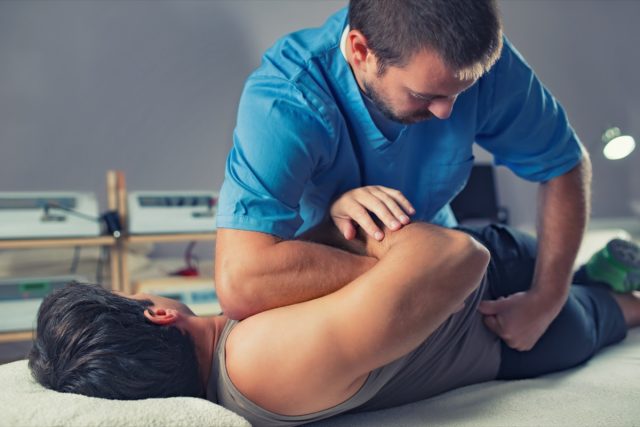
Chiropractic adjustments move joints. They don’t build the muscles that hold the joints in place. A good adjustment can give someone a temporary sense of relief and improved position, but within a day or two, the muscles pull the joints back to where they were, because those muscles are what dictate posture, not the bones.
Bodyweight moves work on the muscles directly. They build strength in the muscles that pull the body upright and length in the muscles that pull it into a slump. Over weeks, this changes the resting posture without needing anyone to keep manipulating your spine. The body ends up holding itself in the better position.
There’s also the daily habit angle. Ten minutes of bodyweight work at home, four or five times a week, adds up to a serious dose of postural retraining across a month. A chiropractic visit is once a fortnight or once a month. The maths on which one shifts posture faster isn’t close.
None of this is a criticism of chiropractors themselves. Many are excellent at what they do, and there are cases where a specific adjustment is exactly what someone needs. But for the everyday postural slump most over 50s carry around, the fix is muscle work, not manipulation.
Wall Angels
This opens the chest, mobilizes the upper back, and fires up the muscles between the shoulder blades that hold the shoulders back where they belong. It’s the single most useful move for reversing the forward-shoulder slump most over 50s develop.
How to Do It:
- Stand with your back, bottom and head against a wall, feet a foot or so out from the wall
- Press the lower back gently towards the wall to flatten the curve
- Raise your arms to shoulder height, elbows bent to 90 degrees, palms facing forwards
- Slowly slide the arms up the wall, keeping backs of hands, elbows and wrists in contact if you can
- Slide back down
Avoid These Mistakes:
- Don’t let your lower back arch off the wall to force the arms further. If your shoulders don’t have the range yet, keep the lower back pinned and only slide the arms as far as they’ll go with that spine position. Range comes with weeks.
Sets and Reps: 8 to 10 slow reps.
Doorway Chest Opener
This stretches the front of the chest, which has been shortened by years of sitting and screen work. Loose chest muscles let the shoulders sit back rather than being pulled forward, which changes the whole line of the upper body.
How to Do It:
- Stand in a doorway with forearms on the frame, elbows at shoulder height
- Step one foot through the doorway
- Let your chest move forward until you feel a stretch across the front of the chest
- Hold for 30 seconds, breathing slowly
- Step back and repeat once more
Avoid These Mistakes:
- Don’t push too hard into the doorway or arch your lower back to fake more stretch. The pull should be at the front of the chest, not in the shoulder joint or low back. If it’s not there, ease off.
Sets and Reps: Hold 30 seconds, repeat once
Bird Dog
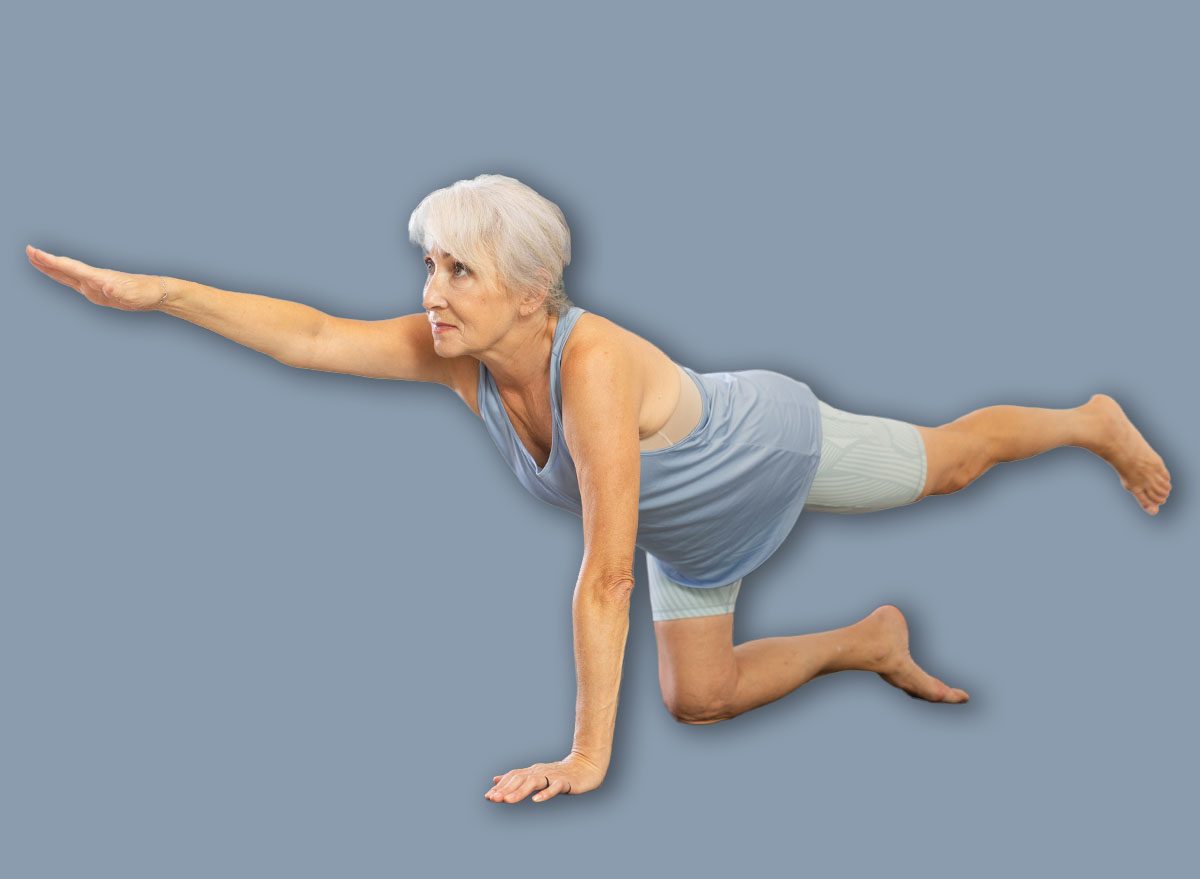
This trains the deep postural muscles that hold the spine steady while the limbs move. It’s the pattern the body uses when walking, reaching or carrying, and it’s the muscle group that’s been most switched off by years of sitting.
How to Do It:
- Come onto all fours, hands under shoulders, knees under hips
- Keep the spine long, not sagging and not arched
- Slowly extend the right arm forwards and the left leg backwards, until both are level with the trunk
- Hold for 3 seconds without letting the trunk twist
- Return to the start position under control
- Repeat on the opposite side
Avoid These Mistakes:
- Don’t lift the arm and leg so high that they arch your lower back. The trunk should stay perfectly level, as if a glass of water were balanced on the small of the back. Height doesn’t matter. Trunk control does.
Sets and Reps: 8 reps per side, 3-second hold.
Glute Bridge
This wakes up the glutes and strengthens the muscles that pull the pelvis into a neutral position. Weak glutes are one of the biggest causes of the forward-tipped pelvis and pushed-out belly most over 50s carry, and this move fixes both at once.
How to Do It:
- Lie on your back with knees bent and feet flat on the floor, hip-width apart
- Squeeze the bottom muscles and lift the hips towards the ceiling until your body forms a straight line from knees to shoulders
- Hold for 3 seconds at the top
- Lower under control
Avoid These Mistakes:
- Don’t push through your lower back instead of your glutes; that loads the back and does nothing for the bottom. If you feel it in the lower back rather than the glutes, tuck the pelvis under a little at the top and squeeze harder.
Sets and Reps: 12 to 15 reps.
Prone Y-T-W
This trains the muscles across the whole upper back and rear shoulders, which pull the shoulders back and down. These are the muscles most commonly ignored in over 50s, and the ones with the biggest visible effect on posture once they wake up.
How to Do It:
- Lie face down on a bed or a firm surface, forehead resting on a folded towel
- Reach both arms out into a Y position above your head, thumbs pointing up
- Lift the arms a few inches off the bed and hold for 2 seconds, then lower for 8 reps
- Bring the arms out to the sides in a T position, thumbs still up; lift, hold, lower, for 8 reps
- Bend the elbows to 90 degrees in a W position, elbows down by the sides, hands up; lift, hold, lower, for 8 reps
Avoid These Mistakes:
- Don’t shrug your shoulders up towards your ears as you lift. The lift should come from the muscles between the shoulder blades, not the traps at the top of the shoulders. Keep the shoulders pulled gently down and away from the ears throughout.
Sets and Reps: 8 reps each in Y, T and W positions, 2-second hold.
How Often to Do This
Three to four days a week is the target. Two rounds of each move takes around 15 to 18 minutes with short rests, which fits into most people’s mornings or evenings.
Alternate this with a 20 to 30 minute walk on the other days. Walking is where the new posture gets grooved into daily movement, so it’s not optional. The moves build the muscles. The walking teaches them to fire in real life.
After the first month, either add a third round of each move or slow the tempo. A 3-second descent on the glute bridge or a 5-second hold at the top of the bird dog doubles the training stimulus without adding time.
The one exception is the doorway chest opener, which can be done daily. Loose chest muscles don’t get overworked, and daily stretching there produces the fastest visible change in shoulder position.
What to Expect
Within the first fortnight, most people notice they’re catching themselves standing taller. That’s the awareness kicking in before the muscles have fully caught up, and it’s the first sign the routine is working.
By 4 weeks, the changes start to show in photos and mirrors. The head sits closer to over the shoulders, the shoulders sit back rather than rolled forward, and the belly looks less pushed-out because the pelvis has started to tip back to neutral. Family members often comment.
By 6 to 8 weeks, the new posture starts to hold without conscious effort. This is the point where the muscles have taken over the job the brain was doing, and it’s the change most people are actually after. Standing up straight becomes the default rather than something you have to remember.
The following months bring bigger changes. A body that’s slouched for thirty years won’t fully undo that in eight weeks, but the direction of travel is unmistakable, and each month the improvement compounds on the last.