5 Chair Exercises That Restore Leg Muscle Faster Than Squats After 60

Strong legs make the day feel more manageable. Standing up, climbing stairs, walking with confidence, and moving around the house all become easier when your legs are getting regular strength work. A chair gives you a simple way to train those muscles with more control and less guesswork.
After 60, restoring leg muscle often works best when the routine covers more than one pattern. Squats are useful, and a chair-based plan can build on that same foundation by adding lunges, knee extensions, hamstring curls, and outer-hip work. That gives your legs a more complete strength session while keeping the setup familiar and approachable.
When I coach older adults, I’m usually looking for reps that grow more confident from week to week. A cleaner sit-to-stand, a steadier supported lunge, or a stronger band curl all tell me the muscles are doing their job. Those small improvements can add up quickly when the routine stays consistent.
Use these five chair exercises two to four days per week. Keep the chair stable, move with purpose, and treat each rep like practice for stronger legs outside the workout.
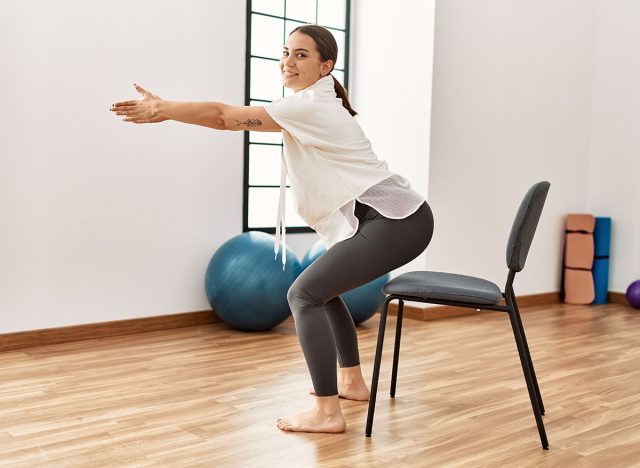
Chair Box Squat
Chair box squats train one of the most important lower-body patterns after 60: sitting down and standing back up with control. The chair gives you a clear target, which helps you own the bottom of the rep without guessing your depth. You’ll train your thighs and glutes while building confidence through a movement you use every day.
Muscles Trained: Quadriceps, glutes, hamstrings, core.
How to Do It:
- Stand in front of a sturdy chair with your feet about shoulder-width apart.
- Brace your core and keep your chest lifted.
- Push your hips back toward the chair.
- Lower until your hips lightly touch the seat.
- Press through your whole feet to stand tall.
- Repeat with smooth control.
Recommended Sets and Reps: Perform 3 sets of 10 to 15 reps. Rest for 45 to 60 seconds between sets.
Best Variations: Higher-chair box squats, pause chair box squats, slow-tempo chair box squats.
Form Tip: Tap the chair lightly and stand back up without relaxing into the seat.
Chair-Supported Reverse Lunge
Chair-supported reverse lunges build single-leg strength while giving you something steady to hold. Stepping backward usually feels smoother on the knees than stepping forward, and the chair lets you focus on the working leg without losing balance. This exercise helps the hips, thighs, and glutes work together through a controlled range.
Muscles Trained: Quadriceps, glutes, hamstrings, calves, core.
How to Do It:
- Stand tall beside or behind a sturdy chair.
- Hold the chair lightly for balance.
- Step your right foot back into a split stance.
- Bend both knees and lower with control.
- Press through your front foot to return to standing.
- Complete all reps, then switch sides.
Recommended Sets and Reps: Perform 3 sets of 6 to 10 reps per side. Rest for 45 to 60 seconds between sets.
Best Variations: Short-range reverse lunges, assisted split squats, slow-tempo reverse lunges.
Form Tip: Keep your front heel planted and use the chair for balance, not to pull yourself up.
Seated Leg Extension
Seated leg extensions give your quadriceps focused work without needing a machine. Stronger quads help support the knee and make everyday movements like stairs and standing up feel more dependable. Add a brief pause at the top so the muscle has to own the position.
Muscles Trained: Quadriceps, hip flexors, core.
How to Do It:
- Sit tall on a sturdy chair with your feet flat on the floor.
- Hold the sides of the chair lightly.
- Brace your core and keep your chest lifted.
- Extend one knee until your leg is straight.
- Pause briefly and squeeze your thigh.
- Lower with control, then switch sides.
Recommended Sets and Reps: Perform 3 sets of 10 to 12 reps per side. Rest for 30 to 45 seconds between sets.
Best Variations: Short-range leg extensions, paused leg extensions, banded leg extensions.
Form Tip: Lift and lower slowly so your thigh does the work through the whole rep.
Seated Band Hamstring Curl
The hamstrings help bend the knee, support the hips, and add power to your stride. Seated band hamstring curls train them directly, which is useful because squats often leave the hamstrings underworked. Keep the pull smooth and control the band as your foot returns.
Muscles Trained: Hamstrings, calves, glutes.
How to Do It:
- Sit tall on a sturdy chair.
- Anchor a resistance band in front of you and loop it around one ankle.
- Start with your working leg slightly extended.
- Pull your heel back toward the chair.
- Pause briefly when you feel your hamstring tighten.
- Slowly extend your leg again before repeating.
Recommended Sets and Reps: Perform 3 sets of 10 to 15 reps per side. Rest for 30 to 45 seconds between sets.
Best Variations: Light-band hamstring curls, shorter-range curls, slow-tempo hamstring curls.
Form Tip: Keep your thigh still and move from the knee so the hamstring gets the work.
Seated Band Hip Abduction
Seated band hip abductions strengthen the outer hips, which play a big role in balance and knee position. Stronger outer hips help your legs feel more stable when you walk, climb stairs, or shift your weight from side to side. This move looks small, but a controlled set can quickly light up the hips.
Muscles Trained: Glute medius, glute minimus, outer hips, core.
How to Do It:
- Sit tall on a sturdy chair with your feet flat.
- Place a mini band around your thighs just above your knees.
- Brace your core and keep your chest lifted.
- Press your knees outward against the band.
- Pause briefly in the open position.
- Return with control and repeat.
Recommended Sets and Reps: Perform 3 sets of 12 to 15 reps. Rest for 30 to 45 seconds between sets.
Best Variations: Bodyweight hip abductions, paused band abductions, slow-tempo band abductions.
Form Tip: Keep your feet planted and move your knees outward without rocking your torso.
How to Use These Chair Exercises After 60
Use these exercises as a lower-body circuit. Complete one set of each exercise in order, rest for 60 to 90 seconds, then repeat for two to three total rounds.
- Start with the chair box squat: This gives the routine a strong, familiar movement before the more targeted exercises.
- Use support without leaning on it: The chair should help your balance while your legs do the real work.
- Train both the front and back of the legs: Leg extensions and hamstring curls help cover more muscle than squats alone.
- Keep the outer hips involved: Band hip abductions support steadier knees, hips, and steps.
- Progress gradually: Add reps, slow the tempo, use a stronger band, or move through a slightly deeper range once the reps stay clean.
Restoring leg muscle after 60 works best when the routine trains the legs from more than one angle. Chair box squats build the foundation, lunges add single-leg strength, and the seated band work fills in the muscles that help your legs feel stronger throughout the day.
References
- Frith, Emily, and Paul D Loprinzi. “The Association between Lower Extremity Muscular Strength and Cognitive Function in a National Sample of Older Adults.” Journal of lifestyle medicine vol. 8,2 (2018): 99-104. doi:10.15280/jlm.2018.8.2.99
- Strasser, Barbara et al. “Role of Dietary Protein and Muscular Fitness on Longevity and Aging.” Aging and disease vol. 9,1 119-132. 1 Feb. 2018, doi:10.14336/AD.2017.0202