If You Can Hold a Squat This Long After 55, Your Lower-Body Power Is Top-Tier
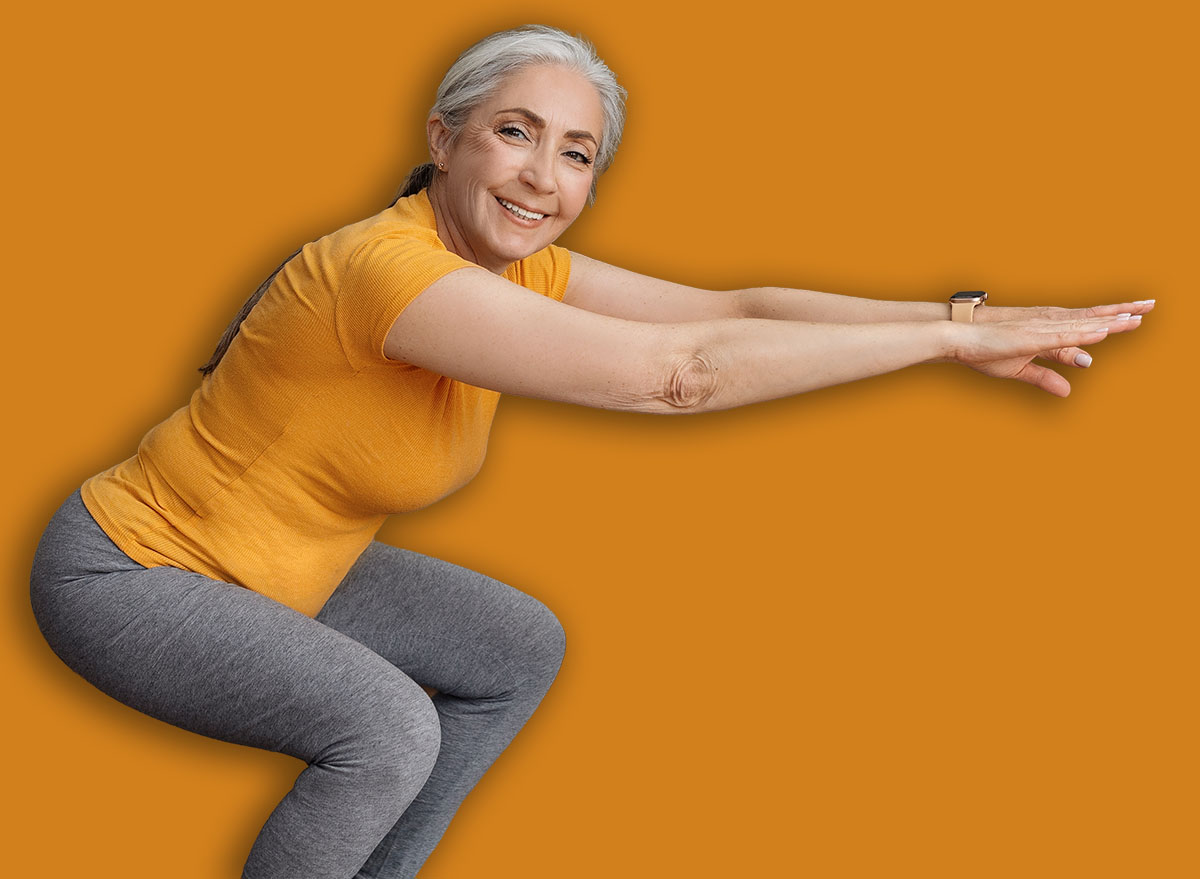

If you’re looking for one of the best lower-body exercises to boost functional strength, metabolism, bone density, and joint stability, consider adding squats to your workouts. This multi-joint, weight-bearing exercise is truly golden—it engages the entire lower body, including your calves, hamstrings, glutes, and quadriceps. You may be surprised to learn that squats even strengthen your spine by putting compressive loads on it.
The squat is an especially productive move as you age, because it boosts functional strength needed to perform everyday movements, like carrying shopping bags, sitting, standing, and climbing stairs. Needless to say, squats are an excellent assessment of your lower-body strength. In fact, if you’re curious whether your lower-body power is top-tier, see if you can hold a squat this long after 55.
If You Can Hold a Squat This Long After 55, Your Lower-Body Power Is Top-Tier
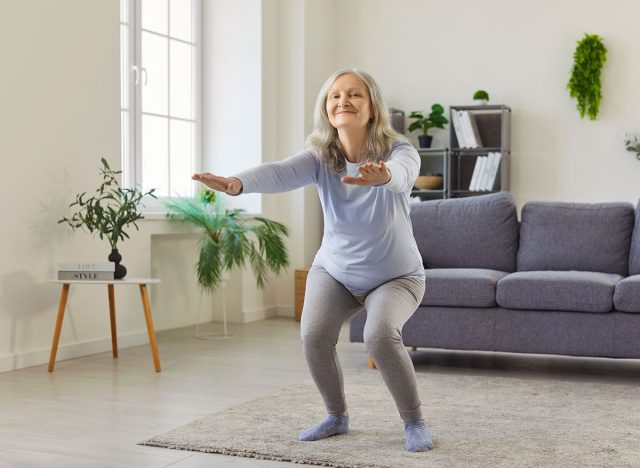
In order to find out the ideal squat hold benchmark for those 55+, we spoke with Dr. Gbolahan Okubadejo, NYC-area Spinal and Orthopaedic Surgeon who specializes in spinal health and fitness and established the company 360 Dynamized Core, which creates innovative, spine-safe core fitness products and routines.
“Anything over 90 seconds in a deep squat is solid for this age group. After 55, hip and ankle mobility naturally decline, so hitting 2 minutes puts you well above the average,” explains Dr. Okubadejo. “Anything under 30 seconds usually signals some mobility work is needed, while 60 to 90 seconds lands right around average.”
How To Do Squats
- Stand tall, feet shoulder-width apart on the floor.
- Extend your arms ahead of you or place your hands on your hips.
- Bend at the knees and hips as you lower into a squat.
- Descend until your thighs are parallel to the floor.
- Press through your heels to rise back up to standing.
RELATED: If You Can Hold a Wall Sit This Long After 60, Your Leg Strength Is Top-Tier
What Makes a Static Squat Hold an Effective Measure of Lower-Body Strength?
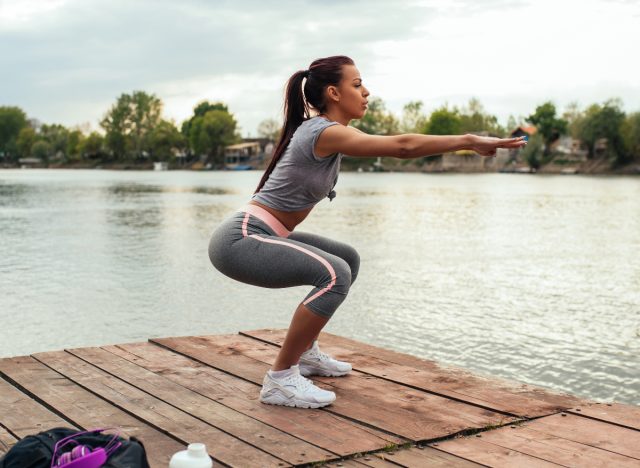
A traditional squat allows you to bounce, rush, or compensate—a squat hold does not. Your calves, quads, and glutes have no other choice but to continuously work, which is what building muscular endurance is all about.
“It also has a way of surfacing problems people don’t know they have. Tight hips will rotate. Stiff ankles will lift your heels. A weak posterior chain will tip you forward,” Dr. Okubadejo tells us. “None of that shows up on a leg press because the machine handles stability for you. The squat hold doesn’t handle anything for you. Most lower-body demands aren’t one-rep efforts. Climbing stairs, hiking, getting up from the floor repeatedly, these all require muscles that can work for sustained periods under load. A hold trains and tests exactly that. It’s not a perfect measure, but as a field test with no equipment, it’s difficult to beat for the information it gives you.”
Strong Lower-Body Endurance Translates to Better Mobility, Balance, and Fall Prevention
According to Dr. Okubadejo, muscles that are able to hold tension for a longer period of time give your joints more support during daily movement. Weak legs are one of the main reasons why older adults become less physically active.
“Better quad and glute endurance means you can catch yourself when you trip instead of going down,” Dr. Okubadejo notes. “Balance relies heavily on the ankles and hips staying strong enough to make constant small adjustments. Falls after 55 are often less about bad luck and more about the body not responding fast enough. Building that endurance buys you more time before your body starts making those kinds of mistakes.”