The 7-Day Standing Balance Challenge That Restores Stability After 60

Balance is the fastest thing I’ve seen change with dedicated practice, and it’s the most important thing to protect after 60. I’ve been a personal trainer for close to 40 years, and for the last 25 I’ve been co-founder of TRAINFITNESS, the UK’s leading fitness education provider. Seven days of focused standing work can shift stability in ways that surprise people, so here’s the exact challenge I use with clients to rebuild it.
What Fades First
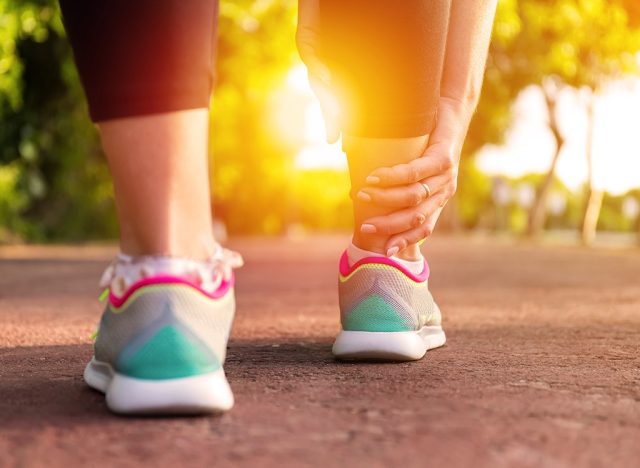
Two things fade together after 60, and most people don’t spot either until they wobble. The first is ankle strength and control. The small muscles that make hundreds of tiny corrections with every step start to switch off, so the body loses the ability to catch itself when the balance goes.
The second is the vestibular system, the balance apparatus in the inner ear. It gets slower and less accurate with age, especially when the head is turning or looking up. That’s why so many falls happen when someone turns to look behind them, or reaches up into a cupboard.
Underneath both of those is muscle loss in the legs and hips. Weak legs can’t respond quickly enough when the balance goes, and weak hips can’t catch a stumble before it becomes a fall. Balance isn’t just an ear or a foot skill; it’s a whole-body one.
There’s also the fear layer. Once someone has had a wobble or a near-miss, they start moving more cautiously, which reduces the balance system’s daily practice, which weakens it further. The confidence side is often as important as the physical side.
Why Standing Balance Works
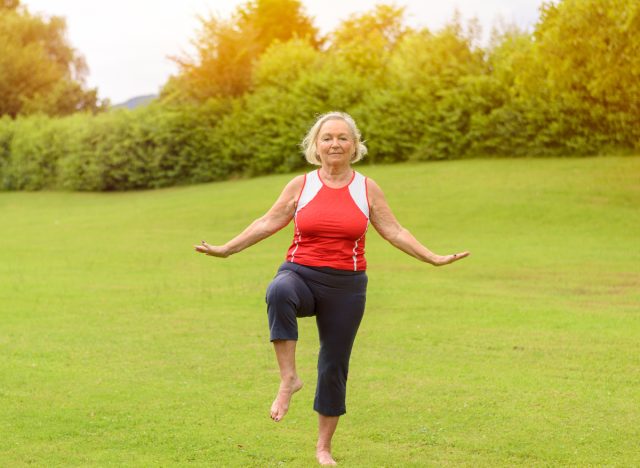
Falls happen while you’re standing, not while you’re lying on a mat. Any balance training that doesn’t spend most of its time on your feet is training the wrong context. The nervous system is very specific about what it learns.
Standing balance training also works the exact muscles that catch a stumble: the ankle stabilizers, the hip stabilizers, and the trunk muscles that hold the body upright over shifting feet. These are the muscles that fire in the fraction of a second between a trip and either a save or a fall.
The research on this is settled. Standing balance work reliably reduces falls in older adults by 20 to 40 percent within a few months. No supplement, no gadget, and no seated exercise program comes close to those numbers. This is one of the clearest wins in the whole field of older-adult training.
Single-Leg Stand
This is the purest test and trainer of balance we have. Standing on one leg forces the ankle, hip and trunk to work together in the same way they do when you take a step, catch a stumble or step over a curb. It also gives you a measurable number, which makes progress easy to track.
How to Do It:
- Stand tall behind a chair or worktop, hands lightly resting on it for safety
- Lift one foot off the floor and hold it there
- Aim for 30 seconds on that leg without touching the floor
- Swap sides
Avoid These Mistakes:
- Don’t grip the chair so hard you’re holding yourself up. The chair is a safety net, not a support, so your hand should be able to lift off at any moment. If you’re pressing down on the chair, the balance system isn’t being trained.
Sets and Reps: 30 seconds per leg.
Form Tip: Progress by taking one hand off the support, then both hands, over the course of the week
Heel-to-Toe Walking
This trains dynamic balance, the kind you need while moving. Walking in a straight line with each foot placed directly in front of the other forces the balance system to work through the transitions between steps, which is where most falls actually happen.
How to Do It:
- Find a stretch of about ten feet along a wall or a hallway
- Stand tall, arms out to the sides for balance
- Place one foot directly in front of the other, so the heel touches the toes of the back foot
- Walk forward in this heel-to-toe line for 10 steps
- Turn around and walk back
- Keep a wall within arm’s reach on one side in case you need it
Avoid These Mistakes:
- Don’t look down at your feet; it throws the balance off further. Look straight ahead, at a spot on the wall about eye height, and let your feet find their line by feel. This is a whole-body skill, not a foot skill.
Sets and Reps: 10 steps forward, 10 steps back.
Sit-to-Stand
This trains the leg strength that catches a stumble before it becomes a fall. Strong legs are half of balance, because the balance system can only save you if the legs can respond to the signal. This is also the move most physios use to predict whether someone will keep their independence.
How to Do It:
- Sit on a sturdy chair with feet flat on the floor, hip-width apart
- Fold your arms across your chest
- Lean slightly forward at the hips
- Push through the heels and stand all the way up
- Sit back down slowly, taking 3 seconds
Avoid These Mistakes:
- Don’t use momentum to throw yourself up. Make the muscles do the work slowly, because that’s the strength you’ll need to catch yourself. If you can’t stand without rocking, use a slightly higher chair and build up from there.
Sets and Reps: 10 to 15 reps.
Standing Hip Abduction
This trains the muscle on the outer hip called the glute medius, which is what stops the pelvis dropping to one side every time you take a step. A weak glute medius is one of the biggest hidden causes of falls in over-60s, and this move loads it directly.
How to Do It:
- Stand behind a sturdy chair, both hands lightly on the back
- Stand tall, feet hip-width apart
- Keeping the leg straight and the toes pointing forward, lift one leg out to the side
- Only go to about 30 degrees, no higher
- Lower with control
Avoid These Mistakes:
- Don’t lean your trunk in the opposite direction to lift the leg higher. Keep your body upright over the standing leg. A small controlled lift with the trunk still trains the right muscle; a big lift with the body leaning trains the wrong one.
Sets and Reps: 10 reps per side.
Your 7-Day Plan
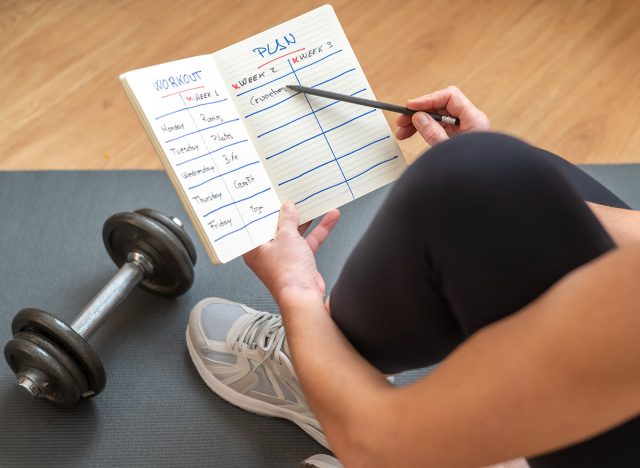
Days 1 and 2: Learn the moves. Do 2 sets of each at a slow pace, with plenty of support from the chair or wall. The point is to get the pattern right before adding any difficulty. Ten minutes per day is plenty.
Days 3 and 4: Same 2 sets, but reduce the support. Take one hand off the chair for the single-leg stand. Walk with only one hand near the wall for the heel-to-toe. Do the sit-to-stand with arms folded rather than pushing off the thighs.
Days 5 and 6: Add a third set of each. Try the single-leg stand with no hands at all for a few seconds at a time. Walk the heel-to-toe line with arms out to the sides rather than near a wall. Slow the sit-to-stand to 4 seconds down and 2 seconds up.
Day 7: Test yourself. Time your single-leg stand on each side, count how many sit-to-stands you can do in 30 seconds, and see how many heel-to-toe steps you can take without touching the wall. Write down the numbers. These are your baseline to measure against a month from now.
The whole 7 days take 10 to 15 minutes per day. It’s not a huge time commitment, and the improvement over a week surprises most people.
What to Expect

By the end of the 7 days, most people can hold the single-leg stand for noticeably longer, sometimes twice as long as on day 1. That’s the neural side of balance responding, which happens quickly with focused practice. Sit-to-stand numbers also improve, though the strength gains are more modest at this stage.
The bigger changes come over the next few months. By 6 weeks of continued practice, single-leg stand times often reach a minute per side, which is a real marker of a stable older adult. The heel-to-toe walk becomes automatic rather than an effort.
By 3 to 6 months, most of the physical markers of fall risk have improved. Ankle stability has grown, hip stabilizers have caught up, and the balance system is firing quickly enough to save a stumble before it becomes a fall.
The bigger prize is the falls that don’t happen. Nobody notices the fall they didn’t take. The research shows people who train balance reduce their fall rate by 20 to 40 percent, which is why I’d recommend keeping this going long after day 7.