If You Can Hold a Chair Sit This Long After 65, Your Leg Strength Is Top-Tier

Research shows it is directly linked to your independence, your fall risk, and how long you can keep doing the things you enjoy without needing help. Plus, the lower body muscles in your thighs, hips, and glutes are what get you out of a chair, into a car, and up off the floor, and they’re also the ones that tend to decline the fastest once you pass 65 if you aren’t regularly strength training. The frustrating part? Muscle loss happens gradually, so most people don’t realize it’s happening until they notice it in their daily life.
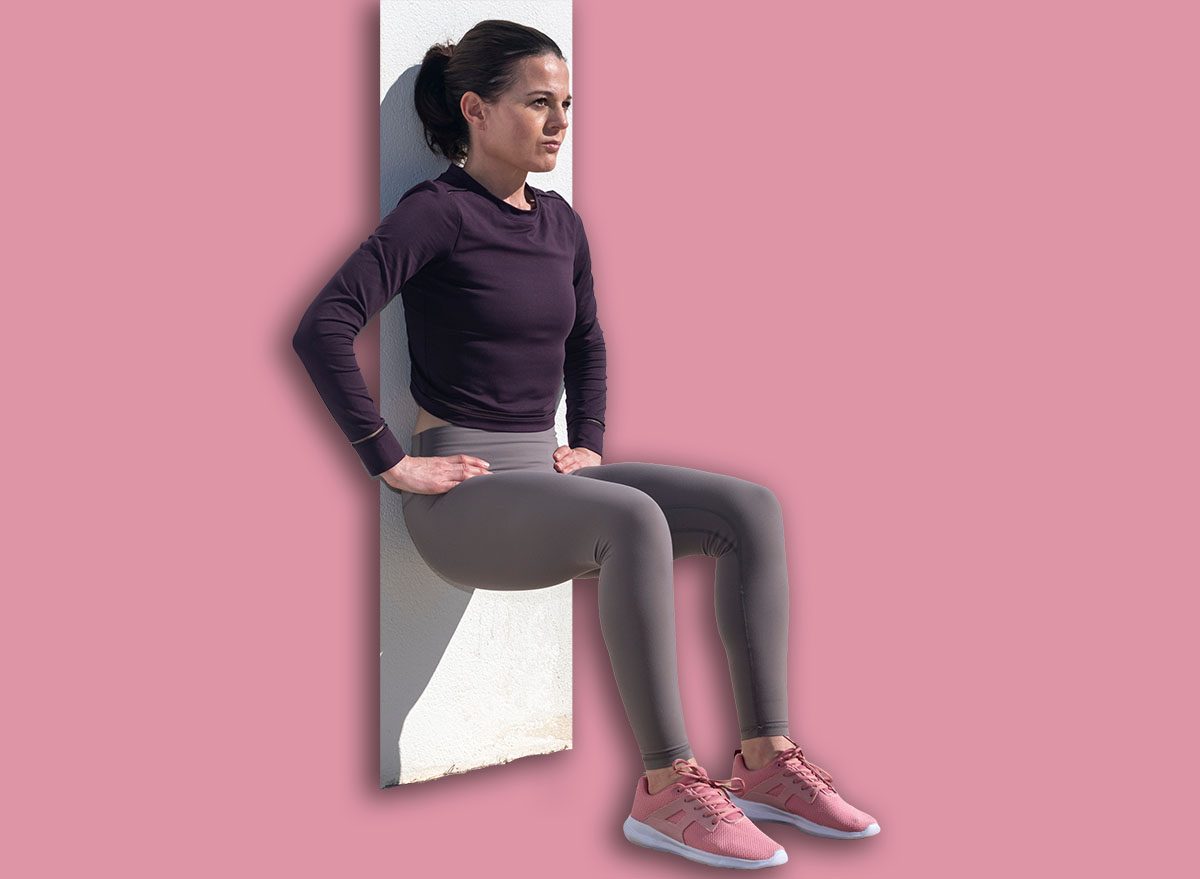
If you want to know where you stand, you’ve come to the right place. One of the simplest ways to gauge your leg strength after 65 is by doing a chair sit test that requires no equipment beyond a wall. This test puts your quads, glutes, and hamstrings under sustained tension, so how long you can hold it reveals a lot about your lower body strength and muscular endurance, which the National Institute on Aging says keeps you steady on your feet as you age.
In this article, we spoke with James Brady, CPT, a certified personal trainer at OriGym, who designed the chair sit test for us. We’ll also cover how long a chair sit should realistically last after 65, what your hold time says about your leg strength compared to your peers, and how to build the test into a simple routine that builds leg strength after 65. Read on to learn more.
(Next up: Be sure to check out 4 Daily Exercises That Restore Ankle Strength Faster Than Gym Workouts After 60.)
Why Leg Strength Is Crucial After 65

Starting in your 30s, you gradually lose muscle mass each decade, and that loss tends to accelerate after 60 unless you’re doing something to counter it. Your leg muscles are especially vulnerable to muscle loss, which is unfortunate as they’re also the ones you can least afford to lose. Weak legs are among the biggest predictors of falls, mobility issues, and the loss of independence that so many people fear as they age.
The good news is that these muscles respond to training at any age. Research shows that older adults can build leg strength well into their 70s, 80s, and beyond. Plus, a benchmark test like the chair sit gives you a starting point, and a reason to keep your leg muscles working.
How Long Should You Be Able to Hold It?

“For most healthy adults over 65, holding a chair sit for 30 to 45 seconds demonstrates good lower body strength and endurance,” says Brady. “If you can maintain good form for 60 seconds or more, that’s an excellent result and suggests your leg strength is well above average for your age.”
How to Do It
- Stand with your back against a wall.
- Slide down until your knees are bent to roughly 90 degrees.
- Keep your feet shoulder-width apart.
- Distribute your weight evenly through your heels.
- Hold the position while breathing steadily through your nose and time yourself.
- Go as long as you can.
How to Increase Your Hold Time

If you’re new to the exercise, Brady recommends starting with 15 to 20 second holds and gradually building your endurance over several weeks. Treat the test as a starting point rather than a one-time score, and repeat it every few weeks to track your progress as your legs get stronger.
The point isn’t just to rack up a longer hold time. “The goal is to strengthen the muscles that support your knees and hips, making everyday movements feel easier and more stable,” explains Brady. As your hold time increases, you’ll likely notice those gains showing up where they count, such as being able to get out of a low chair, climbing stairs with ease, and feeling confident in your mobility.