5 Morning Exercises That Flatten Torso Thickening Faster Than Ab Workouts After 60

Torso thickening is one of the most common concerns clients bring to me from 60 onwards, and most of it has very little to do with food. I’ve spent almost 40 years as a personal trainer and over 25 years running TRAINFITNESS, the UK’s leading provider of in-person and online personal training courses, and in that time I’ve learned that five morning exercises, done consistently, address the actual cause more effectively than any number of crunches.
What’s Really Happening

Three things are going on at once, and most people only see one of them.
Fat is redistributing from the hips and thighs to the belly and lower back, driven by falling oestrogen in women and falling testosterone in men. This is why the waist thickens even when the weight on the scales hasn’t changed much. The total amount of fat often hasn’t changed. Only its location has, and that reshapes the waist on its own.
The second is loss of muscle in the trunk and around the waist. The deep muscles that used to hold everything in and up have wasted away without anyone noticing. Without them, the abdomen sags forward and the sides of the waist lose their shape. What looks like extra flesh is often just less muscle underneath the same amount of skin.
The third is the postural change. As the upper back rounds forward and the pelvis tips, the abdomen is squashed forward and looks thicker even if nothing has changed underneath. Fix the posture and the torso often looks meaningfully thinner within a fortnight, before any actual fat has moved.
Why Mornings Beat Ab Workouts

Traditional ab workouts train the wrong muscles for this problem. Crunches, sit-ups, and leg raises work the rectus abdominis, the six-pack muscle on the front. That’s a small part of the trunk, and strengthening it does almost nothing for the shape of the waist.
The muscles that actually pull the torso in are deeper. The transverse abdominis, which wraps around the trunk like a corset. The obliques, which run diagonally across the waist. And the muscles of the lower back, which hold everything upright from behind. These are the muscles morning exercises train, because morning exercises done standing engage all of them at once.
There’s also the timing question. Morning movement raises the metabolic rate for the rest of the day, which matters for fat loss. Evening ab work has none of that effect. And getting the trunk muscles working first thing sets the day’s posture, which is half the visual battle with a thickening waist.
Standing Knee To Opposite Elbow
This move trains the obliques through rotation while getting the heart rate up, which combines waist work with calorie burn. It’s the move that mimics a bicycle crunch without any floor time or spinal flexion.
How to Do It:
- Stand tall with feet hip-width apart, hands behind the head, elbows wide
- Lift the right knee and rotate the trunk to bring the left elbow towards the lifted knee
- Return to standing
- Repeat on the other side
- Aim for 10 reps per side
Avoid These Mistakes:
- Don’t pull the head down with your hands. It strains the neck and takes the effort out of the waist. The elbows come towards the knee because the trunk rotates, not because the head bends forward.
Form Tip: Keep the chin lifted.
Standing Wood Chopper
This move trains the deep rotational muscles of the trunk in a pattern the body actually uses to lift, reach, and turn. It firms the sides of the waist while training the deep stabilizers at the same time.
How to Do It:
- Stand tall with feet just wider than hip-width apart
- Clasp your hands together at chest height
- Rotate the trunk to lift the hands up and to the right, above the right shoulder
- Chop them diagonally down and across to the left, ending outside the left hip
- Do 8 chops in one direction, then 8 in the other
- Add a light dumbbell or a full water bottle to progress
Avoid These Mistakes:
- Don’t move only the arms and leave the trunk still. The whole torso should turn as the hands travel across the body. If your hips are frozen and only your shoulders swing, the exercise isn’t working the waist.
Sets and Reps: 8 chops per direction, progressing with added weight.
Counter Plank
This move trains the deep muscle corset that holds the whole trunk in. A plank against a kitchen worktop is safe for the shoulders and the back, and it’s easier to hold for the length of time that actually builds strength than a floor plank is.
How to Do It:
- Place both hands or forearms on the edge of a sturdy kitchen worktop, shoulder-width apart
- Walk the feet back until the body is straight from heels to head
- Squeeze the bottom, brace the belly, and hold for 30 seconds
- Rest for 20 seconds
- Repeat for 3 rounds
Avoid These Mistakes:
- Don’t let the hips sag, or the bottom lift into a peak. Both take the load off the trunk. The whole body should be one straight line, from the heels through the hips to the shoulders and the top of the head. If you can’t feel the belly working, adjust the position until you can.
Sets and Reps: 30 seconds on, 20 seconds rest, 3 rounds.
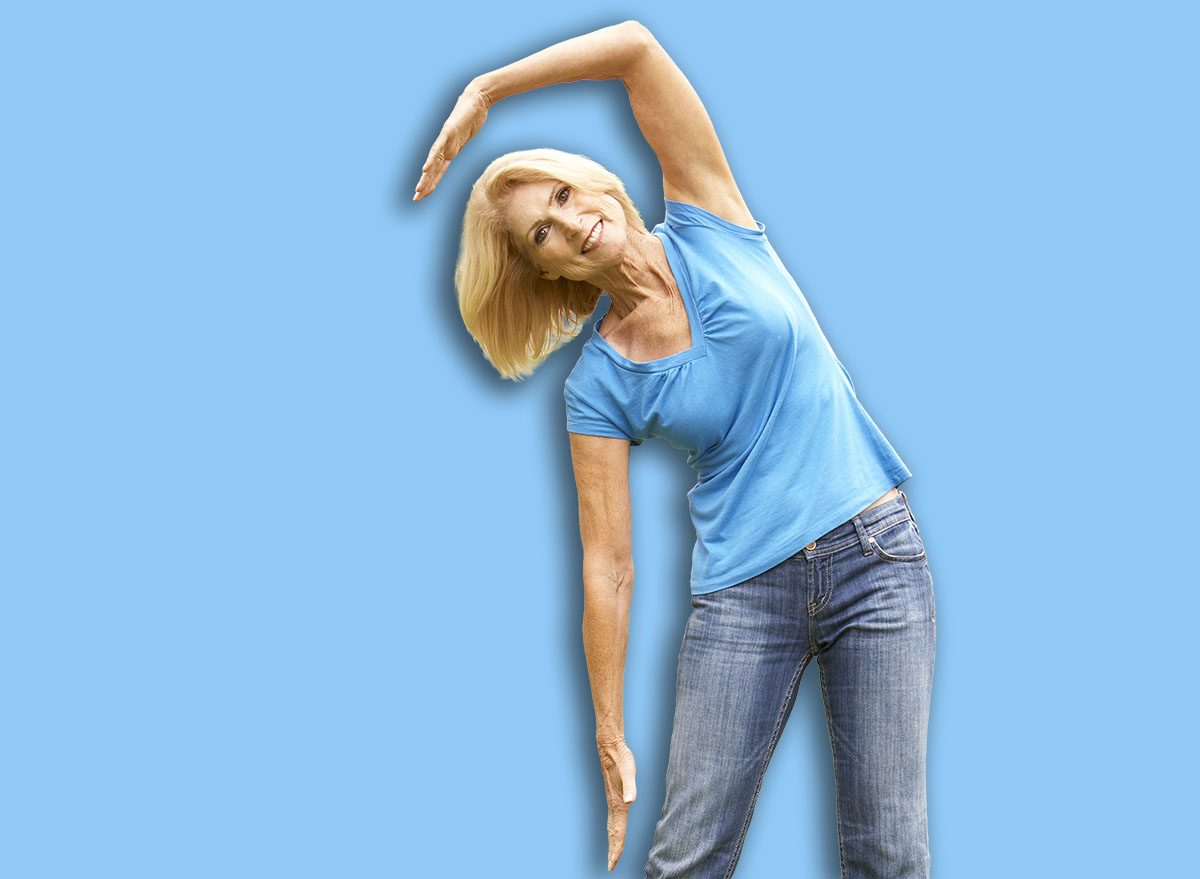
Standing Side Bend With Reach
This move trains the side of the waist directly by lengthening and then contracting the obliques. It gives the waist its shape back, especially the muscle just above the hip bone that many over 60s haven’t used in years.
How to Do It:
- Stand tall with feet hip-width apart
- Reach one arm straight up overhead
- Slowly bend to the opposite side, letting the other hand slide down the outside of the thigh
- Only go as far as you can while keeping the trunk facing forward
- Return to upright by pulling with the side of the waist
- Do 8 reps per side
Avoid These Mistakes:
- Don’t twist forward as you bend. It turns the exercise into a diagonal reach and misses the side of the waist. Imagine you’re between two panes of glass, so the only way to move is sideways.
Sets and Reps: 8 reps per side.
Squat To Overhead Reach
This move uses the biggest muscles in the body, the legs and glutes, in a pattern that also stretches the trunk and opens the chest at the top. The whole-body load is what pushes the metabolism up for hours afterwards, which is what shifts the fat around the belly.
How to Do It:
- Stand with feet hip-width apart, arms by your sides
- Push the hips back and bend the knees into a squat
- Lower as far as your body comfortably allows
- As you stand back up, reach both arms overhead, palms facing each other
- Lower the arms as you sink into the next squat
- Do 12 to 15 reps
Avoid These Mistakes:
- Don’t reach overhead by arching the lower back. Lift through the shoulders instead. The trunk should stay long, not curved backward. If the arms don’t want to go straight overhead, that’s a shoulder mobility limit, not a lower back one.
Sets and Reps: 12 to 15 reps.
How To Fit This Into Your Week
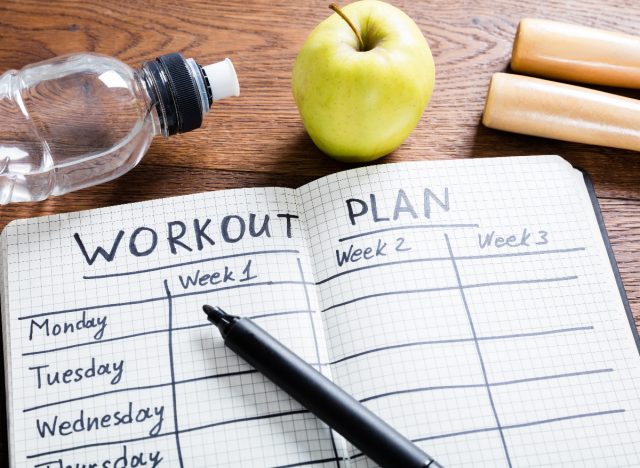
Do the five exercises in the order above, 45 seconds of work with 15 seconds of rest between each. That’s one round of 5 minutes. Take a 30-second breather, then do a second round. Total time is about 11 minutes.
Four to five mornings a week is what I recommend to most clients. Daily is fine and doesn’t overload the body because the loading is low. The one exception is the counter plank, which sometimes needs a rest day the first week if the trunk hasn’t been trained in years.
Add a 30-minute walk on the other days. Walking on top of the strength work is what really shifts torso thickening, because it burns fat without eating into the muscle you’re building.
After the first month, slow the tempo. A 3-second descent on the squat and a 3-second lowering on the side bend doubles the work without adding any equipment. That’s usually where the visible change accelerates.
What Results To Expect

By the end of the second week, most people notice their trousers fit differently around the waist. That’s the deep muscles starting to hold everything in properly, and it happens well before any actual fat has moved.
By 4 weeks, the visible change in the mirror begins. The waist looks narrower from the front, the belly sits back rather than forwards, and the sides look less soft. Posture usually improves at the same time, which makes the whole trunk look longer and thinner.
By 6 to 8 weeks, the change is enough that clothes people had shelved come back into rotation. Strength gains on the actual exercises are typically 30 to 50 percent, which means the trunk is doing much more of its job than it was.
Bigger changes come with time. Six months in, most clients are noticeably smaller around the waist and back in clothes they’d put away. The walking on top of the strength work and a bit of sensible attention to eating gets you there faster.