If You Can Master These 5 Standing Exercises at 65, You’re Fitter Than Most 50-Year-Olds

A little bit of competition can be beneficial—science says so. Research shows that competitive games and physical competition can improve attention and memory. So, a little dash of competition goes a long way.
If you’ve wondered just how physically fit you are, there’s a competition of sorts you can try right at home that we learned from Domenic Angelino, MS, MPH, CSCS, CPT, Chief Exercise Scientist at FitCraft. If you can master these five standing exercises at 65, you’re fitter than most 50-year-olds.
“Different types of standing exercises place different demands on your body. Some will require you to stabilize more with your lower back. Others will demand more from your abdominal muscles. It can vary a lot. So, it’s helpful to include a variety of standing exercises in your routine,” Angelino tells us. “In the real world, nearly all physical activity requires you to heavily stabilize your body as you do it. For example, when walking around, you need to use your lower back muscles to hold your torso upright so your body doesn’t collapse forward. If you’re sitting on a machine at the gym, those same muscles will still be at work to help you hold your torso upright, but they won’t have to work nearly as hard because the supports of the seat remove a lot of the demand that keeping your torso upright places on your body.”
If you’re looking to build functional strength and fitness, adding the following standing moves to your routine is a must.
Goblet Squat
“Squatting like this is a great way to build functional fitness because you’re doing something with your lower body, core, and upper body at the same time,” Angelino tells us.
- Stand tall with your feet slightly wider than shoulder-width.
- Grasp a dumbbell or kettlebell with both hands, holding the weight in front of your chest with your elbows pointing down and tucked in.
- Hinge at the hips and bend your knees to squat, keeping the weight in place.
- Squat as far as you can with a straight back.
- Push through your heels to return to the starting position.
Push Press
“The push press is an explosive exercise, meaning that it’s something that has to be done quickly. Explosive exercises help you build muscular power. And, the push press involves being explosive in both your upper and lower body. You also have to coordinate your upper and lower body muscles so that they work together to lift the weight both quickly and safely,” Angelino explains.
- Begin by standing tall with your feet hip-distance apart.
- Hold a dumbbell in one hand at shoulder level with your palm facing forward or inward.
- Activate your core, maintain a tall chest, and have a slight bend in your knees.
- Drive through your legs as you explode in an upward motion, pressing the weight overhead until your arm is completely extended.
- Use control to lower the dumbbell to shoulder height.
Bent-Over Row
- Stand tall, feet hip-width apart, with a dumbbell in each hand in front of you.
- Hinge at the hips until your torso is parallel to the ground.
- Maintain a flat back and soft knees.
- Allow the weights to lower with your arms completely extended.
- Row the dumbbells up toward your torso.
- Hold for 1 second.
- Lower to the start position with control.
RELATED: The 60-Second Strength Test That Reveals Your True Fitness Age
Sumo Deadlifts
“Deadlifts are highly functional because they involve many muscles in your body working together in a complicated way to produce a large amount of force. Some muscles are working to lift the weight, like your quads and glutes. Other muscles are working to keep your body stable while you lift, like your transverse abdominis and trapezius,” Angelino explains.
- Stand tall with your feet just outside shoulder-width in a squat position.
- Hold a dumbbell or kettlebell, and stand with your chest tall and back flat.
- Control the movement back down to the start position, maintaining the same posture.
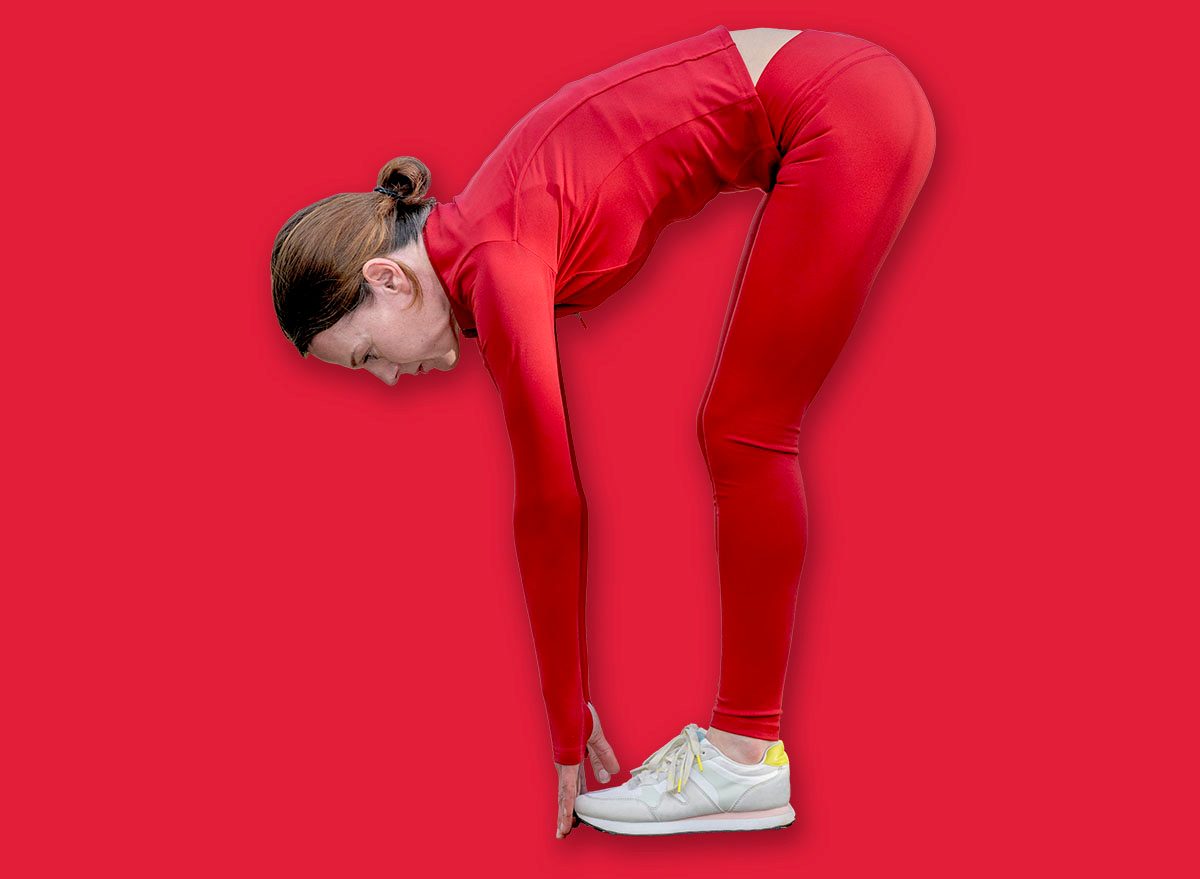
Standing Toe Touches
“Standing toe touches are useful to build into your training because they largely test your hamstring flexibility. Tight hamstrings are common causes of a variety of different types of injuries. They’re also associated with persistent daily discomfort in some cases,” Angelino notes.
- Stand tall with your feet hip-distance apart.
- Hinge forward at your hips, maintaining a straight back.
- Reach toward your toes with the goal of touching them.
- Hold for 30 to 45 seconds. Allow your head to hang naturally.
- Release.