4 Bodyweight Exercises That Build More Strength Than Gym Machines After 50

Walk into any gym and you’ll see the same thing: rows of machines, each one isolating a specific muscle group and guiding you through perfectly linear movements. While machines do have their place for beginners and those recovering from injuries, they rarely tell the full story of what your body can do. After 50, building strength becomes more about joint health, coordination, mobility, and balance. That’s where bodyweight exercises come in.
Bodyweight exercises require you to create your own stability instead of letting a machine provide it, which becomes crucial as you age. Research consistently shows that functional, multi-joint movements help preserve pillars of healthy aging, including strengthening muscle fibers, improving neuromuscular coordination, and maintaining bone density. They also mirror the realities of daily life, such as standing up from a chair, bending down to pick something up, leaning sideways, or engaging your core during a reach or twist.
“Bodyweight exercises require balance, coordination, joint control, and full-body engagement,” explains Ed Gemdjian, General Manager of The Gym Venice. “After 50, those qualities matter just as much as muscle size. And in most cases, people in their 50s and beyond are fully capable of performing full bodyweight movements unless a specific injury limits them.”
In this article, Gemdjian shares four essential bodyweight exercises that can help you build more strength than gym machines after 50. Read on for the exercises and detailed step-by-step instructions. Then, when you’re finished, check out these 5 Standing Exercises That Melt Belly Pooch Faster Than Running After 50.
How to Structure Each Exercise
- Three sets per exercise
- 8 to 12 reps per set (or 20 to 30 seconds per hold)
- Rest for 60 to 90 seconds between sets
- Aim for a Rating of Perceived Exertion (RPE) of seven to eight (the exercise should be challenging but within your ability)
- Prioritize proper form and control over speed and number of reps
Squat to Chair
This foundational compound exercise strengthens the major muscles in your lower body responsible for walking, standing up, taking stairs, and preventing falls. For adults over 50, strong legs and hips matter more than nearly anything else for maintaining independence.
How to do it:
- Stand in front of a chair with your feet shoulder-width apart.
- Sit back and down in a controlled, smooth descent until you lightly tap the chair.
- Stand up by driving through your heels and pushing the floor away.
Why it works:
- Uses multiple major muscle groups
- Builds joint control and balance
- Strengthens real-life movements like standing and climbing stairs
Progressions:
- Air squat (remove the chair)
- Goblet squat holding a weight at chest level
Incline Push-Up
Unlike chest press machines that lock your body into position, incline push-ups force your core, shoulders, and arms to stabilize your body. This makes the movement far more functional, which is exactly what adults over 50 need to maintain strong, pain-free shoulders and upper body strength.
How to do it:
- Place your hands on a sturdy and secure bench, countertop, or table.
- Lower your chest slowly to the ground over three seconds.
- Press back up in one second.
Why it works:
- Engages stabilizer muscles that machines can’t train
- Strengthens chest, shoulders, triceps, and core
- Helps prepare you for floor push-ups or weighted pressing exercises
Progressions:
- Move to a lower surface
- Perform full floor push-ups
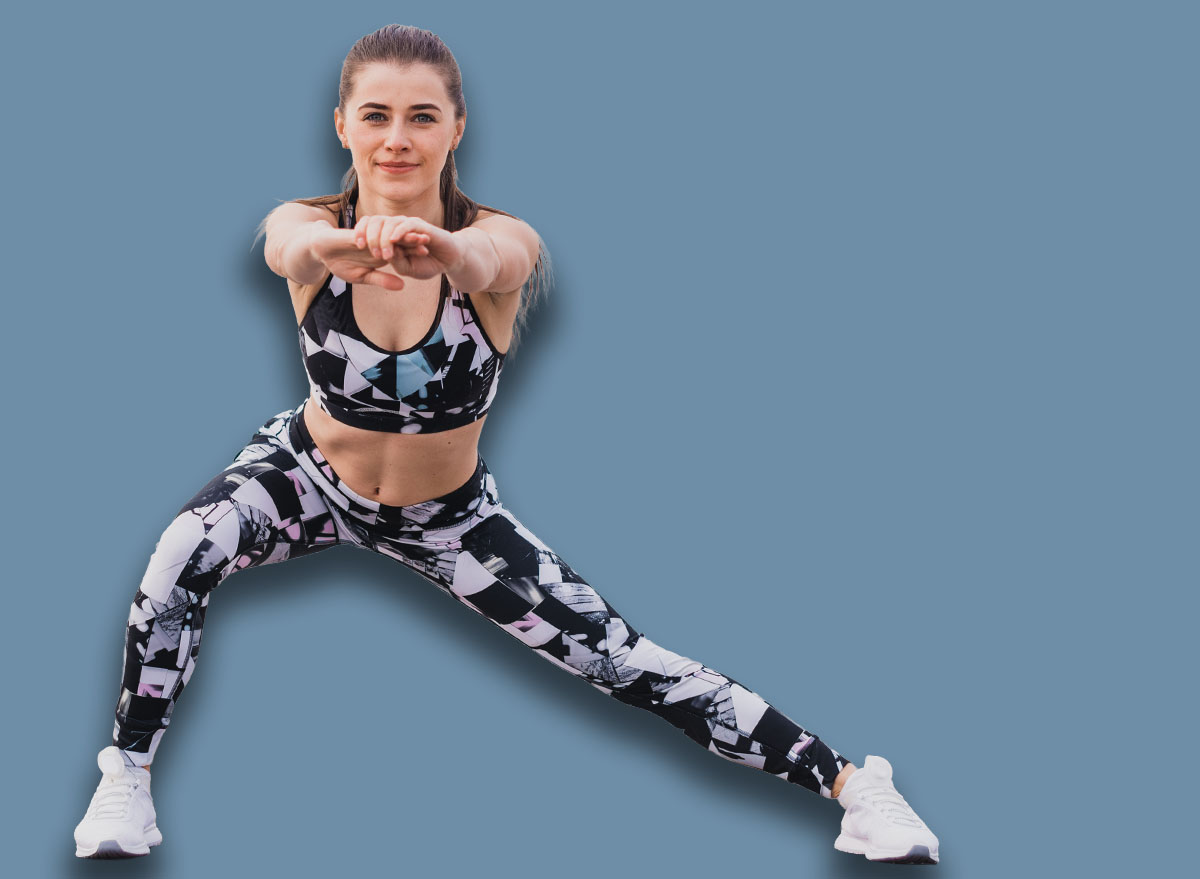
Lateral Lunge
Most machines move only forward and backward, but that’s not the reality of how your body actually moves. This side-to-side movement builds strength, balance, and mobility in directions machines rarely train, making it a non-negotiable anti-aging exercise after 50.
How to do it:
- Stand with your feet hip-width apart.
- Step out to the side while bending your stepping leg and keeping your other leg straight.
- Sit back into your hip with your chest lifted.
- Push through your stepping leg and return to the standing position.
Why it works:
- Builds hip strength and mobility
- Challenges balance and single-leg control
- Strengthens glutes, quads, and inner thighs
- Trains movement patterns not replicated by machines
Progressions:
- Hold a weight at chest level
- Step deeper and lower
Bodyweight Row (TRX or Resistance Bands)
Pulling strength is often neglected by machine-focused programs, yet it’s crucial for maintaining good posture and shoulder health. Rows recruit stabilizer muscles around your spine and shoulder blades that no fixed-path machine can hit.
How to do it:
- Hold handles or bands anchored at chest height.
- Lean back with your arms extended.
- Pull your chest toward your hands while squeezing your shoulder blades together.
Why it works:
- Activates stabilizer muscles that machines can’t engage
- Strengthens upper back and arms
- Improves posture and shoulder mechanics
- Balances pushing movements and prevents imbalances
Progressions:
- Step out with your feet farther forward
- Slow the tempo or add pauses at the top and bottom of the movement
Why Bodyweight Exercises Can Beat Machines
Gemdjian says bodyweight exercises can trump workout machines in the following ways:
- Bodyweight exercises force you to stabilize your joints.
- Bodyweight exercises challenge multiple muscle groups at once.
- Bodyweight exercises build coordination and balance.
- Bodyweight exercises mimic real-life daily movement far better than machines.
While machines can still help you build muscle at any age, they don’t train you to move better in three dimensions. After 50, that ability is what helps you maintain independence and reduce injury risk.