7 Chair Exercises That Restore Knee Strength Faster Than Yoga After 60

Weak knees can totally compromise your daily lifestyle. Did you know that knee pain is a common musculoskeletal issue among the elderly population, and its prevalence only heightens with age? According to research, knee pain can cause physical disability and overall reduced quality of life. In addition, osteoarthritis—a degenerative condition impacting the joints—is a main cause of knee pain and affects over 27 million people in the United States. This condition brings on pain, compromised balance, stiffness, and limited function. And that’s not all—it can also cause mental stress.
“Cartilage in your knees wears down over the years, leaving less cushion between the bones,” explains Dr. Gbolahan Okubadejo, Board Certified Spinal Surgeon at The Institute for Comprehensive Spine Care. “The muscles around the knee, especially the quads, naturally shrink and weaken as you age, so there’s less support holding everything in place. Ligaments also get stiffer and less flexible, which makes the joint feel less steady. All of this together means simple things like going downstairs, getting up from a chair, or walking on a slope start to feel risky or painful.”
Whatever is causing your knees to be weak, it’s important to strengthen them to avoid additional problems down the road—and we have just the routine to help. We spoke with experts who recommend chair workouts, which are kind on the knees and will get the job done. They shared seven chair exercises that can help restore knee strength faster than yoga after 60.
Why the Knees Typically Lose Strength and Stability After 60

You begin to naturally lose lean muscle once you hit 30.
“As we keep aging, the muscles around the knees that stabilize it—quads, hamstrings and glutes—get weaker if the individual does not do strength training. The tendons and ligaments also lose elasticity. And joint cartilage also thins over time. That is, if there is no activity to counteract the effects of natural normal aging,” explains Terry Tateossian, Founder, Certified Lifestyle Medicine Coach, Trainer, Nutritionist for Women 40+ at THOR – The House of Rose.
That’s where chair exercises come in clutch. According to Tateossian, they serve as an effective starting point for individuals seeking to build stronger knees and legs.
“One of the main reasons chair exercises are more aligned with building muscle over yoga is that they allow progressive overload as the person gets stronger,” she says. “So you can perform chair squats, for example, with just using body weight the first month and then progressively start to add a dumbbell, then two dumbbells, then more reps, slower tempo, and more sets. This is all considered progressive overload, and it helps promote muscle growth.”
How Chair-Based Training Can Be More Effective Than Yoga
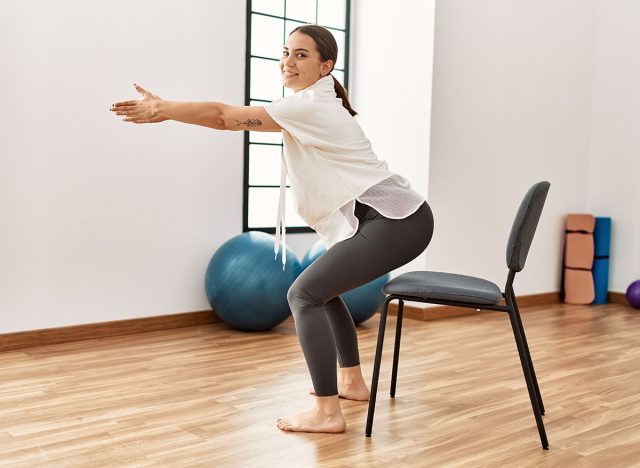
Rebuilding and rehabbing knee strength when you’re over 60 depends on your current starting point. Chair-based exercises are typically more productive for those with limited mobility and/or significant knee pain, says Rachel Pieroni, NASM CNC, CPT, with Pure Barre / Xponential Fitness.
“Traditionally, yoga focuses on flexibility, coordination, and muscular endurance, which may help reduce pain and stiffness in the knee(s), but may not have the same benefits in terms of strength that chair-based exercises can offer,” she says. “Overall, chair-based exercises are highly effective for building foundational strength in the quadriceps, hamstrings, and glutes, without placing added pressure on the knee joint.”
According to Dr. Okubadejo, many older adults simply feel safer with a sturdy chair nearby.
“A chair takes most of the body weight out of the equation, so the muscles can work without the joint taking a beating. That means you can do more reps, build strength gradually, and stay consistent without flare-ups stopping you every few days,” he says.
Below are several chair exercises to add to your fitness routine in order to restore knee strength.
Chair Squats
- Begin by standing tall in front of a sturdy chair with your feet hip-width apart on the ground.
- Activate your core and keep your chest lifted.
- Bend at the knees and hips and lower slowly into a squat—as if you’re about to sit down. Make sure your weight stays in your heels.
- Lightly touch the surface of the chair with your glutes.
- Press through your heels to rise back up.
- Perform 2 to 3 sets of 10 to 15 reps, sticking with a 3010 tempo and resting for 60 seconds between sets.
Seated Leg Extensions
- Begin sitting tall with your back supported against the chair.
- Place your feet flat on the floor.
- Hold the sides of the chair for added stability.
- Lift your legs in front of you until your knees are completely extended. For max quad engagement, keep your toes flexed toward your shins the entire time.
- To increase the challenge, hold a dumbbell between your feet.
- Perform 2 to 3 sets of 10 to 15 reps, sticking with a 3010 tempo and resting for 60 seconds between sets.
Seated Banded Hip Abductions
- Begin sitting tall on a sturdy chair or workout bench with your feet planted flat on the ground and your knees bent.
- Position a resistance band just above your knees.
- Begin with your knees hip-distance apart.
- Press your knees out against the resistance band.
- Use control to release.
- Complete 2 to 3 sets of 25 to 35 reps, sticking with a 3010 tempo and resting for 60 seconds between sets.
Seated Banded Hamstring Curls
- Begin sitting tall on a sturdy chair or workout bench with your feet flat on the ground and your knees bent to 90 degrees.
- Position a resistance band securely around one ankle and anchor the other end to a sturdy pole or heavy object ahead of you.
- Scoot back just a bit to establish some tension.
- Slowly pull your heel back under the chair, bending your knee against the band’s resistance.
- Use the control to return to the start position.
- Complete 2 to 3 sets of 25 to 35 reps, sticking with a 3010 tempo and resting for 60 seconds between sets.
Seated Toe Taps
- Begin sitting tall with your feet flat on the floor and knees bent.
- Lift both feet off the ground, maintaining a bend in the knees.
- Tap one set of toes on the ground while the other leg stays lifted.
- Complete 2 to 3 sets of 10 to 15 reps on each leg, sticking with a 3010 tempo and resting for 60 seconds between sets.
Seated March
- Begin seated with your feet placed hip-width apart on the floor.
- Lift your left knee up to hip height.
- Lower.
- Then, lift your right knee up to hip level.
- Lower.
- Maintain solid posture as you continue to “march.”
- Perform 3 sets of 20 reps.
Purre Barre Reverse Chair

For those looking for an added challenge, Purre Barre’s reverse chair exercise is essentially a wall sit using an invisible chair.
- Begin with your back to the barre (or a wall).
- Position one loop of a tube resistance band around both thighs.
- Bring your feet hip-distance apart and parallel to each other.
- Bring your arms out wide on the barre and walk your feet forward.
- Bend your knees and sink your buttocks toward knee level, as if you’re sitting on a chair.
- Make sure your knees are stacked over the ankles, and your shoulders are over your hips.
- Start to press out on the resistance tube, pausing to hold the position for a moment before releasing.
- Perform 3 sets of 15 to 20 reps.