5 Daily Exercises That Rebuild Lost Muscle Better Than Weight Training After 50
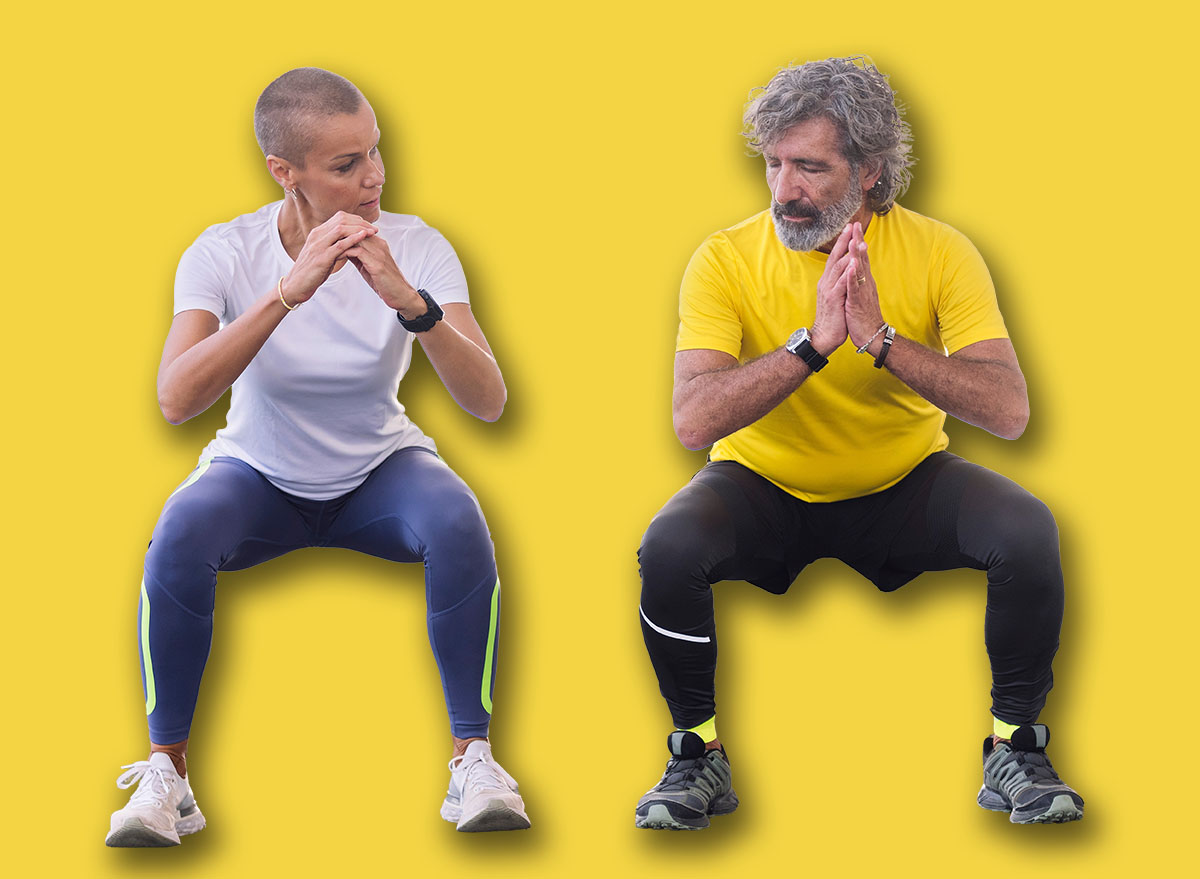

If you’re over 50 and notice muscle loss, don’t panic. It’s a natural occurrence in this phase of life. In fact, the process is known as sarcopenia and it starts after the age of 30. We spoke with experts who recommend five daily exercises to rebuild lost muscle after 50—and they’re even better than weight training.
“As we enter our 50s, our physical needs change, and bodyweight exercises can help us improve balance, strength, and resilience,” Eric North, aka The Happiness Warrior—a wellness speaker, coach, and advocate redefining what it means to age with purpose, strength, and emotional vitality, tells us. “Bodyweight and standing exercises can be more effective for rebuilding muscle in older adults because they improve functional strength by engaging multiple muscles, including stabilizers, which compares to real-life movements better than relying on machines.”
These training modalities also boost coordination, balance, and joint mobility—all of which are essential for preventing falls and maintaining an active, independent lifestyle.
Squats
“Squats help strengthen the legs, gluteal muscles and core,” North tells us. “They will significantly increase leg strength and help us maintain a physically independent lifestyle.”
By performing the movement slowly, you’re forcing your core, legs, and hips to stay engaged. “The muscles rebuild without the added knee pressure that heavier weights can cause. It also more closely mirrors the motion used to stand and sit from chairs, which helps keep everyday mobility functional and strong,” says Denise Chakoian, Rhode Island certified fitness trainer and owner of Core Cycle and Fitness LaGree.
- Begin by standing tall with your feet shoulder-width apart.
- Extend your arms in front of you or place your hands on your hips.
- Bend at the knees and hips to lower into a squat.
- Descend until your thighs are parallel to the floor.
- Press through your heels to return to standing.
- Perform 3 sets of 10 to 12 reps.
Pushups
“Pushups are important for building upper-body strength, improving core stability, and supporting overall fitness by working multiple muscle groups at once. They also contribute to cardiovascular health, bone density, better posture, and balance,” North explains. “Because they are a bodyweight exercise, pushups are accessible to almost everyone and can be modified for various fitness levels.”
- Start in a high plank with your hands under your shoulders and your body straight from head to heels.
- Activate your core.
- Bend your elbows to lower your chest toward the floor. Maintain a long, straight body as you lower.
- Press back up, straightening your arms.
Hinge
For this exercise, North recommends a glute bridge or Romanian deadlift to master the hinging motion.
“This is an essential movement for lower back strength and helps prevent injuries and reduce downtime that might come from everyday activities,” he tells us.
- For the glute bridge, by lying flat on your back with bent knees and feet hip-width apart on the floor.
- Arms should be at your sides with palms pressing into the ground.
- Press through your heels to lift your hips until your body forms a straight line from head to heels.
- Squeeze your buttocks, holding at the top for a moment.
- Lower your hips back to the start position.
Planks
“Planks are a great exercise to strengthen the deep core muscles that stabilize the spine and help with balance,” Chakoian tells us. “A strong core is key to making walking, lifting, and everyday activities easier. Modified planks on a counter remain just as effective while reducing the pressure on the lower back.”
- Assume a forearm plank with your forearms on the floor—elbows under your shoulders—and body straight from head to heels.
- Alternately, assume a high plank with your hands under your shoulders.
- Avoid letting your hips sag or rise.
- Hold your plank for 20 to 30 seconds, performing 3 rounds in total.
Rowing
“Rowing movements help with aging because they are a low-impact, full-body exercise that builds cardiovascular health, strength, and flexibility while being gentle on joints,” North explains. “Rowing strengthens major muscle groups, improves balance and coordination, can reduce the risk of falls, and may even boost cognitive function. This makes it an excellent option for maintaining a healthy and active lifestyle as we age.”
To sum everything up, North tells us, “These compound exercises build muscle efficiently and improve functional strength for everyday activities. Rather than being restricted to traditional weight machines, these exercises can be done with our own body weight or resistance bands and should be performed with precision and controlled movements. Most importantly, they can be done anywhere at any time!”