4 Most Effective Daily Exercises To Slow Muscle Aging After 50

Muscle loss after 50 is a reality many of us face, but it doesn’t have to define your fitness journey. As we age, preserving lean muscle mass becomes increasingly important for maintaining strength, mobility, and overall quality of life. The good news is that with the right approach, you can effectively slow muscle aging and even build new muscle tissue. Read on to discover the four most effective daily exercises to keep your muscles strong and youthful, plus the common mistakes you need to avoid.
Mistakes You Need To Avoid

The four biggest mistakes people over 50 make when trying to slow muscle loss are:
Don’t use isolation exercises instead of compound exercises. Compound exercises allow us to recruit more motor units which in turn lead to building more lean muscle mass, whereas isolation exercises recruit fewer motor units and therefore less muscle growth.
Don’t overdo cardio. Excessive cardiovascular activity increases cortisol levels, which in turn catabolize or decrease the amount of lean muscle mass we carry. While doing some cardio is very beneficial for both fat reduction and heart health, too much is counterproductive to muscle growth.
Don’t skimp on protein. Resistance training helps break down current muscle tissue to stimulate new growth; however, if protein intake is inadequate, one does not have the building blocks to create the new muscle tissue. You can safely consume up to 1 gram of protein per pound of body weight.
Don’t think you have to use heavy weights to build muscle. Many studies show that this is absolutely not the case. By utilizing a lighter weight with a high volume, generally meaning at least five sets of at least 15 repetitions per set, you build as much muscle as a lower volume with heavy weights. The advantage of using these lighter weights to build muscle is that you greatly reduce your chances of injury, especially injuries to the tendons, which are very common with heavy loads.
Squat Bar Warm-Up
Why It Works
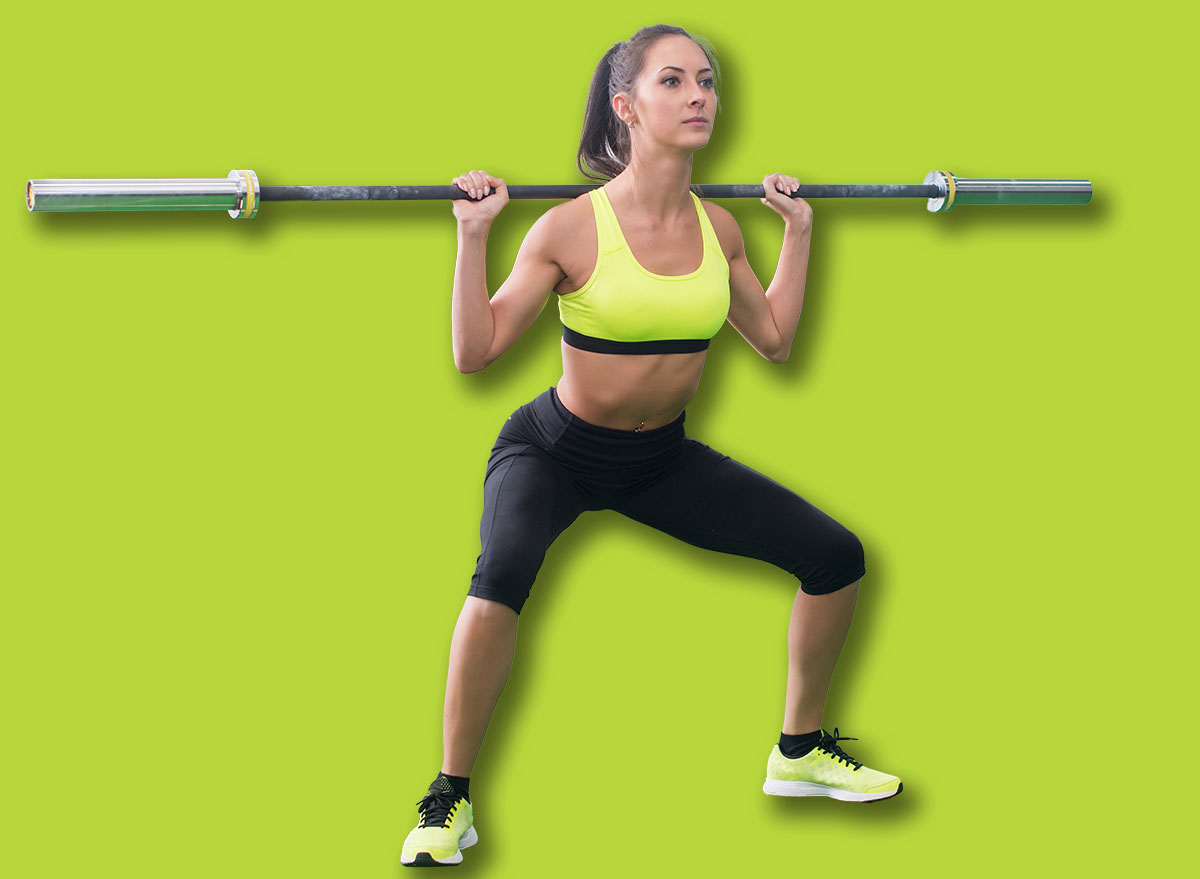
The squat bar warm-up works to preserve muscle through the time under tension mechanism. This simply means the longer you are supporting a weight the more your muscles have to work. The squat bar warm-up also utilizes all of the leg muscles as well as all of the spinal muscles. This makes it a compound exercise and as mentioned earlier compound exercises require the most motor unit recruitment, and therefore your best opportunity to build muscle.
How To Perform
- Place a dowel or a squat bar at the base of your neck
- Have your hands a little wider than shoulder width apart for comfort
- Try to maintain a gravity line which means your ear, shoulder, hip, and ankle are all in line
- Once you have an understanding of the gravity line, follow along with the video for all of the steps
Modifications For Beginners
- Do the minimum amount of reps
- Use a dowel instead of a bar at the base of your neck
Avoid These Mistakes
- Don’t use too heavy of a bar
- Don’t try to perform too many reps early on
- Don’t neglect your gravity line for proper form
Lunge Matrix
Why It Works
The lunge matrix is great for building muscle due to its high volume of repetitions and its ability to stimulate all of the muscles of the lower body. When stimulated, the large muscles of the lower body help us produce the largest amount of testosterone and growth hormone, which are both imperative to building muscle.
How To Perform
- Make sure that your knees are healthy enough to do a proper lunge
- If you can do a proper lunge, then you are ready for the lunge matrix
- See the video for all the steps
Modifications For Beginners
- Lunge to a much more shallow depth
- Perform fewer repetitions
- Perform near a wall so that you have something to help you balance
Avoid These Mistakes
- Don’t allow the knee to crash in towards midline
- Don’t let the heel come off the ground on the lead leg
- Don’t perform an unequal amount of reps on each side
Segmental Longissimus Strengthening
Why It Works
Segmental Longissimus Strengthening is beneficial as the Longissimus is one of the largest of the spinal muscles. It is the primary muscle of spinal extension, meaning it’s the muscle that does the most work to hold your spine upright against gravity. Building strength in this muscle ensures a healthy spine that can provide you a greater amount of strength to support all of your other muscle building efforts and increase your longevity, allowing you to workout longer, safer, and more frequently in your efforts to build muscle.
How To Perform
- Begin by lying on your stomach
- Stack your hands on top of each other with your head stacked on top of your hands
- Once you establish this position, check out the video to master the six positions for strengthening the longissimus
Modifications For Beginners
- Simply do the minimum amount of reps you can do without any pain
- Some readers may feel better with a pillow under their pelvis to prevent excessive motion of the pelvis and arching of the lumbar spine
Avoid These Mistakes
- Don’t extend the neck
- Don’t twist the spine
- Don’t skip out on the isometric portion of the exercise
Short Hinge Abdominal
Why It Works
The short hinge abdominal exercise is great for building muscle because it works all of the abdominal muscles as well as the hip flexors. Building core and hip strength are the foundation to be able to do more complex lifts such as squats, deadlifts, and lunges. A strong core also ensures a healthy spine, allowing you to miss fewer of your workouts and build more lean muscle tissue.
How To Perform
- See the video to learn all the steps safely and correctly
Avoid These Mistakes
- Don’t skip mastering the isometric portion first
- Don’t try to do too large of a range of motion before you can stabilize it
- Don’t reach forward with the head—curl through the abdominal instead
What Results You Can Expect
Start by picking one of the above exercises and perform a different one each day. If you are looking for a full workout, perform all the exercises on the same day in this order:
- Squat bar warm-up
- Abdominals
- Lunge matrix
- Spinal strength
Perform 3 times per week.
After 6 to 8 weeks of doing these exercises consistently, you should notice an increase in lean muscle mass, improved mobility, higher energy levels, and a definite increase in strength.