If You Can Do This Many Lunges After 50, Your Leg Strength Is Top-Tier
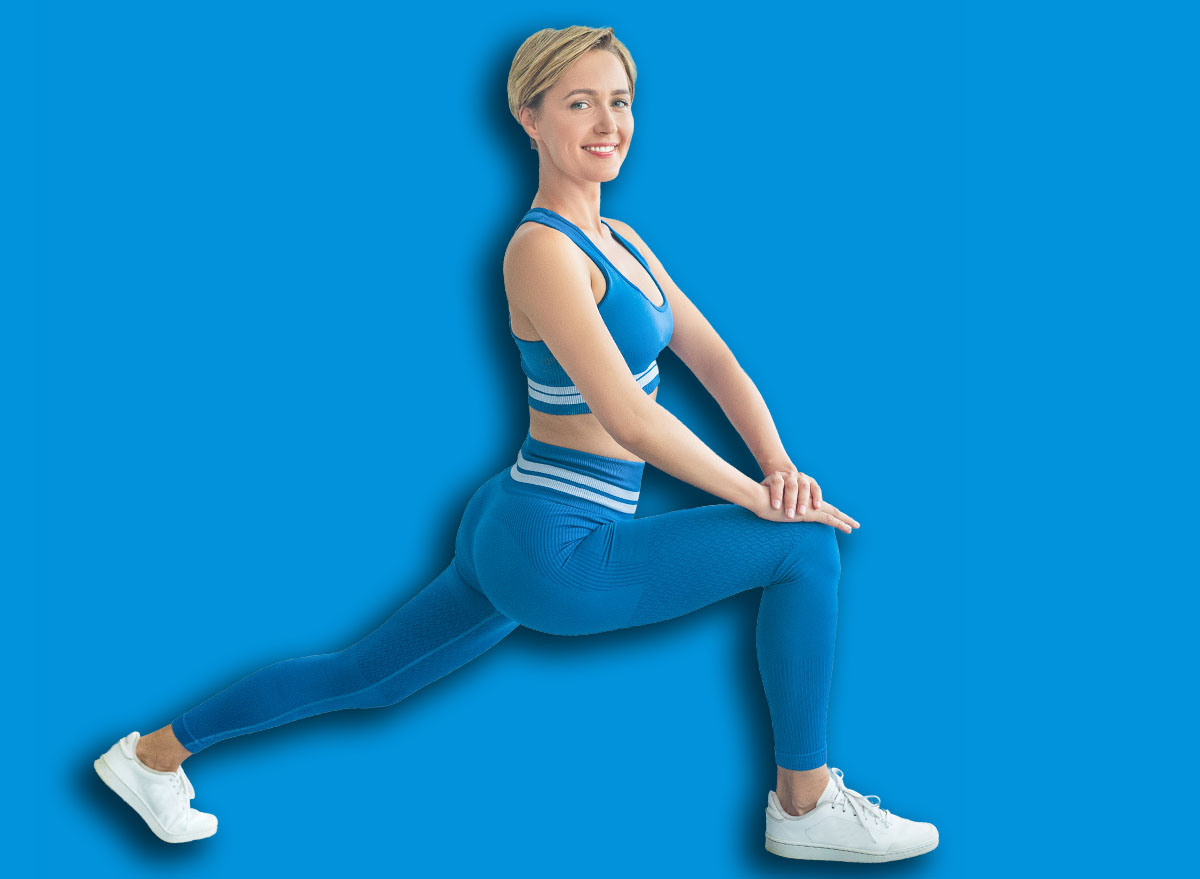

If you don’t include lunges in your regular workout rotation, you should reconsider your plan. They’re a potent exercise that improves stability, balance, and coordination while building lower-body strength—and that’s not all. Lunges activate your core and boost functional fitness, which is key for living an active, independent lifestyle while avoiding injury.
That said, lunges can be quite challenging. After all, you’re basically squatting on one leg and balancing. Lunges require quite a bit of stability—and practice makes perfect. Once you’ve mastered them, you’re on the road to being quite fit. In fact, according to Domenic Angelino, CPT with International Personal Trainer Academy, which offers NCCA-accredited Personal Trainer (CPT) and Certified Nutrition Specialist (CNS) programs, if you can do this many lunges after 50, your leg strength is considered top-tier.
“Lunges are productive for developing lower-body strength because they allow you to simultaneously train four major muscle groups that cover a majority of your leg. And, you’ll train them in a way that leads to significant adaptation for three of them,” Angelino says.
These Age-Related Changes Majorly Impact Leg Strength

According to Angelino, most individuals experience a gradual loss of lean muscle and strength as early as in their 20s.
“The older you get, the more the effects of muscle and strength loss compound,” Angelino explains. “The exact point at which it becomes noticeable depends on your genetics, your diet, and how regularly and effectively you do resistance training. Part of that loss comes from something called sarcopenia, which is the natural loss of muscle mass with age. It’s the biggest driver and is largely linked to your genetics. The next biggest driver is behavioral, whether you’ve been resistance training regularly or not over the years.”
Another hurdle? Most individuals don’t regularly train their legs and prioritize the upper body instead. Even if you lift weights throughout your life, decreased leg strength can occur after 50.
Why Lower-Body Strength Matters for Balance

Preserving your balance as you age is crucial for avoiding falls, which could lead to fracturing a bone.
“Hip fractures are a leading cause of preventable death and are more common in people over 50 than in younger adults,” Angelino points out. “Part of the reason for this is that, along with the loss of muscle mass and strength with age, bone density tends to decrease as well. If bone density goes down, your risk of fracturing a bone goes up. Plus, to make matters worse, the same sort of things that contribute to lower muscle size and strength with age also contribute to lower bone density.”
If You Can Do This Many Lunges After 50, Your Leg Strength Is Top-Tier
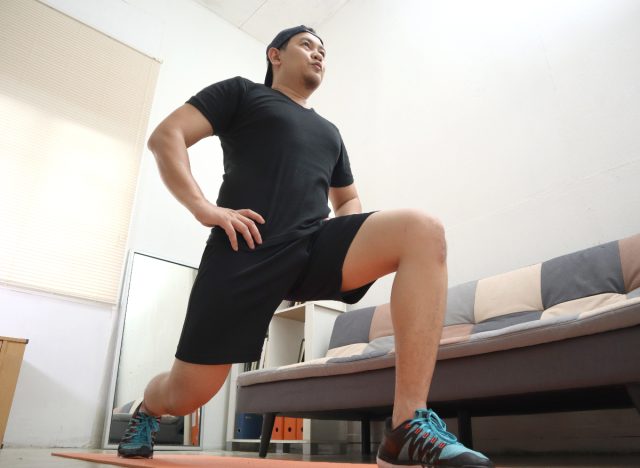
In general, if you’re able to perform 12 lunges on each leg with just your body weight—and moving through the full range of motion—you’ll be in a solid spot. However, aiming for 20 reps per leg while sticking to a 2-2-2-2 tempo is considered ideal.
“If you can hit that benchmark, then you’re in a good spot relative to your body weight. Reason being that performing that number of repetitions at that tempo will test not just your lower-body strength, but lower-body muscular endurance,” Angelino explains. “Since it’s so long of a set, it’ll do it in a way that will cause your muscle fibers to fatigue.”