If You Can Do This Many Pushups After 50, Your Arm Strength Is Top 10%


Upper body strength becomes increasingly important after 50 because it supports far more than gym performance. Your arms help you push yourself up from the floor, brace during slips, carry loads, and stabilize your shoulders during daily movement. When arm strength declines, those tasks quietly demand more effort and often place added stress on the joints.
Muscle strength and endurance in the upper body also tie closely to long-term resilience. Strong arms help preserve lean muscle, support shoulder health, and improve posture as activity levels change with age. Endurance matters because most real-life tasks require repeated effort rather than one maximal push.
That’s why the pushup remains such a valuable test. In under a minute, it reveals how well your arms, shoulders, and core work together under fatigue. Think of it as a quick upper body check-up that offers meaningful insight without complicated equipment or setup.
The Benefits of Strong Arms After 50

Strong arms support how well your entire upper body functions. Pushing with strength helps protect your shoulders, improve posture, and keep force evenly distributed across your joints. When your arms are strong, everyday movements feel more stable and controlled.
Upper body strength also plays a role in balance and in the response to falls. When you stumble or reach to stabilize yourself, your arms often act first. Strong arms absorb force, support quick reactions, and help prevent small slips from turning into bigger issues.
Beyond physical performance, arm strength supports independence. It allows you to lift, carry, push, and support your own body weight with confidence. Strong arms help you stay engaged in the activities you enjoy without hesitation.
How to Perform a Flawless Pushup
Even though pushups feel familiar, clean technique matters more after 50. Good alignment protects your shoulders and elbows while ensuring your muscles do the work they’re meant to do. Small form breakdowns add up quickly when fatigue sets in.
Before testing your strength, focus on consistency. Every rep should look and feel similar, even in the final seconds.
- Place your hands slightly wider than shoulder-width
- Stack your shoulders over your wrists
- Keep your body in a straight line from head to heels
- Lower with control until your chest approaches the floor
- Press back to full lockout with control
Clean reps always matter more than speed or volume.
How to Perform the Pushup Strength Test
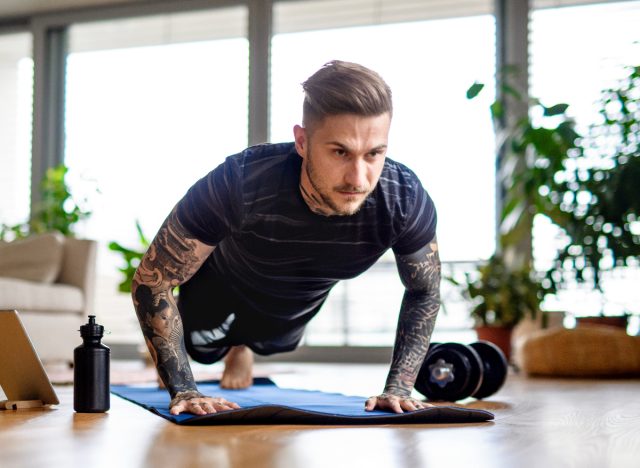
This test works best when you keep it simple and honest. The goal is to measure repeatable strength, not to chase a rushed number.
- Set a timer for 60 seconds
- Use standard floor pushups as the benchmark
- Modify only if needed by elevating your hands or performing a knee push-up.
- Maintain a full range of motion on every rep
- Move at a steady pace that allows clean form
- Count only reps that meet your quality standard (elbows reach 90-degrees, minimum)
When the timer ends, record your total and move on. That number gives you a clear snapshot of your current upper body strength and endurance.
Ranking of Pushup Scores After 50

Your final score reflects more than arm strength alone. It captures shoulder stability, core control, pacing, and fatigue management. These qualities matter just as much as strength as you age.
- Under 10 push-ups: Upper-body strength and endurance need improvement. Daily pushing tasks may feel fatiguing.
- 10 to 19 pushups: You’ve built a functional base. Your arms handle routine demands, though endurance may fade.
- 20 to 29 pushups: This range indicates strong, capable upper-body strength with solid control.
- 30 or more pushups: That’s top 10 percent arm strength for your age. Your upper body shows excellent endurance, coordination, and stability.
Form always outweighs the final count.
The Best Tips for Increasing Arm Strength

Building arm strength after 50 comes from consistent, well-planned training that challenges your muscles while respecting your joints. Progress depends on repeatable movement patterns, controlled reps, and balanced loading that supports shoulder and elbow health. Strength that holds up under repeated effort matters more than occasional hard days, especially as recovery becomes more important. When training stays focused on quality, smart exercise selection, and adequate recovery, arm strength improves steadily without unnecessary wear and tear.
- Train pushing and pulling two to three times per week: Balanced upper body work supports shoulder health and strength gains.
- Control every rep: Slower reps increase time under tension and improve joint stability.
- Strengthen your triceps: Strong triceps improve pushup lockout and shoulder support.
- Build core stability: A stable core allows your arms to express strength more efficiently.
- Prioritize recovery: Reduce volume if joints feel irritated, rather than forcing reps.
References
- Yang, Justin et al. “Association Between Push-up Exercise Capacity and Future Cardiovascular Events Among Active Adult Men.” JAMA network open vol. 2,2 e188341. 1 Feb. 2019, doi:10.1001/jamanetworkopen.2018.8341
- National Institute on Aging. How Can Strength Training Build Healthier Bodies as We Age? National Institutes of Health, 30 June 2022, https://www.nia.nih.gov/news/how-can-strength-training-build-healthier-bodies-we-age. Accessed 25 Jan. 2026.