If You Can Complete These 5 Morning Exercises Without Rest After 50, Your Fitness Is Top 10%

Morning movement can reveal a lot about your true fitness level. After 50, the ability to move continuously with control, coordination, and steady breathing reflects more than just strength. It shows cardiovascular capacity, core stability, joint mobility, and muscular endurance all working together. When someone can flow through multiple exercises without stopping, that is a strong sign that their body still has plenty of gas in the tank.
With many of the adults I work with, morning sessions provide a clear snapshot of how well their fitness carries over into real life. You are not fully warmed up, your body is just getting moving, and fatigue tolerance shows up quickly. When clients can string movements together smoothly, it usually tells me their foundation is solid. This type of continuous work builds resilience that supports everything from workouts to long active days.
Below are five simple but effective morning exercises. Complete them back-to-back without rest, and you will be operating in rare air for your age group. Focus on smooth transitions, steady breathing, and clean reps from start to finish.
Jumping Jacks
Jumping jacks quickly elevate your heart rate while reinforcing coordination and rhythm. This movement wakes up the cardiovascular system and prepares the body for more demanding work. I like placing it first because it gets blood flowing and challenges timing right away. When performed with good posture, it also builds light plyometric capacity that many adults gradually lose. It is simple, effective, and surprisingly revealing.
Muscles Trained: Calves, quadriceps, shoulders, and cardiovascular system
How to Do It:
- Stand tall with your feet together and your arms at your sides.
- Jump your feet out to the sides while raising your arms overhead.
- Land softly on the balls of your feet.
- Jump your feet back together while lowering your arms.
- Continue at a steady, controlled rhythm.
Recommended Sets and Reps: Perform 30 to 50 continuous reps.
Best Variations: Low-impact jacks, seal jacks, cross jacks
Form Tip: Stay light on your feet and keep your chest tall.
Plank With Shoulder Taps
This movement challenges your core to resist rotation while your upper body stays active. It builds the type of stability that supports strong posture and controlled movement. I often use shoulder taps to expose weak links in trunk control because the body wants to sway if the core is not fully engaged. Done correctly, it lights up the entire midsection. It also builds shoulder stability.
Muscles Trained: Rectus abdominis, transverse abdominis, shoulders, and glutes
How to Do It:
- Start in a strong high plank with your hands under your shoulders.
- Brace your core and squeeze your glutes.
- Lift your right hand and tap your left shoulder.
- Place your hand back down with control.
- Repeat on the opposite side and continue alternating.
Recommended Sets and Reps: Perform 20 to 30 total taps.
Best Variations: Wide stance plank taps, slow tempo taps, incline plank taps
Down Dog Hold
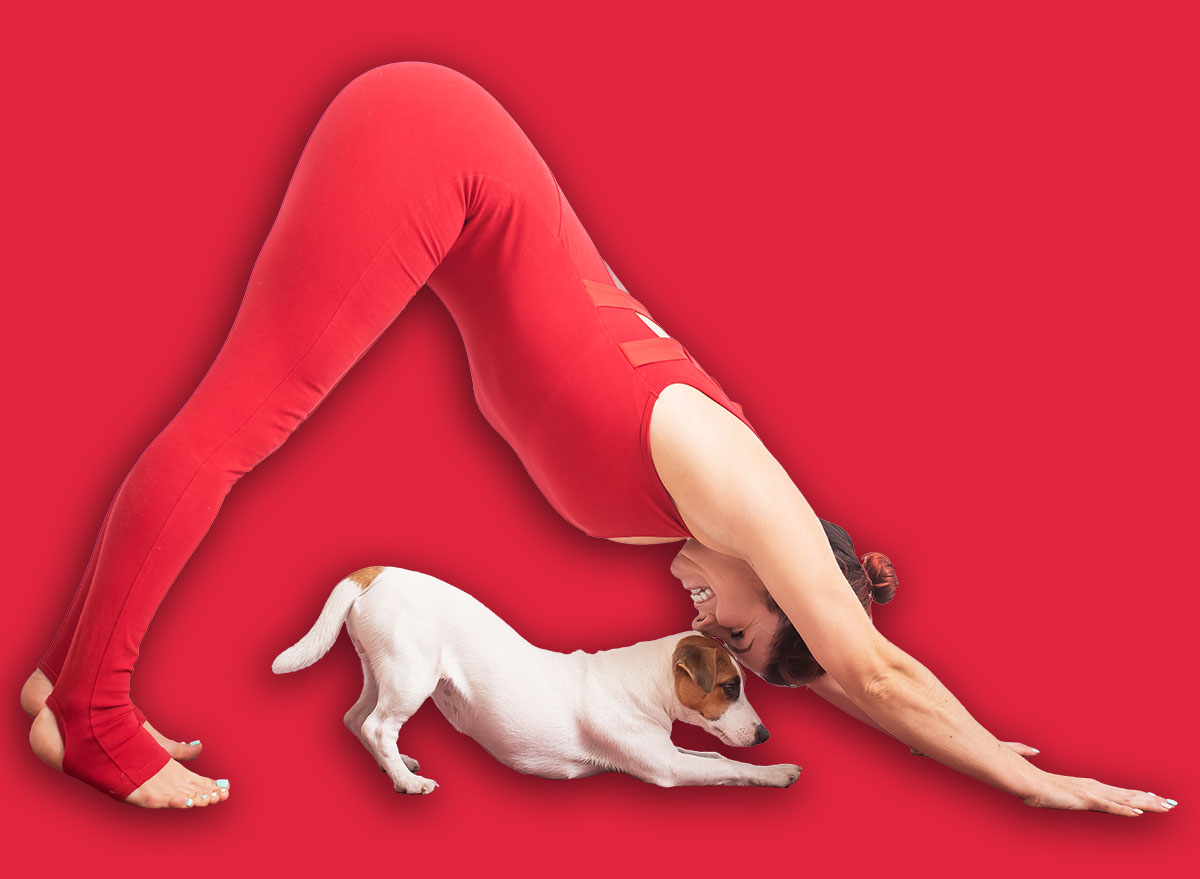
The down dog restores length through the posterior chain while reinforcing shoulder and hip mobility. After the first two movements raise your heart rate, this position challenges your control while keeping your body active. I like using it mid-sequence because it blends mobility with strength. Many adults feel immediate relief in the hamstrings and upper back. It also reinforces strong overhead positioning.
Muscles Trained: Shoulders, hamstrings, calves, and core stabilizers
How to Do It:
- Start on your hands and knees on the floor.
- Press through your palms and lift your hips toward the ceiling.
- Straighten your legs as much as your mobility allows.
- Gently push your chest back toward your thighs.
- Hold the position while breathing steadily.
Recommended Sets and Reps: Hold for 30 to 45 seconds.
Best Variations: Bent knee down dog, pedal down dog, elevated hands down dog
Form Tip: Focus on lengthening your spine rather than forcing your heels down.
Glute Bridge
The glute bridge builds hip extension strength, which supports walking, climbing, and overall lower-body endurance. Many adults underuse their glutes, leading to early fatigue during longer activities. I program bridges often because they help restore strong hip drive quickly. When the glutes fire well, movement becomes more efficient. This exercise also supports lower back comfort.
Muscles Trained: Glutes, hamstrings, and core stabilizers
How to Do It:
- Lie on your back with your knees bent and feet flat on the floor.
- Place your arms at your sides and brace your core.
- Press through your heels and lift your hips upward.
- Squeeze your glutes firmly at the top.
- Lower your hips back down under control and repeat.
Recommended Sets and Reps: Perform 15 to 20 reps.
Best Variations: Single leg bridge, pause bridge, banded bridge
Form Tip: Drive through your heels to maximize glute activation.
Alternating Reverse Lunges
Reverse lunges challenge leg strength, balance, and coordination all at once. They closely mirror real-world movement patterns and help build lower-body endurance. I often place them late in the sequence because they reveal how well someone manages fatigue. When performed smoothly, they strengthen the hips and knees while reinforcing control. This is where many people separate from the pack.
Muscles Trained: Glutes, quadriceps, hamstrings, and core
How to Do It:
- Stand tall with your feet hip-width apart.
- Step your right foot back into a reverse lunge.
- Lower until your front thigh approaches parallel.
- Press through your front heel to return to standing.
- Alternate sides and continue moving smoothly.
Recommended Sets and Reps: Perform 16 to 20 total reps.
Best Variations: Supported reverse lunge, slow tempo lunge, deficit reverse lunge
Form Tip: Step back far enough to keep your front knee tracking over your toes.
The Best Tips to Improve Morning Fitness After 50

Building the capacity to move continuously in the morning takes consistency and smart progression. Many adults over 50 regain impressive stamina once they train with intention and keep sessions repeatable. I have seen clients go from frequent rest breaks to smooth nonstop circuits in a matter of weeks. The key is to practice controlled movement while gradually increasing workload. Stay patient and focus on steady improvements.
- Train short morning circuits three to four days per week: Frequent exposure builds endurance quickly.
- Focus on smooth breathing: Steady nasal breathing helps delay fatigue.
- Prioritize clean transitions between movements: Efficiency matters when fatigue builds.
- Build strength alongside conditioning: Strong muscles support longer, continuous work.
- Progress volume gradually: Add a few reps or seconds each week.
- Stay consistent above all else: Regular effort drives the biggest gains.
Adhere to this routine with consistency and effort, and you can build the kind of all-around fitness that keeps you in the top tier for your age.
References:
- Schumacher, Leah M et al. “Consistent Morning Exercise May Be Beneficial for Individuals With Obesity.” Exercise and sport sciences reviews vol. 48,4 (2020): 201-208. doi:10.1249/JES.0000000000000226
- Reimers, C D et al. “Does physical activity increase life expectancy? A review of the literature.” Journal of aging research vol. 2012 (2012): 243958. doi:10.1155/2012/243958