5 Morning Exercises That Restore Core Strength Faster Than Gym Workouts After 50
Core strength after 50 has less to do with chasing a harder ab burn and more to do with how well your midsection supports the rest of your body. A strong core helps your hips stay steady, keeps your spine better supported, and gives your arms and legs a stronger base to move from. You notice the difference during simple things like getting out of bed, carrying groceries, reaching across your body, or walking on uneven ground.
Morning core work gives you a clean window to train those qualities before your day starts pulling you in different directions. Instead of saving core exercises for the end of a gym session when you’re already tired, these movements put control, bracing, and steady breathing first. That’s the stuff I look for when coaching core work: clean positions, smooth reps, and enough tension to make the body stay organized without turning the set into a scramble.
The exercises below train your core from several angles. Bird dogs and dead bugs teach your midsection to stay steady while your arms and legs move. Side plank rotations build strength through the sides of your waist. Planks with leg lifts connect your core and glutes. Pallof holds train your body to resist being pulled out of position. Together, they build strength that helps you move better long after the workout ends.
Bird-Dogs
Bird-dogs train your core, glutes, lower back, and shoulders while your body works to stay steady on all fours. As one arm and the opposite leg reach away from your body, your midsection has to brace to keep your hips from shifting or your lower back from arching. That makes bird-dogs a strong core builder after 50 because they train control while your limbs move, which is exactly what your body needs during walking, reaching, and lifting. Clean reps here build a better connection between your core, hips, and shoulders.
Muscles Trained: Core, glutes, lower back, shoulders
How to Do It:
- Start on all fours with your hands under your shoulders and your knees under your hips.
- Brace your core and keep your back flat.
- Extend your right arm forward and your left leg straight back.
- Hold briefly while keeping your hips level.
- Return to the starting position with control.
- Repeat on the opposite side.
Recommended Sets and Reps: Perform 3 sets of 8 to 10 reps per side. Rest for 30 seconds between each set.
Best Variations: Paused bird-dogs, banded bird-dogs, slower tempo bird-dogs
Form Tip: Keep your hips square to the floor and reach long instead of lifting high.
Side Plank With Rotation
Side planks with rotation train your obliques, shoulders, hips, and deep core while your body controls a twist from a supported side position. The rotation adds a challenge because your waist has to guide the movement without letting your hips drop or your shoulder collapse. That builds the core strength you need for turning, reaching across your body, carrying on one side, and staying steady when your weight shifts. Compared with most gym ab machines, this move trains your core to stabilize and rotate with control.
Muscles Trained: Obliques, core, shoulders, glutes
How to Do It:
- Lie on your side with your forearm under your shoulder.
- Stack your feet or stagger them for more support.
- Lift your hips until your body forms a straight line.
- Reach your top arm toward the ceiling.
- Rotate your top arm under your body with control.
- Return to the starting position and complete all reps before switching sides.
Recommended Sets and Reps: Perform 3 sets of 6 to 8 reps per side. Rest for 30 to 45 seconds between each set.
Best Variations: Bent-knee side plank rotation, side plank hold, slower rotations
Form Tip: Keep your hips lifted as your torso rotates.
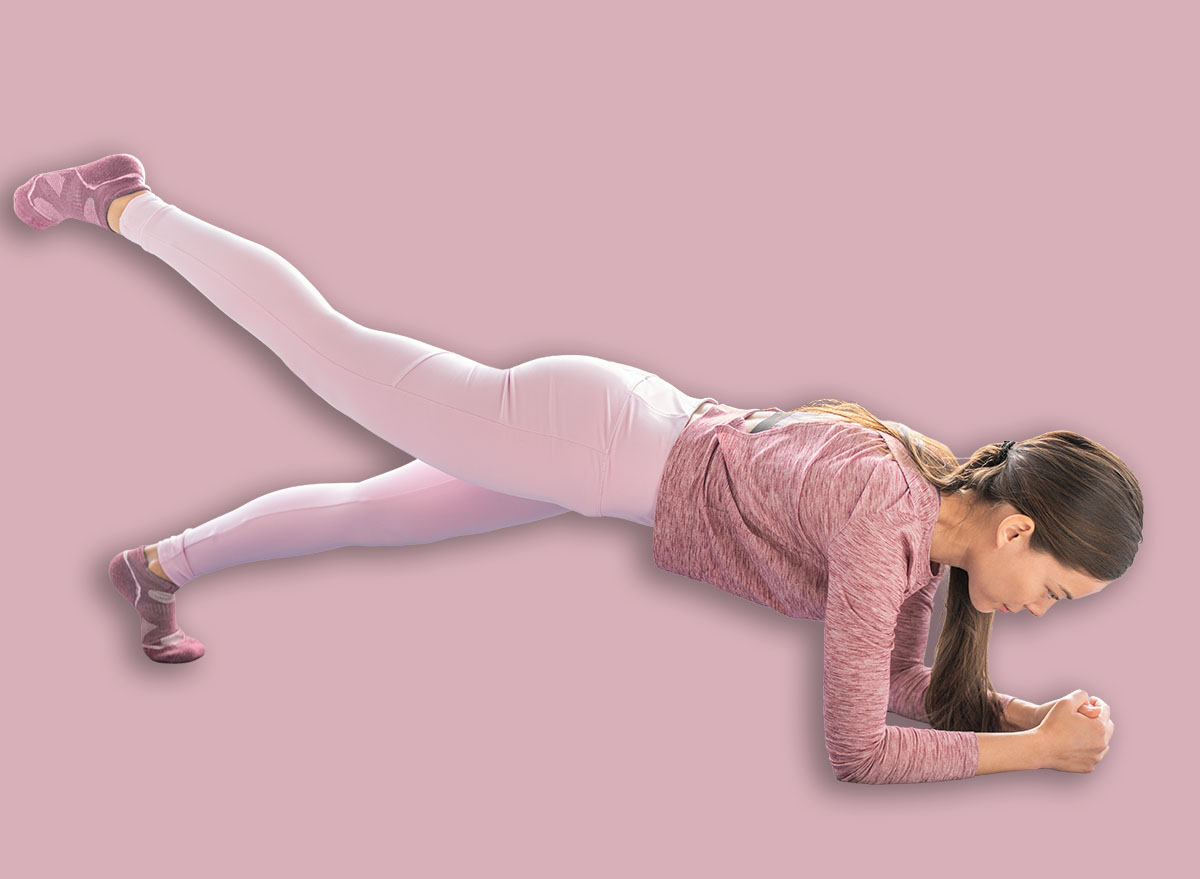
Plank With Leg Lift
Planks with leg lifts train your abs, glutes, shoulders, and lower back while your core fights to keep your hips still. Lifting one leg removes a point of support, so your midsection has to brace harder to keep your body aligned. That makes the exercise useful for restoring core strength because your glutes and abs have to work together instead of letting your lower back take over. The carryover helps with walking, climbing stairs, and staying stable when one leg is doing more work.
Muscles Trained: Core, glutes, shoulders, lower back
How to Do It:
- Start in a forearm plank with your elbows under your shoulders.
- Brace your core and squeeze your glutes.
- Keep your body in a straight line from head to heels.
- Lift one leg a few inches off the floor.
- Lower your foot with control.
- Alternate legs while keeping your hips steady.
Recommended Sets and Reps: Perform 3 sets of 8 to 10 lifts per leg. Rest for 45 seconds between each set.
Best Variations: Knee plank with leg lift, high plank leg lift, plank hold
Form Tip: Lift your leg only as high as you can without arching your back.
Alternating Dead Bug
Alternating dead bug trains your lower abs and deep core while your arms and legs move in opposite directions. Your midsection has to keep your ribs and pelvis steady so your lower back stays supported. That kind of control matters after 50 because your core needs to stabilize your spine while the rest of your body moves. Slow dead bugs can do more for real core strength than rushed gym crunches because every rep teaches your abs to control position.
Muscles Trained: Lower abs, deep core, hip flexors, shoulders
How to Do It:
- Lie on your back with your arms reaching toward the ceiling.
- Lift your knees over your hips and bend them to 90 degrees.
- Press your lower back gently into the floor.
- Extend your right arm and left leg away from your body.
- Return to the starting position with control.
- Repeat on the opposite side.
Recommended Sets and Reps: Perform 3 sets of 8 to 10 reps per side. Rest for 30 seconds between each set.
Best Variations: Heel-tap dead bugs, paused dead bugs, same-side dead bugs
Form Tip: Move only as far as you can while keeping your lower back set.
Banded Pallof Hold
Banded Pallof holds train your core to resist rotation while your arms hold tension away from your chest. The band tries to pull your torso sideways, and your midsection has to keep your body square. That makes the Pallof hold one of the most practical core exercises after 50 because it trains bracing strength in a standing position. Better anti-rotation strength helps you carry groceries, lift uneven loads, turn with control, and stay steady when your body gets pulled off-center.
Muscles Trained: Core, obliques, shoulders, glutes
How to Do It:
- Anchor a resistance band at chest height.
- Stand sideways to the anchor with your feet shoulder-width apart.
- Hold the band at your chest with both hands.
- Brace your core and press your hands straight forward.
- Hold the position without letting your torso rotate.
- Bring your hands back to your chest and switch sides.
Recommended Sets and Reps: Perform 3 sets of 15 to 25 second holds per side. Rest for 30 to 45 seconds between each set.
Best Variations: Pallof press reps, split-stance Pallof hold, overhead Pallof hold
Form Tip: Keep your ribs down and resist the band pulling you sideways.
How to Make Morning Core Work Count
Morning core training works best when the reps look calm and controlled. A shaky, rushed set usually means your body is surviving the exercise instead of learning from it. The goal is to brace before you move, breathe without losing tension, and keep your hips and ribs in a strong position. Five to 10 focused minutes can do more than a longer routine filled with sloppy reps.
- Move slowly enough to stay connected: Bird-dogs and dead bugs work best when every reach has control. If your hips shift or your back arches, shorten the range.
- Train your core from multiple angles: Side planks, Pallof holds, and planks challenge different parts of your midsection. That variety helps your core support twisting, bracing, and one-sided movement.
- Keep your glutes involved: Planks with leg lifts and bird-dogs work better when your glutes help stabilize your hips. Squeeze lightly and keep your pelvis steady.
- Use holds to build strength: Pallof holds and side plank positions teach your core to stay engaged under tension. Holds also make lighter exercises feel more demanding.
- Repeat the routine consistently: A few mornings per week gives your core regular practice without draining your energy. Consistency matters more than turning every session into a grind.
Start the day with controlled core work, and you’ll notice the payoff beyond your workout mat. A stronger midsection makes walking, reaching, lifting, and balancing feel more supported, which is the real win after 50.
References
- Rodríguez-Perea, Ángela et al. “Core training and performance: a systematic review with meta-analysis.” Biology of sport vol. 40,4 (2023): 975-992. doi:10.5114/biolsport.2023.123319
- Huxel Bliven, Kellie C, and Barton E Anderson. “Core stability training for injury prevention.” Sports health vol. 5,6 (2013): 514-22. doi:10.1177/1941738113481200