6 Standing Arm Exercises That Tighten Sagging Arms in 30 Days After 60
Sagging arms usually start with the muscles that aren’t getting enough direct work. The triceps along the back of the upper arm tend to draw the most attention, but the biceps, shoulders, and upper back all influence how firm your arms look and feel. When those areas lose strength, the upper arm can start to look softer, and daily tasks like lifting, reaching, pushing, and carrying can feel less sharp than they used to.
A targeted arm routine after 60 should train more than curls. You want biceps work for the front of the arm, triceps work for the back of the arm, shoulder raises and presses for shape, and upper-back work to support your posture from the top down. That combination gives your arms a stronger frame, rather than chasing one muscle with endless reps.
I’ve coached plenty of people who made better progress once they gave their arms a simple plan and repeated it consistently. Thirty days is enough time to build momentum, improve muscle engagement, and start to notice more control in the upper body. The six standing exercises below use bands and dumbbells to train the arms from multiple angles while keeping the setup simple enough to stick with.
Standing Band Curls
Standing band curls train your biceps while your shoulders and core help keep your body steady. The band adds more resistance as you curl, so your arms have to keep working through the top of the rep instead of relaxing. Stronger biceps help add shape to the front of the upper arm and support pulling tasks like carrying bags or lifting objects. Keep your elbows still and make the muscle do the work instead of swinging your arms.
Muscles Trained: Biceps, forearms, core
How to Do It:
- Stand on the middle of a resistance band with your feet hip-width apart.
- Hold the band handles or ends with your palms facing forward.
- Brace your core and keep your elbows close to your sides.
- Curl your hands toward your shoulders.
- Squeeze your biceps at the top.
- Lower your hands with control.
Recommended Sets and Reps: Perform 3 sets of 12 to 15 reps. Rest for 45 seconds between each set.
Best Variations: Alternating band curls, hammer-grip band curls, slow-tempo curls
Form Tip: Keep your upper arms still and avoid leaning back while curling.
Standing Dumbbell Front Raise
Standing dumbbell front raises train the front of your shoulders, helping build a stronger frame for your upper arms. Every rep asks your core to stay braced so your torso doesn’t rock as the weights lift. Stronger front delts help with reaching, lifting items in front of you, and keeping your shoulders more capable during daily tasks. Use light dumbbells and keep the control clean, because momentum can turn this move into a swing rather than a shoulder exercise.
Muscles Trained: Front delts, upper chest, core
How to Do It:
- Stand tall with a dumbbell in each hand.
- Hold the dumbbells in front of your thighs.
- Brace your core and keep your shoulders down.
- Raise the dumbbells in front of you to shoulder height.
- Pause briefly at the top.
- Lower the dumbbells with control.
Recommended Sets and Reps: Perform 3 sets of 10 to 12 reps. Rest for 45 seconds between each set.
Best Variations: Alternating front raises, single-dumbbell front raises, slower front raises
Form Tip: Stop at shoulder height and keep your ribs down.
Band Pull-Aparts
Band pull-aparts target the rear shoulders and upper back, helping your arms look stronger by improving posture and shoulder position. Pulling the band apart forces the muscles behind your shoulders to work, an area many people neglect when they only train curls and presses. Stronger rear delts and upper back muscles help your shoulders sit better, which can make the arms look firmer and more supported. Move slowly and squeeze between your shoulder blades at the end of each rep.
Muscles Trained: Rear delts, upper back, rhomboids, core
How to Do It:
- Stand tall and hold a resistance band at chest height.
- Place your hands slightly wider than shoulder-width apart.
- Brace your core and keep a soft bend in your elbows.
- Pull the band apart until your hands move toward your sides.
- Squeeze your shoulder blades together.
- Return to the starting position with control.
Recommended Sets and Reps: Perform 3 sets of 12 to 15 reps. Rest for 45 seconds between each set.
Best Variations: Underhand pull-aparts, diagonal pull-aparts, paused pull-aparts
Form Tip: Keep your shoulders down and avoid shrugging.
Standing Single-Arm Shoulder Press
Standing single-arm shoulder presses train your shoulders and triceps, while your core helps keep your body from leaning. Pressing one dumbbell at a time creates an uneven load, so your midsection has to stay engaged as your arm drives overhead. The shoulder and triceps work together here, which helps build the top and back of the arm in one movement. This exercise also carries over to reaching overhead, putting items on shelves, and keeping your upper body strong after 60.
Muscles Trained: Shoulders, triceps, upper back, core
How to Do It:
- Stand tall with your feet hip-width apart.
- Hold one dumbbell at shoulder height.
- Brace your core and squeeze your glutes.
- Press the dumbbell overhead until your arm is straight.
- Lower the dumbbell back to shoulder height with control.
- Complete all reps, then switch sides.
Recommended Sets and Reps: Perform 3 sets of 8 to 10 reps per side. Rest for 60 seconds between each set.
Best Variations: Neutral-grip press, alternating shoulder press, half-kneeling single-arm press
Form Tip: Keep your ribs down and avoid leaning away from the dumbbell.
Standing Two-Dumbbell Triceps Extensions
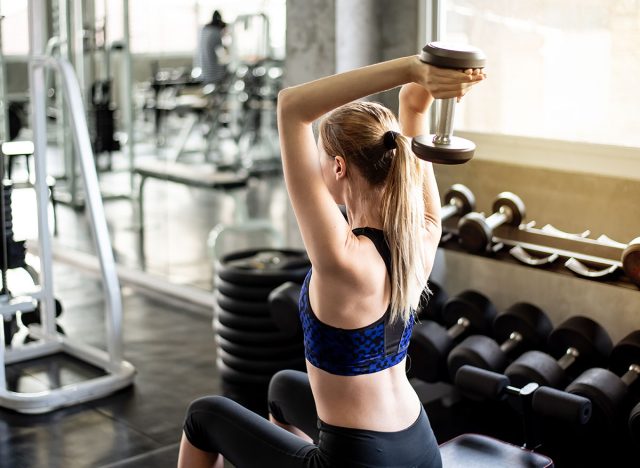
Standing two-dumbbell triceps extensions train the back of your upper arms, which is usually the main area people want to tighten. Holding one dumbbell in each hand gives each arm its own work, so your stronger side can’t take over as easily. The triceps have to control the lowering phase and extend the elbows at the top, which helps build firmness where arm sagging is most noticeable. Keep the motion smooth and have the elbows do the bending, rather than letting your shoulders drift around.
Muscles Trained: Triceps, shoulders, core
How to Do It:
- Stand tall with a dumbbell in each hand.
- Raise the dumbbells overhead with your arms straight.
- Brace your core and keep your elbows pointing forward.
- Bend your elbows to lower the dumbbells behind your head.
- Extend your arms to lift the dumbbells back overhead.
- Repeat with steady control.
Recommended Sets and Reps: Perform 3 sets of 10 to 12 reps. Rest for 45 to 60 seconds between each set.
Best Variations: Single-dumbbell overhead extension, alternating extensions, slower tempo extensions
Form Tip: Keep your elbows close and avoid flaring them out.
Standing Dumbbell Lateral Raise
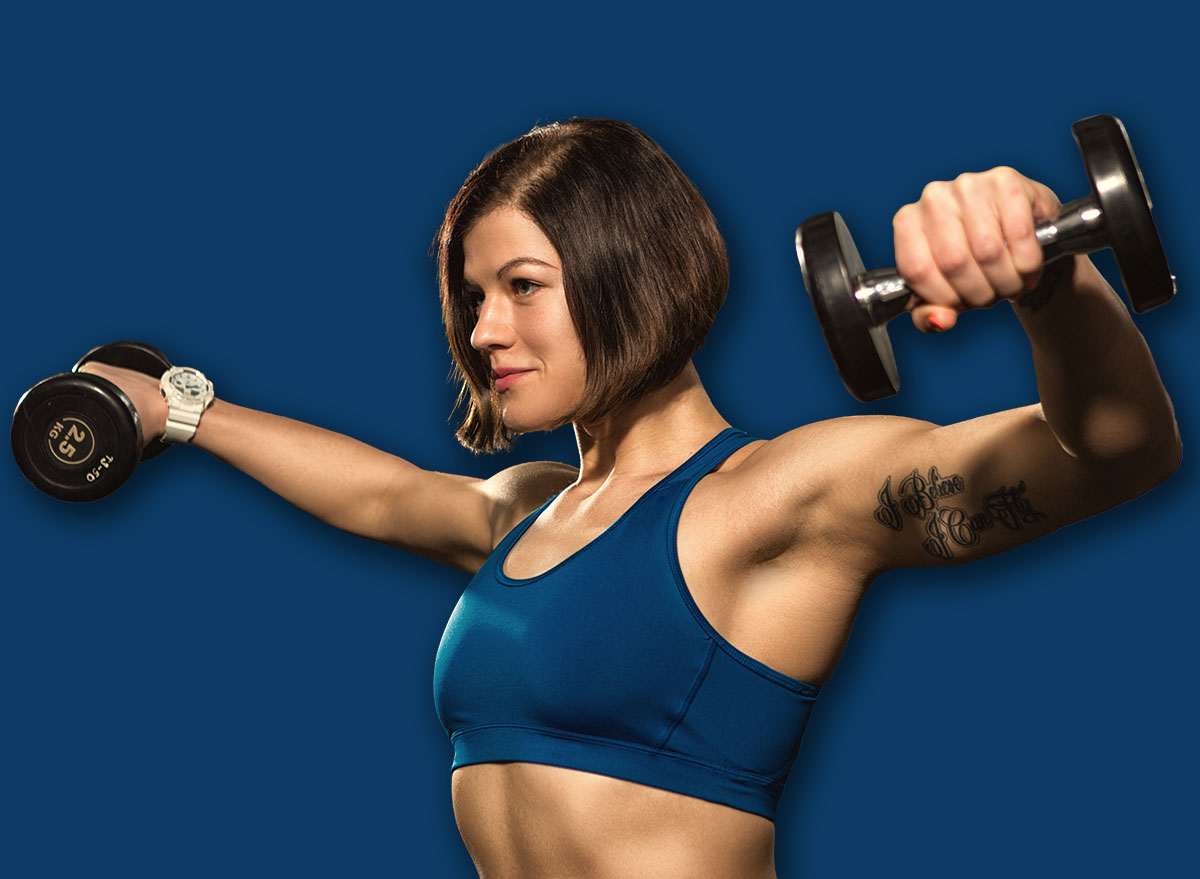
Standing dumbbell lateral raises train the side delts, which help give the shoulders more shape and make the upper arms look more defined. The movement doesn’t need heavy weight to work well. Lighter dumbbells, slower reps, and clean control usually create a better burn without letting the traps take over. Stronger side delts support better arm position, shoulder stability, and the rounded look that helps tighten the upper arms.
Muscles Trained: Side delts, upper traps, core
How to Do It:
- Stand tall with a dumbbell in each hand.
- Keep your arms at your sides with a slight bend in your elbows.
- Brace your core and relax your shoulders.
- Raise the dumbbells out to your sides.
- Stop when your arms reach shoulder height.
- Lower the dumbbells with control.
Recommended Sets and Reps: Perform 3 sets of 12 to 15 reps. Rest for 45 seconds between each set.
Best Variations: Single-arm lateral raises, seated lateral raises, paused lateral raises
Form Tip: Lead with your elbows and avoid shrugging your shoulders.
How to Tighten Your Arms in 30 Days After 60
Thirty days gives you enough time to build momentum, improve strength, and start feeling more firmness in your arms. The key is training the right areas often enough: biceps for shape, triceps for the back of the arms, shoulders for the frame, and upper back for posture. Keep the weights manageable, slow your reps, and make the final few reps feel challenging without compromising your form.
- Train your triceps directly: The triceps make up a large portion of the upper arm, so overhead extensions deserve real focus. Move slowly on the way down and fully extend your arms at the top.
- Use controlled reps instead of momentum: Swinging through curls, raises, or presses takes work away from the muscles you’re trying to train. Slow reps keep tension on the arms and shoulders longer.
- Hit the shoulders from more than one angle: Front raises, lateral raises, and presses train different parts of the shoulder. Stronger shoulders help the upper arms look firmer and more defined.
- Support your arm work with upper-back training: Band pull-aparts help posture and shoulder position. Better alignment can make the arms look stronger while also helping your shoulders feel better.
- Repeat the routine consistently: Aim for 2 to 4 sessions per week over the next month. Add reps, use a slightly stronger band, or pick up slightly heavier dumbbells when the sets start to feel too easy.
A month of focused work can change how your arms feel, how your sleeves fit, and how much strength you notice during daily tasks. Keep each rep clean and give the biceps, triceps, shoulders, and upper back a steady reason to respond.
References
- Tanton, Leah & Cappaert, Thomas & Gordon, Paul & Zoeller, Robert & Angelopoulos, Theodore & Price, Thomas & Thompson, Paul & Moyna, Niall & Seip, Richard & Pescatello, Linda & Devaney, Joseph & Gordish-Dressman, Heather & Hoffman, Eric & Visich, Paul. (2009). Strength, Size, and Muscle Quality in the Upper Arm Following Unilateral Training in Younger and Older Males and Females. Clinical Medicine : Arthritis and Musculoskeletal Disorders. 2009. 10.4137/CMAMD.S1180.
- Schoenfeld, Brad J et al. “Loading Recommendations for Muscle Strength, Hypertrophy, and Local Endurance: A Re-Examination of the Repetition Continuum.” Sports (Basel, Switzerland) vol. 9,2 32. 22 Feb. 2021, doi:10.3390/sports9020032