If You Can Complete This 5-Minute Chair Test at 55, You’re in Peak Shape
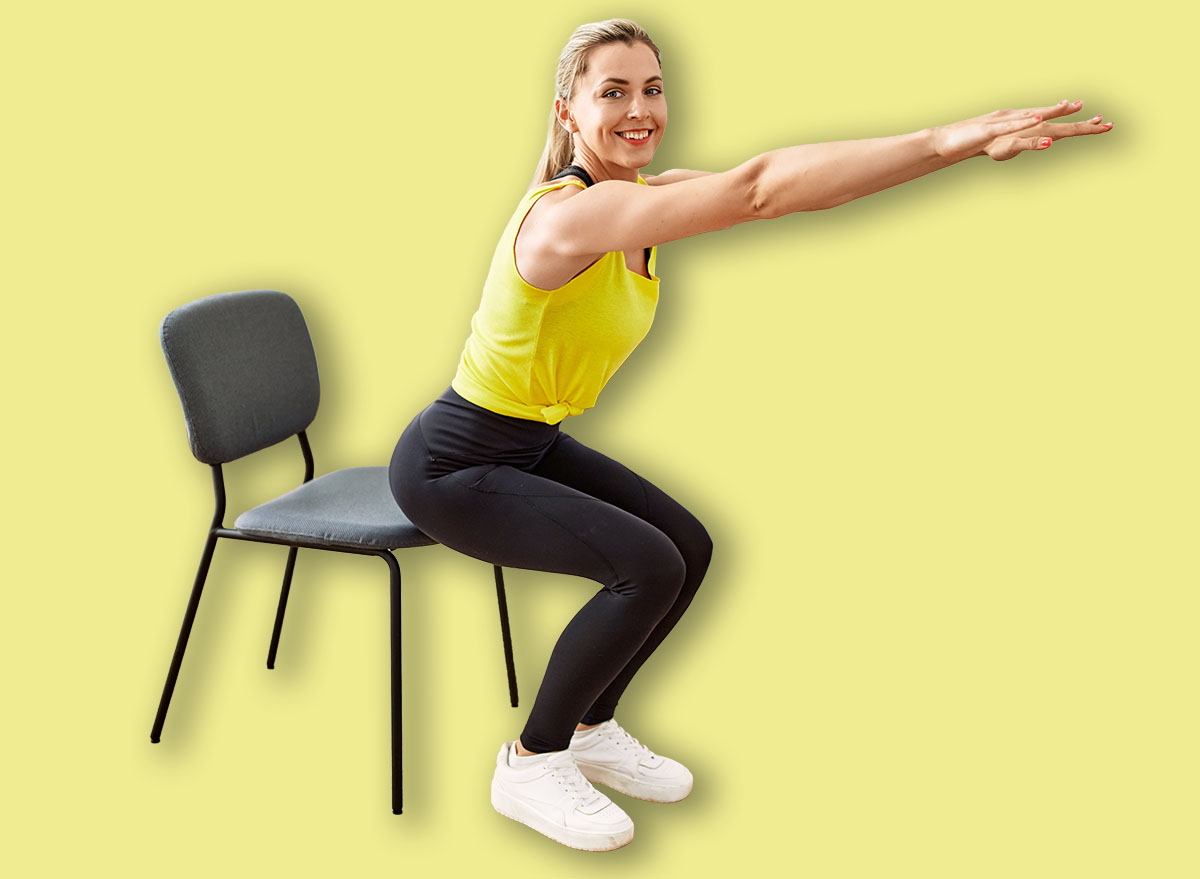

After 55, you don’t need a treadmill stress test or a max bench press to know if you’re in peak shape. Sometimes, one of the most revealing fitness tests is also one of the simplest: standing up and sitting down from a chair.
The five-minute chair test, which involves repeated “sit-to-stands” performed continuously without using your hands, offers a surprisingly comprehensive snapshot of your functional fitness level. It challenges muscular endurance in your quads and glutes, requires core stability to maintain posture, and elevates your heart rate. Essentially, this test looks at your strength, coordination, and aerobic capacity simultaneously.
Research supports the crucial importance of being able to stand from a sitting position unassisted. Variations of the sit-to-stand test are widely used in clinical and research settings to assess lower-body strength and functional independence. Studies show that sit-to-stand performance correlates strongly with mobility, fall risk, and even mortality risk in older adults. Repeated “sit-to-stands” are also strong indicators of cardiovascular fitness when performed consistently over time.
According to James Brady, personal trainer at OriGym, the ability to complete five continuous minutes of controlled sit-to-stands without using your hands at 55 signals excellent functional fitness. “It demonstrates that the legs, core, heart, and lungs are all working efficiently together,” says Brady. “More importantly, it mirrors real-world demands, such as getting out of a car, climbing stairs, standing from low seats, and preventing falls.”
Here, we break down the five-minute chair test into its essential components and how to perform it correctly. If you can maintain a steady tempo, keep your posture in check, and breathe with control for the full five minutes, you’re not just fit—you’re operating well above average for your age.
Read on to learn more.
(Next up: Check out these 5 Exercises That Restore Walking Endurance After 65, According to a Trainer.)
The Five-Minute Sit-to-Stand Chair Test
The foundation of the five-minute chair test is simple: stand up and sit down repeatedly for five continuous minutes without using your hands. This movement targets your quads, glutes, and hips, all of which are essential muscles for maintaining independence as you age.
How to do it:
- Place a sturdy chair against a wall to prevent sliding.
- Sit tall with your feet flat on the floor and hip-width apart.
- Cross your arms over your chest.
- Lean slightly forward from your hips.
- Press through your heels to stand all the way up.
- Extend your hips fully at the top.
- Lower yourself back down slowly with control.
- Repeat continuously for five minutes at a steady pace.
Controlled Descent Focus
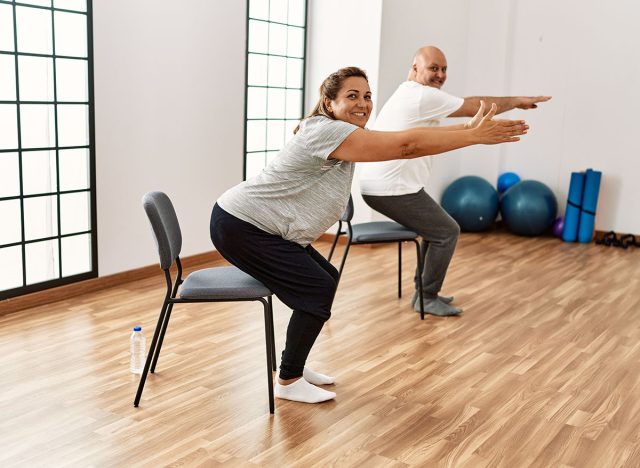
Like any other exercise, maintaining proper form during the test matters just as much as completing the test. Controlling your descent can help prevent knee strain and ensure the right muscles are doing the work.
How to do it:
- Stand fully upright at the top of each rep.
- Brace your core before sitting down.
- Push your hips back as you begin to descend.
- Bend your knees in a controlled manner.
- Keep your chest tall and your back straight with a neutral spine.
- Lower until your backside lightly touches the chair.
- Avoid dropping heavily onto the seat.
- Immediately transition into the next rep.
Core and Posture Check

Keeping your chest upright and your ribs stacked over your hips helps ensure your core is engaged during the movement. Strong trunk stability reduces stress on your lower back and supports efficient force transfer through your legs. Research shows that trunk stability improves balance and reduces fall risk, both of which are critical factors for longevity after 50.
How to do it:
- Sit upright with your shoulders relaxed.
- Stack your ribs directly over your pelvis.
- Engage your core muscles.
- Avoid rounding your upper back.
- Keep your gaze forward.
- Stand without leaning forward too much.
- Maintain good posture throughout each rep.
- Reset alignment if you begin to slouch.
Breathing and Cardiovascular Control
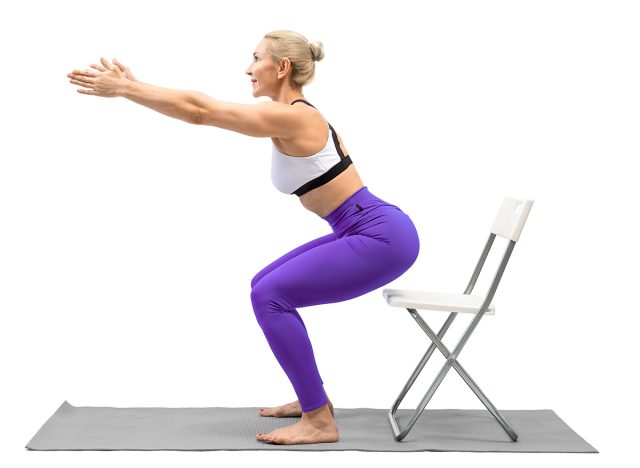
It goes without saying that this test will elevate your heart rate. If you can work hard the entire time without completely losing your breath, you have a solid aerobic capacity. Studies show that cardiovascular endurance is linked to reduced disease risk and enhanced longevity.
How to do it:
- Take a deep breath in through your nose as you sit down.
- Exhale slowly through your mouthas you stand up.
- Avoid holding your breath and maintain rhythmic breathing.
- Monitor how quickly your breathing increases.
- Keep a pace you can sustain for five minutes (slow down if you become dizzy).
- Resume a steady tempo once your breathing stabilizes.
Consistent Tempo Maintenance
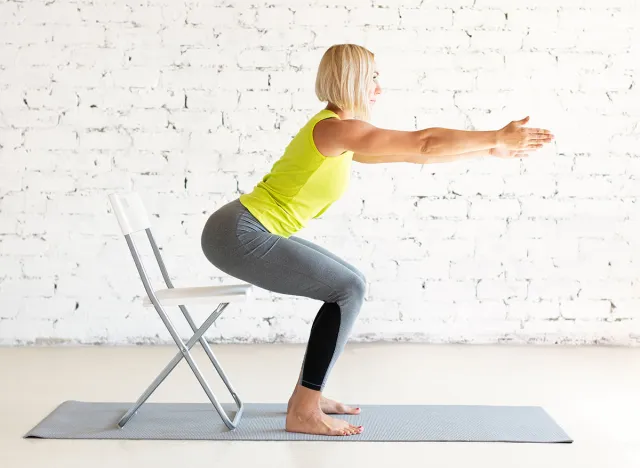
When you start the test, be careful not to go too hard too fast. Rushing through reps early can cause you to slow down and burn out before the five minutes are up. Instead, using a controlled, sustainable tempo is the best approach for completing the test.
How to do it:
- Choose a moderate starting pace.
- Stand fully upright on every rep.
- Sit lightly without bouncing.
- Keep reps smooth and even (avoid speeding up).
- Maintain proper form without support for the entire five minutes.
- Source: https://academic.oup.com/ageing/article-abstract/36/5/555/40653?redirectedFrom=fulltext&login=false
- Source: https://pmc.ncbi.nlm.nih.gov/articles/PMC9340829/
- Source: https://pubmed.ncbi.nlm.nih.gov/40188700/
- Source: https://www.sciencedirect.com/science/article/pii/S2095254625000614
- Source: https://academic.oup.com/eurjpc/advance-article/doi/10.1093/eurjpc/zwaf325/8163161?login=false
- Source: https://pmc.ncbi.nlm.nih.gov/articles/PMC11368597/