If You Can Complete These 3 Standing Moves at 55, You’re Stronger Than Most 40-Year-Olds


Strength after 55 doesn’t disappear, it becomes harder to measure. Gym numbers lose relevance when joints, balance, and coordination start to matter more than raw load. True strength shows up through controlled movement, posture, and the ability to generate tension without assistance.
Standing benchmarks reveal real-world strength better than machines or floor tests. When the body supports itself against gravity, weak links show immediately. The core must stabilize, the hips must produce force, and the upper body must coordinate without momentum or external support.
These three standing moves challenge total-body strength through balance, control, and sustained tension. Completing them with clean form at 55 places your strength well above average compared to most people in their 40s.
Standing Push Hold
This movement tests pressing strength without relying on speed or momentum. Holding the arms extended forces the shoulders, chest, and arms to maintain continuous tension while the core stabilizes the torso. Standing posture increases demand by removing back support, revealing true upper body strength.
The inability to maintain the hold often reflects weaknesses masked by traditional lifting. Strong performers show calm breathing, steady arms, and an upright torso throughout.
How to Do It
- Stand tall holding light weights or bands
- Press arms forward or overhead
- Hold position without locking elbows
- Stop when form breaks
Hip Hinge Strength Hold
This move tests lower-body and posterior-chain strength through sustained tension. Holding the hinge position forces the glutes and hamstrings to support the body without momentum. The core must brace to protect the spine, making this a true total-body strength challenge.
Strong performers maintain a flat back, stable hips, and controlled breathing throughout the hold. Shaking or rising early signals strength gaps that machines often hide.
How to Do It
- Stand with feet hip-width
- Push hips back into hinge
- Hold position with chest tall
- Return upright with control
Standing Carry Hold
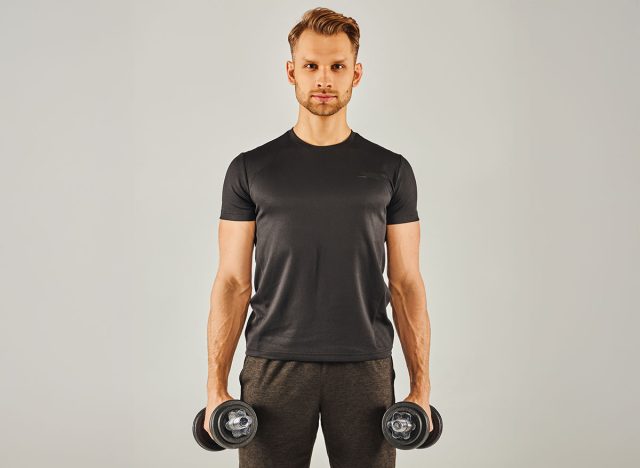
Carries reveal strength more honestly than almost any lift. Holding weight while standing tall forces the arms, shoulders, grip, and core to work together continuously. No joint escapes responsibility, making this a powerful benchmark of functional strength.
Completing this hold with steady posture and calm breathing reflects strength well beyond average for age. Loss of posture or grip strength exposes limitations quickly.
How to Do It
- Hold weights at sides or chest
- Stand tall with ribs stacked
- Maintain posture without leaning
- End when grip fades