If You Can Hold These 3 Standing Exercises After 50, Your Balance Is Exceptional
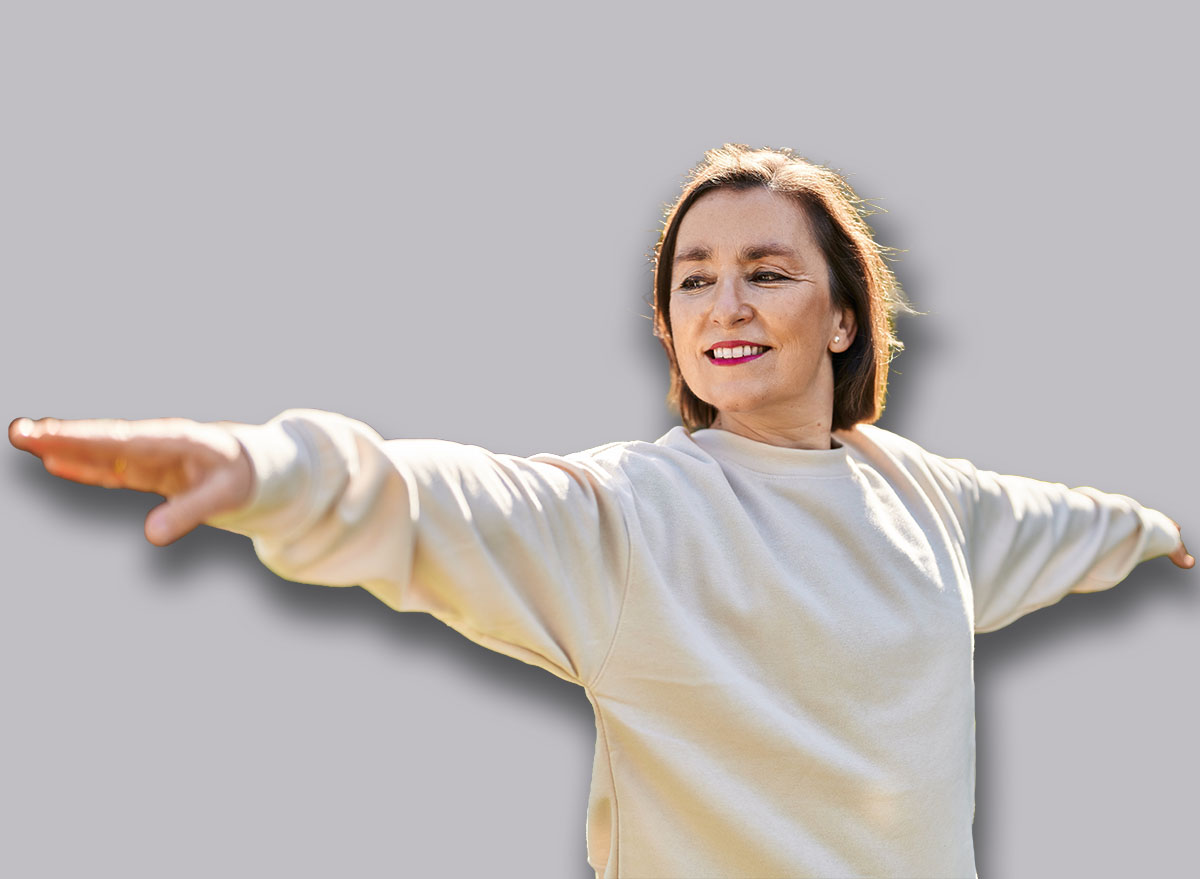

Balance training is an underrated form of exercise that becomes more essential than ever as you age. After all, having solid balance is key for longevity, injury and fall prevention, and completing daily tasks with ease. It encourages better posture, functional mobility, and coordination. That’s why we’re here to update your workout routine. If you can hold these three standing exercises after 50, your balance is exceptional. If not, there’s room for improvement.
How Balance Changes After 50
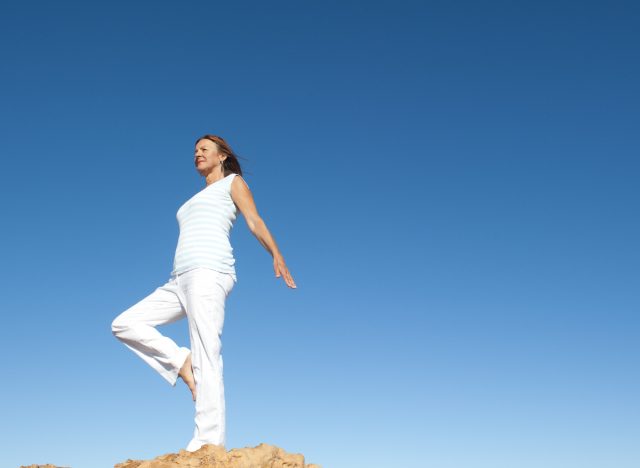
As you age, your body naturally changes. For instance, balance becomes more complex.
“After you hit 50, it’s not just about muscles; it’s a total body conversation between your brain, nervous system, sensory feedback, joints, and muscular control,” explains Felicia Hernandez, NASM-certified personal trainer and community engagement lead at Eden Health Club.
Major culprits behind a decline in balance include stiff joints, changes in vision, the loss of lower-body muscle mass (particularly in the hips, glutes, and ankles), weakened proprioception, and slower nerve conduction, which leads to slower reaction time.
“All of this adds up to one thing: Your body stops trusting itself in space,” Hernandez tells us. “The good news is that this is completely trainable. I have seen balance work help. With focused balance work, you’re not just preventing falls; you’re retraining the brain and your body to function sharply together.”
These 3 Standing Exercises Signal Strong Balance
According to Hernandez, these standing holds support real-world balance demands while firing up the stabilizing muscles from the ground up.
Single-Leg Stand, Barefoot (Eyes Open or Closed)
“This reveals your true balance baseline. Eye closure forces your proprioceptive system to activate fully. If you can hold this for 20+ seconds without wobbling, your stabilizers are on point,” Fernandez points out.
- Stand tall on a flat surface with your feet hip-width apart and arms at your sides.
- Shift your body weight onto your left foot.
- Lift your right foot off the floor.
- Activate your core while keeping your shoulders stacked over your ribs and your hips level.
- The time begins once your leg comes off the floor and stops when your foot touches the ground.
- Progress the exercise by closing your eyes.
- Perform 3 sets of 20 to 30 seconds on each leg.
Staggered Stance Overhead Reach Hold (Unilateral Load)
“Holding a load overhead pulls on your entire midline, lighting up your core, glutes, and foot stabilizers. The split stance challenges gait and dynamic balance—key components of fall prevention,” Fernandez tells us.
- Assume a split stance with one foot forward.
- Hold a small dumbbell in one hand, extending that arm overhead.
- Keep your ribs and hips stacked.
- Perform 3 rounds, holding the position for 20 seconds on each side.
Heel-to-Toe Line Hold (Tandem Stance)
“This narrow base of support challenges lateral stability and ankle strength—two of the first things to go with age,” Fernandez points out.
- Position one foot directly in front of the other with your front heel against your back toes, like you’re about to walk on a tightrope.
- Pull the crown of your head upward, and activate your glutes to stand tall.
- Perform 3 rounds of 30 seconds on each side.
Why These Exercises Matter
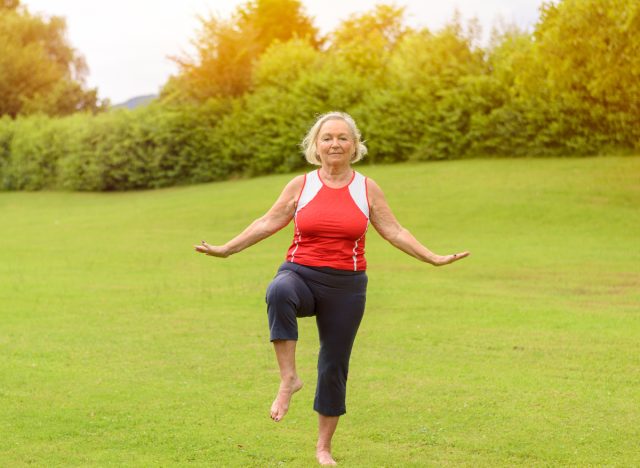
“Because you are dealing with the shifts, inside your body, the muscles, the joints, the eyes, and the inner ear have to synchronize. Think about this: most adults over 50 struggle with flat-ground balance. If you can maintain stillness and integrity during advanced standing holds, that tells us you’ve maintained (and trained) multi-system coordination,” Fernandez points out.
Even a brief standing test can tell a lot about proprioceptive gaps, muscular imbalances, or reduced sensory feedback. Holding these positions with solid form shows that your body is resilient and sharp.
“The important thing is that the signal shows independence. And independence is what we’re really aiming for,” Fernandez adds.