5 Bed Exercises That Restore Back Strength Faster Than Physical Therapy After 60

If getting out of bed takes longer than it used to, or standing up straight feels like something you have to think about, that’s not just aging. It’s your back muscles losing the strength they need to do their job, and it happens gradually enough that most people don’t notice until it’s already affecting their daily life.
I’m a personal trainer and fitness educator at TRAINFITNESS, and I’ve been working in the fitness industry for 40 years. Back weakness is one of the most common issues I see in people over 60, and it affects nearly every aspect of daily life. The good news is that rebuilding back strength doesn’t require a gym membership or complicated equipment. Some of the most effective exercises can be done right in your bed before you even start your day.
Why Back Strength Fades After 60

The most common issue is weakness in the erector spinae, the muscles that run along your spine, and the latissimus dorsi, the large muscles on the sides of your back. When these muscles weaken, everything becomes harder. Getting out of bed takes longer. Standing up straight feels like work. Lifting shopping bags or reaching for something on a high shelf becomes a challenge.
This weakness doesn’t happen overnight. It builds gradually over years of reduced activity. We start sitting more, moving less, and our backs simply stop getting the stimulus they need to stay strong. The muscles atrophy, and the supporting structures around the spine become less stable.
Recovery is slow for older adults because muscle protein synthesis, the process by which your body builds new muscle, slows down with age. Younger people can bounce back from inactivity quickly. For someone over 60, it takes longer and requires more consistency. The body still responds to exercise, but it needs regular stimulus and adequate recovery time between sessions.
Pain also plays a role. Many older adults have experienced back pain at some point and have developed a fear of movement. They start avoiding activities that might aggravate their back, which creates a vicious cycle. Less movement leads to weaker muscles, which leads to more vulnerability and more pain.
Why Bed Exercises Work So Well

Bed-based exercises work because they remove most of the barriers that stop older adults from exercising consistently. There’s no need to get dressed, drive to a gym, or worry about people watching. You can do them immediately when you wake up, which means you’re more likely to actually do them.
The surface of a bed provides just enough instability to engage your core and stabiliser muscles without being dangerous. You’re not on a hard floor where discomfort might stop you mid-exercise, but you’re also not on something so soft that the exercises become ineffective. This balance makes bed exercises accessible for people who find floor work too challenging.
Bed exercises are also low-impact. Traditional back exercises often involve standing or complex movements that require good balance and coordination. If you’re already dealing with back weakness, these movements can feel risky. Bed exercises start from a supported position, which builds confidence while still providing effective stimulus for the muscles.
The other advantage is progression. You can start with very basic movements and gradually increase difficulty without needing new equipment or changing location. When exercise feels simple and convenient, it’s much more likely to become part of your daily routine.
Prone Shoulder Blade Squeeze
This targets the rhomboids and mid-trapezius muscles between your shoulder blades. These muscles pull your shoulders back and help maintain upright posture. When they’re weak, your shoulders round forward and your upper back curves.
Muscles Trained: Rhomboids, mid-trapezius
How to Do It:
- Lie face down on your bed with your arms by your sides
- Squeeze your shoulder blades together as if you’re trying to hold a pencil between them
- Hold the squeeze for 3 to 5 seconds, then release
- Keep your arms relaxed throughout; the movement happens in your upper back, not your neck or shoulders
Recommended Sets and Reps: 2 sets of 10 repetitions, resting 30 seconds between sets
Common Mistakes to Avoid:
- Lifting your head or tensing your neck; your face should stay down throughout
- Letting the work drift into your neck or shoulders rather than your shoulder blades; if you feel tension in your neck, you’re doing it wrong.\
Supine Arm Raises
This works the latissimus dorsi and strengthens the muscles responsible for pulling movements. It also improves shoulder mobility, which often becomes restricted when back muscles are weak.
Muscles Trained: Latissimus dorsi, shoulder stabilisers
How to Do It:
- Lie on your back with your knees bent and feet flat on the bed
- Start with your arms by your sides
- Slowly raise both arms overhead, keeping them as straight as comfortable, until they’re resting on the bed above your head
- Pause for a second, then bring them back down to your sides
- Keep the movement controlled and smooth throughout
Recommended Sets and Reps: 2 sets of 12 repetitions, resting 30 seconds between sets
Common Mistakes to Avoid:
- Arching your lower back as your arms go overhead; your lower back should stay in contact with the bed throughout
- If your lower back lifts, your core isn’t properly engaged and you’re compensating with your back instead of using your shoulder and upper back muscles.
Prone Back Extension (Superman Hold)
This directly targets the erector spinae muscles that run along your spine. These muscles are responsible for keeping you upright and preventing your spine from rounding forward. Weakness here is one of the main reasons people struggle to stand up straight.
Muscles Trained: Erector spinae, lower back
How to Do It:
- Lie face down with your arms extended above your head
- Lift your chest and arms slightly off the bed while keeping your legs down
- You’re not trying to lift high, just enough to feel your lower back muscles working
- Hold for 5 to 10 seconds, then lower back down
Recommended Sets and Reps: Start with 2 sets of 6 repetitions, holding each for 5 seconds; as you get stronger, increase the hold time to 10 seconds
Common Mistakes to Avoid:
- Lifting too high and hyperextending the lower back; this exercise isn’t about how far you can lift
- A small lift where you feel your back muscles working is far more effective than straining to go higher.
Bridge Hold
While primarily known as a glute exercise, the bridge also works the erector spinae and helps coordinate the muscles along the back of your body. When your glutes and back work together properly, it takes pressure off your lower back during everyday movements.
Muscles Trained: Erector spinae, glutes, core
How to Do It:
- Lie on your back with your knees bent and feet flat on the bed, hip-width apart
- Push through your heels and lift your hips until your body forms a straight line from your shoulders to your knees
- Squeeze your glutes and keep your core tight
- Hold for 10 to 15 seconds, then lower back down
Recommended Sets and Reps: 2 sets of 8 repetitions, holding each for 10 to 15 seconds, resting 30 seconds between sets
Common Mistakes to Avoid:
- Pushing your hips too high and overarching your lower back; you want a straight line from shoulders to knees, not a curve
- If your lower back feels pinched or uncomfortable, you’ve gone too high; lower slightly until you feel your glutes and back working without strain.
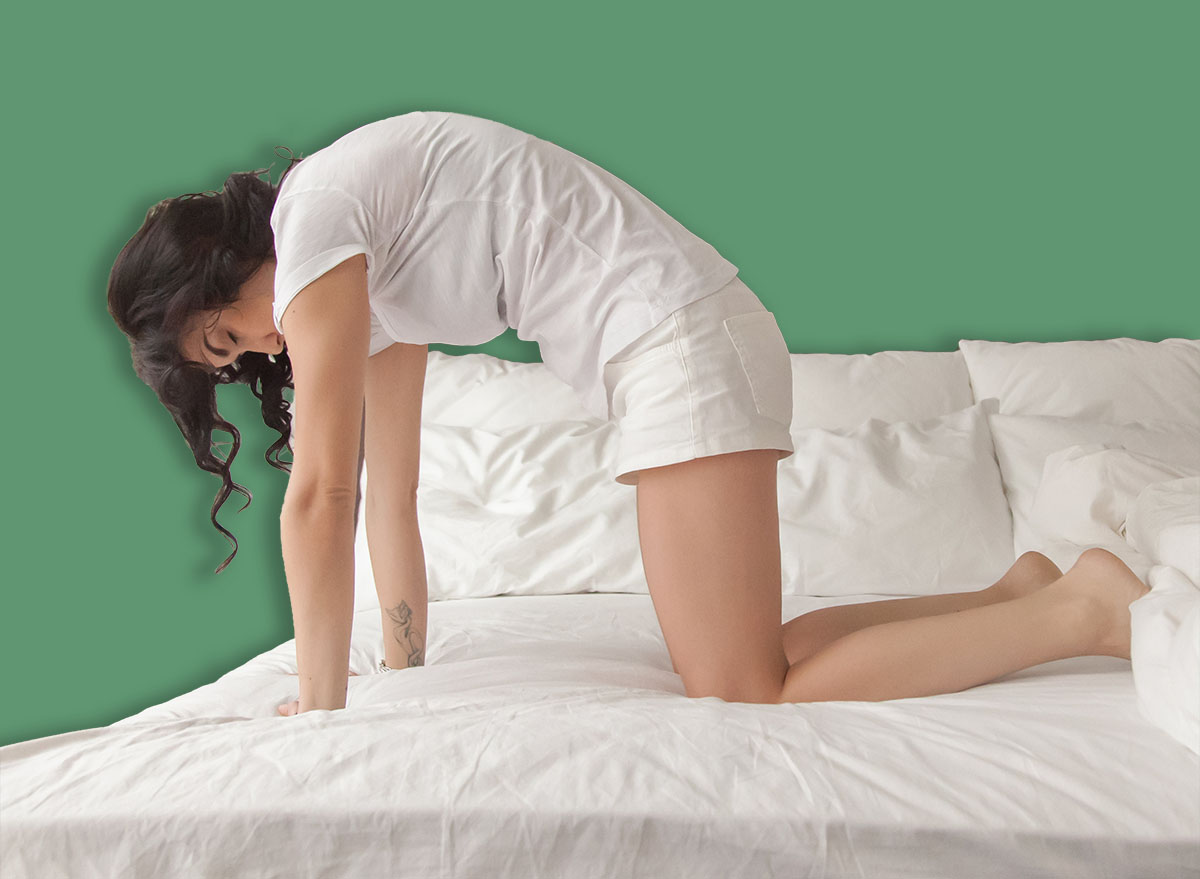
Cat-Cow Stretch (Modified Bed Version)
This isn’t purely a strengthening exercise, but it’s important for back health. It mobilises the spine, stretches tight muscles, and helps coordinate movement through your entire back. Many older adults have stiff spines that limit their ability to perform daily activities comfortably.
Muscles Trained: Full spinal stabilisers, erector spinae, core
How to Do It:
- Get on your hands and knees on the bed; the cushioning makes this easier on your knees than doing it on the floor
- Start in a neutral position with your back flat
- Slowly arch your back, dropping your belly toward the bed and lifting your head and tailbone; this is cow. Hold for 2 seconds
- Then round your back, tucking your chin to your chest and pulling your belly button toward your spine; this is cat. Hold for 2 seconds
- Move slowly and smoothly between positions
Recommended Sets and Reps: 2 sets of 10 repetitions
Common Mistakes to Avoid:
- Rushing through the movement; this isn’t about speed, it’s about controlled, deliberate movement through your entire spine
- Each position should take 2 to 3 seconds, with a smooth transition between them; if you’re moving quickly, you’re not getting the benefit.
How to Fit This Into Your Day

The best time to do these exercises is first thing in the morning, before you get out of bed. This removes any excuse about not having time or forgetting. The entire routine takes less than 10 minutes. Do it every other day to start, giving your muscles time to recover between sessions. As you get stronger, you can do it daily if you want.
Start with just one set of each exercise for the first week. This lets your body adapt without overwhelming it. In week two, add the second set. By week three, you should be doing the full routine comfortably.
Stop immediately if you feel sharp, shooting pain. Muscle fatigue is normal and expected. A burning sensation in the working muscles is fine. But pain that feels like something is wrong, sharp, stabbing, or radiating down your legs, is a sign to stop.
Check with a doctor before starting if you have any of the following: diagnosed osteoporosis, recent back surgery or injury, herniated discs, severe arthritis, uncontrolled high blood pressure, or any condition where lying flat or bending causes significant pain.
Other warning signs to watch for include dizziness during the exercises, numbness or tingling in your legs, or pain that gets worse rather than better over several days.
What to Expect After 4 to 6 Weeks

After two weeks, you’ll find it easier to perform daily activities such as getting out of bed or standing from a seated position. You might not notice any real visual changes yet, but you’ll be functioning better.
After four weeks, you’ll notice you’re standing more upright with less strain on your back during activities that previously caused discomfort. You’ll also feel more confident in the way you move because your back is feeling more stable.
After six weeks, you should notice genuine strength gains. Carrying groceries or doing gardening shouldn’t feel as stressful, and you’ll find it easier to maintain good posture throughout the day.
The Four Things That Actually Drive Results

How well you adhere to the programme is the key factor. Exercising three times a week and then stopping for two weeks won’t bring the results you want. Your muscles need to be continually stimulated to get stronger. Even every other day, done consistently, beats sporadic bursts followed by long gaps.
Progression is the second element. If the exercises become easy, make them a little more challenging. Add another set, increase the hold time, or slow the movement down to increase the time your muscles are working. Your muscles adapt to what you challenge them with; if you keep doing the same exercises at the same intensity without any change, you won’t continue to progress.
Recovery is the third element. Sleep, nutrition, and stress all impact how quickly your muscles rebuild. If you’re not getting enough sleep or eating enough protein, recovery slows down. The daily protein requirement for older adults is 1.2 to 1.6 grams per kilogram of body weight to maintain and build muscle mass.
Finally, be patient. Muscle function won’t improve overnight, especially after 60. With consistent effort you’ll notice improvements after six weeks, but it takes months to make real changes. The people who succeed are the ones who understand this is a long-term process, not a quick fix.