5 Best Bodyweight Core Exercises That Build Strength Faster Than Planks After 55
Core training after 55 works best when it feels simple and repeatable. A long plank can get old fast, especially when your shoulders start talking before your abs really get much out of it. Bodyweight core work gives you more room to move, adjust, and actually feel what your midsection is doing.
The best core exercises teach your abs to stay active while your arms or legs move. That’s a bigger skill than simply holding still for as long as possible. You’re building control through your trunk, which can help your back feel more supported, and your movement feel stronger.
I often give these exercises to my remote clients because it’s simple enough to use at home and challenging enough to see and feel the results. You’ll work from your back, from a bear position, and through hollow-body tension. Keep the first round controlled, then build the effort as your body warms up.
Use these five bodyweight core exercises three to five days per week. Start with two rounds, then add time or reps once the movements feel steady.
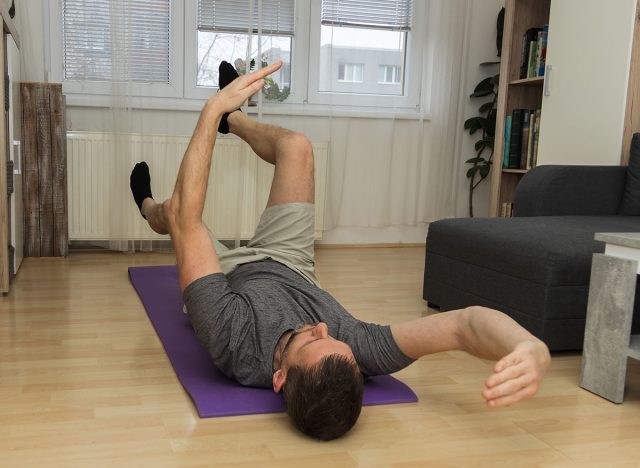
Alternating Dead Bug
The alternating dead bug is one of the best core exercises after 55 because it builds control without beating up your spine. It trains your abs to hold your lower back steady while your arms and legs move, which gives it more value than a basic static hold. It also scales well, so you can shorten the range early on and make the movement harder as your core gets stronger.
Muscles Trained: Abs, deep core, hip flexors.
How to Do It
- Lie on your back with your knees bent and lifted over your hips.
- Reach both arms toward the ceiling.
- Brace your core and gently press your lower back toward the floor.
- Lower one arm behind you as the opposite leg extends.
- Return to the starting position.
- Switch sides and continue alternating.
Recommended Sets and Reps: Perform 2 to 3 sets of 6 to 10 reps per side.
Best Variations: Bent-knee dead bugs, heel-tap dead bugs, slower dead bugs.
Form Tip: Shorten the reach if your lower back starts to arch.
Reverse Crunch
The reverse crunch gives your lower abs a clear job and keeps the movement easy to understand. Instead of chasing a big swing, you’re using your core to curl your hips slightly off the floor. That makes it a strong pick after 55 because it builds core strength through a small range that still feels challenging. It also fits well with the dead bug because one move emphasizes control, while this one adds a stronger contraction.
Muscles Trained: Abs, lower abs, hip flexors.
How to Do It
- Lie on your back with your knees bent.
- Place your arms on the floor by your sides.
- Lift your feet so your knees stack over your hips.
- Brace your core.
- Curl your hips slightly off the floor.
- Lower with control and repeat.
Recommended Sets and Reps: Perform 2 to 3 sets of 8 to 12 reps.
Best Variations: Bent-knee reverse crunches, reverse crunch with a pause, smaller-range reverse crunches.
Form Tip: Think about lifting your hips, not swinging your legs.
Flutter Kicks
Flutter kicks build core endurance, which is where many plank-only routines start to lose steam. Your abs have to stay active while your legs move continuously, creating a steady challenge through the front of your midsection. This move also adds a little pace without turning it into a high-impact exercise. Keep the kicks small and controlled so the work stays in your core.
Muscles Trained: Abs, hip flexors, deep core.
How to Do It
- Lie on your back with your legs extended.
- Place your hands by your sides or under your hips for support.
- Brace your core and lift both legs a few inches.
- Raise one leg slightly as the other lowers.
- Continue alternating small kicks.
- Stop the set before your lower back lifts off the floor.
Recommended Sets and Reps: Perform 2 to 3 sets of 20 to 30 seconds.
Best Variations: Bent-knee flutter kicks, higher-leg flutter kicks, shorter flutter-kick intervals.
Form Tip: Keep the range small enough that your lower back stays steady.
Bear Hold With Shoulder Taps
The bear hold with shoulder taps brings your core work off your back and onto your hands and knees. That shift gives your abs a different job because they have to keep your torso steady while one hand leaves the floor. It’s a great bodyweight option after 55 because you build trunk strength, shoulder control, and coordination in one simple position. The taps make the hold more useful than just waiting out a timer.
Muscles Trained: Abs, shoulders, upper back, hip flexors.
How to Do It
- Start on your hands and knees.
- Place your hands under your shoulders and your knees under your hips.
- Tuck your toes and lift your knees slightly off the floor.
- Hold the bear position.
- Tap one hand to the opposite shoulder.
- Place it back down and switch sides.
Recommended Sets and Reps: Perform 2 to 3 sets of 6 to 10 taps per side.
Best Variations: Bear hold, bear hold with slower taps, elevated bear hold.
Form Tip: Keep your hips as still as possible when your hand lifts.
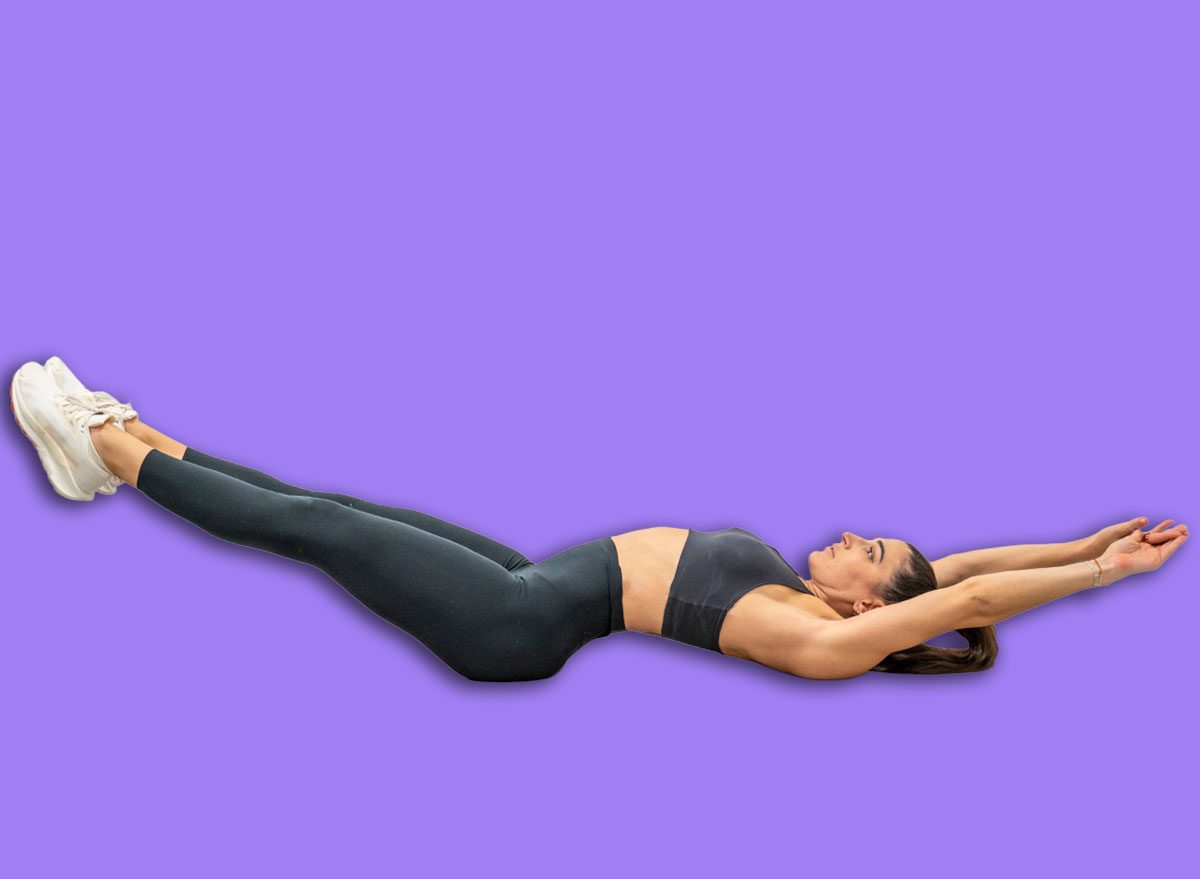
Hollow Hold
The hollow hold is a strong finisher because it teaches full-body tension through your abs. You’re asking your core to hold your ribs and pelvis in a strong position while your arms and legs extend away from the center. That makes it challenging, even without equipment. After 55, it’s worth scaling carefully so you can build strength without losing control.
Muscles Trained: Abs, deep core, hip flexors.
How to Do It
- Lie on your back with your knees bent.
- Brace your core and gently press your lower back toward the floor.
- Lift your head and shoulders slightly.
- Extend your arms by your sides or overhead.
- Extend your legs to a range you can control.
- Hold the position while breathing steadily.
Recommended Sets and Reps: Perform 2 to 3 holds of 10 to 25 seconds.
Best Variations: Tuck hollow hold, one-leg hollow hold, hollow body rock.
Form Tip: Bend your knees if your lower back starts to leave the floor.
How to Use These Bodyweight Core Exercises After 55
This routine works best when you keep it short enough to repeat during the week. Core strength after 55 improves through steady practice, especially when the exercises give your abs different jobs without making the workout feel complicated. Start with two rounds and rest as needed between movements. Once the reps feel smoother, add a third round or extend the holds by a few seconds. Keep the focus on control, breathing, and a level of effort that lets you come back to the routine again.
- Start with the dead bug: It helps you find your brace before the harder exercises.
- Keep the reps clean: Stop each set before your lower back takes over.
- Use shorter holds at first: A strong 10-second hollow hold beats a shaky 30-second one.
- Rest when your form slips: A quick reset helps the next set feel better.
- Repeat the same routine for a few weeks: Familiar exercises make progress easier to notice.
Building core strength after 55 doesn’t require marathon plank holds. These bodyweight exercises give your abs movement, tension, and enough variety to keep the routine useful without making it harder to start.
References
- Rodríguez-Perea, Ángela et al. “Core training and performance: a systematic review with meta-analysis.” Biology of sport vol. 40,4 (2023): 975-992. doi:10.5114/biolsport.2023.123319
- Hsu, Shih-Lin et al. “Effects of core strength training on core stability.” Journal of physical therapy science vol. 30,8 (2018): 1014-1018. doi:10.1589/jpts.30.1014