5 Bodyweight Exercises That Build Muscle Faster Than Dumbbells After 55
Bodyweight training can build a surprising amount of muscle when you treat the movements like real strength work. After 55, that matters because muscle doesn’t hang around just because you want it to. Your body needs regular tension, clean reps, and enough effort to keep building or maintaining lean mass.
Dumbbells are useful, but bodyweight exercises bring something different to the table. You have to control your position, brace your core, move your own body through space, and keep tension where it belongs. A slow push-up, a steady split squat, or a controlled glute bridge walkout can challenge your muscles hard without a rack of weights sitting nearby.
I’ve seen plenty of clients make strong progress once they stop treating bodyweight work like a warm-up. When the reps slow down and the positions get cleaner, these exercises expose weak spots fast. They also fit easily into the week, which helps with consistency. You can do them at home, add them after a walk, or use them as quick movement snacks when a full workout isn’t happening.
The five exercises below train your upper body, legs, glutes, hamstrings, and core with nothing more than your own bodyweight. Push-ups and close-grip push-ups build pressing strength. Split squats and glute bridge walkouts hit the lower body. Reverse crunches bring in the deep core work that supports better movement and control.
Push-Ups
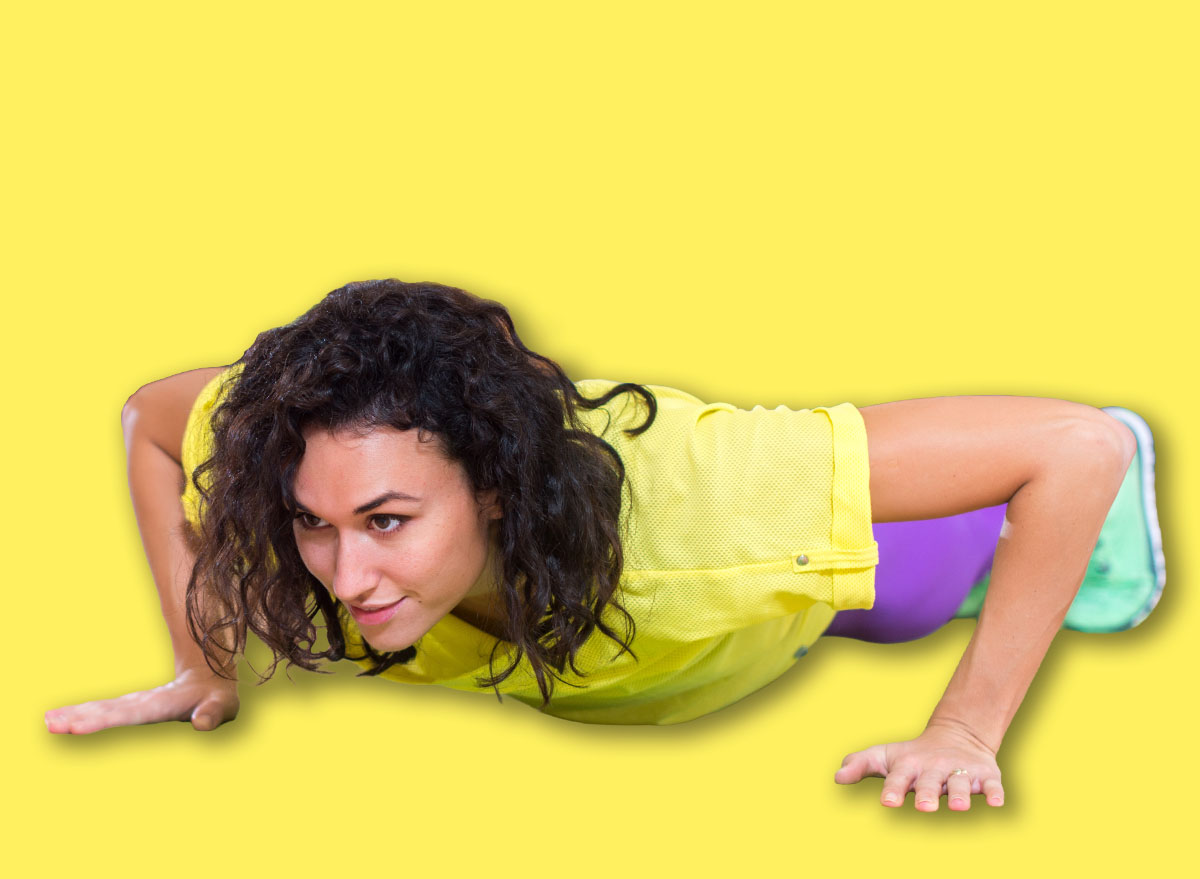
Push-ups train your chest, shoulders, triceps, and core while forcing your body to stay locked in from head to heels. As you lower and press back up, your upper body has to create tension while your midsection keeps your hips from sagging. That makes push-ups more than a chest exercise. They build pressing strength, core control, and full-body coordination in one movement, which carries over to pushing yourself up, bracing with your hands, and handling daily tasks with more strength.
Muscles Trained: Chest, shoulders, triceps, core
How to Do It:
- Place your hands on the floor under your shoulders.
- Step your feet back into a plank position.
- Brace your core and squeeze your glutes.
- Lower your chest toward the floor with control.
- Press through your hands to return to the starting position.
Recommended Sets and Reps: Perform 3 sets of 8 to 12 reps. Rest for 60 seconds between each set.
Best Variations: Incline push-ups, knee push-ups, slow-tempo push-ups
Form Tip: Keep your elbows angled slightly back and your hips level.
Split Squats
Split squats train your quads, glutes, hamstrings, and core while each leg moves through its own range of motion. The staggered stance forces your front leg to handle most of the effort while your midsection keeps your torso steady. That makes split squats a strong muscle-building option after 55 because they challenge leg strength without needing extra load right away. They also carry over well to stairs, walking, getting up from low positions, and staying strong on one leg.
Muscles Trained: Quadriceps, glutes, hamstrings, core
How to Do It:
- Stand in a split stance with one foot forward and one foot back.
- Brace your core and keep your torso tall.
- Lower your back knee toward the floor with control.
- Press through your front foot to rise back up.
- Complete all reps, then switch sides.
Recommended Sets and Reps: Perform 3 sets of 8 to 10 reps per leg. Rest for 60 seconds between each set.
Best Variations: Assisted split squats, pause split squats, slow-tempo split squats
Form Tip: Keep your weight centered over your front foot and avoid pushing off your back leg.
Close-Grip Push-Ups
Close-grip push-ups train your triceps, chest, shoulders, and core, with greater focus on the backs of your arms. Bringing your hands closer makes the press harder for your triceps, which helps build upper-body muscle without dumbbells. Your core still has to brace through every rep, so your body stays strong and aligned while your arms do the pressing. Stronger triceps help with pushing, getting up from the floor, and maintaining upper-body strength as you age.
Muscles Trained: Triceps, chest, shoulders, core
How to Do It:
- Place your hands slightly inside shoulder width.
- Step your feet back into a plank position.
- Brace your core and keep your body in a straight line.
- Lower your chest toward the floor while keeping your elbows close.
- Press through your hands to return to the starting position.
Recommended Sets and Reps: Perform 3 sets of 6 to 10 reps. Rest for 60 seconds between each set.
Best Variations: Incline close-grip push-ups, knee close-grip push-ups, paused close-grip push-ups
Form Tip: Keep your elbows close to your ribs and avoid letting them flare wide.
Glute Bridge Walkouts
Glute bridge walkouts train your glutes, hamstrings, and core while keeping your hips lifted under tension. As your feet move farther away, your hamstrings have to work harder to maintain position and keep your hips from dropping. That makes the exercise a strong choice for building muscle through the backside of your body without using weights. Stronger glutes and hamstrings help with walking, standing, climbing stairs, and keeping your lower back from taking over.
Muscles Trained: Glutes, hamstrings, core
How to Do It:
- Lie on your back with your knees bent and your feet flat on the floor.
- Press through your heels and lift your hips.
- Brace your core and squeeze your glutes.
- Walk your feet forward one small step at a time.
- Walk your feet back in while keeping your hips lifted.
Recommended Sets and Reps: Perform 3 sets of 6 to 8 walkouts. Rest for 60 seconds between each set.
Best Variations: Shorter walkouts, paused bridge holds, single-leg bridge holds
Form Tip: Keep your hips high and stop the set before your lower back takes over.
Reverse Crunches
Reverse crunches train your lower abs and deep core while teaching your pelvis to move with control. As your knees come toward your chest, your lower belly has to curl your hips instead of letting your legs swing. That control helps your core support bigger movements, including push-ups, split squats, and bridge walkouts. A stronger core also helps you brace better, move with more control, and keep your lower back supported during daily activity.
Muscles Trained: Lower abs, deep core, hip flexors
How to Do It:
- Lie on your back with your knees bent and your feet lifted.
- Place your arms at your sides for support.
- Brace your core and keep your movement small.
- Curl your hips slightly off the floor.
- Lower your hips back down with control.
Recommended Sets and Reps: Perform 3 sets of 8 to 12 reps. Rest for 45 seconds between each set.
Best Variations: Bent-knee reverse crunches, paused reverse crunches, slow-tempo reverse crunches
Form Tip: Curl your pelvis instead of swinging your legs.
How to Make Bodyweight Muscle Building Work After 55
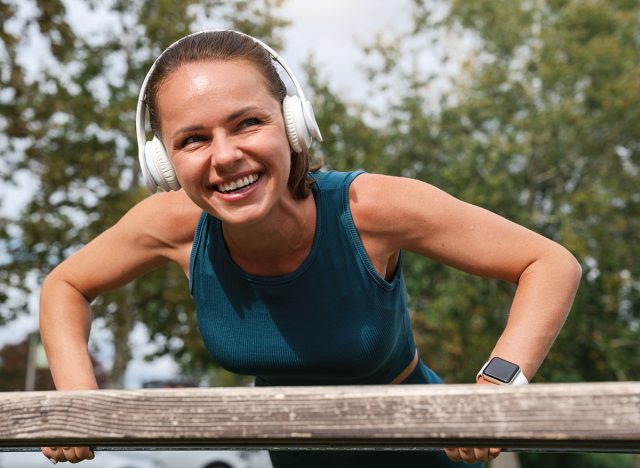
Bodyweight training works best when every rep feels intentional. You want enough control to keep tension on the muscles and enough effort to make the final reps challenging. The exercises above give you a strong mix of pressing, single-leg strength, posterior-chain work, and core control. Done consistently, they can help rebuild muscle without needing every session to revolve around dumbbells.
- Slow down your reps: Take your time on the lowering phase of push-ups and split squats. More control keeps the muscles working longer and makes bodyweight exercises feel much more demanding.
- Add pauses where the movement feels hardest: Hold the bottom of a split squat, pause halfway down in a push-up, or keep your hips high during bridge walkouts. Pauses create more tension without adding weight.
- Train close to effort: The last few reps should feel challenging while your form stays clean. If a set feels too easy, adjust the variation, slow the tempo, or add another set.
- Use easier versions when needed: Incline push-ups, assisted split squats, and shorter bridge walkouts still build strength when you perform them well. Clean reps beat forced reps every time.
- Repeat the movements across the week: Bodyweight work fits well into short sessions. A few focused rounds several days per week can build more momentum than one long workout you rarely repeat.
References
- Siparsky, Patrick N et al. “Muscle changes in aging: understanding sarcopenia.” Sports health vol. 6,1 (2014): 36-40. doi:10.1177/1941738113502296
- Archila, Linda R et al. “Simple Bodyweight Training Improves Cardiorespiratory Fitness with Minimal Time Commitment: A Contemporary Application of the 5BX Approach.” International journal of exercise science vol. 14,3 93-100. 1 Apr. 2021, doi:10.70252/WEQD2681