5 Chair Exercises That Restore Hip Strength Faster Than Lunges After 60
Hip strength is highly impactful, as it affects how you move. You feel it when your first few steps in the morning feel stiff, when stairs take a little more effort, or when standing up from a chair takes an extra push. The hips are involved in almost every lower-body movement, so when they lose strength, the rest of your body usually notices.
Lunges can help build the hips, but they demand a lot before the muscles you’re targeting even get a fair shot. Balance, knee control, stride length, and mobility all have to line up. Chair exercises lower the entry point and let you focus on the work itself: lifting the knee, pressing through the feet, squeezing the glutes, and strengthening the muscles around the hips without worrying about tipping or rushing through a rep.
I’ve used chair-based drills with clients who needed to rebuild confidence before moving into bigger lower-body exercises. The chair adds support, but the muscles still have to work. In this routine, seated marches train the hip flexors, reverse planks wake up the glutes, banded abductions target the outer hips, adduction holds strengthen the inner thighs, and sit-to-stands bring everything together in a movement you use every day.
Seated Marching
Seated marching trains your hip flexors and core while giving your body a supported way to practice lifting one leg at a time. Strong hip flexors help you walk with a cleaner stride, step over objects, and climb stairs without dragging your feet. The chair keeps your balance out of the equation, so your hips can focus on doing the work. Move slowly, stay tall, and make each knee lift feel controlled instead of rushed.
Muscles Trained: Hip flexors, quadriceps, core
How to Do It:
- Sit tall near the front edge of a sturdy chair.
- Plant your feet flat on the floor.
- Brace your core and keep your chest lifted.
- Lift one knee toward your chest.
- Lower your foot back to the floor with control.
- Alternate legs in a steady rhythm.
Recommended Sets and Reps: Perform 3 sets of 10 to 12 reps per leg. Rest for 30 seconds between each set.
Best Variations: Paused seated marches, banded seated marches, slower tempo marches
Form Tip: Keep your torso tall and avoid leaning back as your knee lifts.
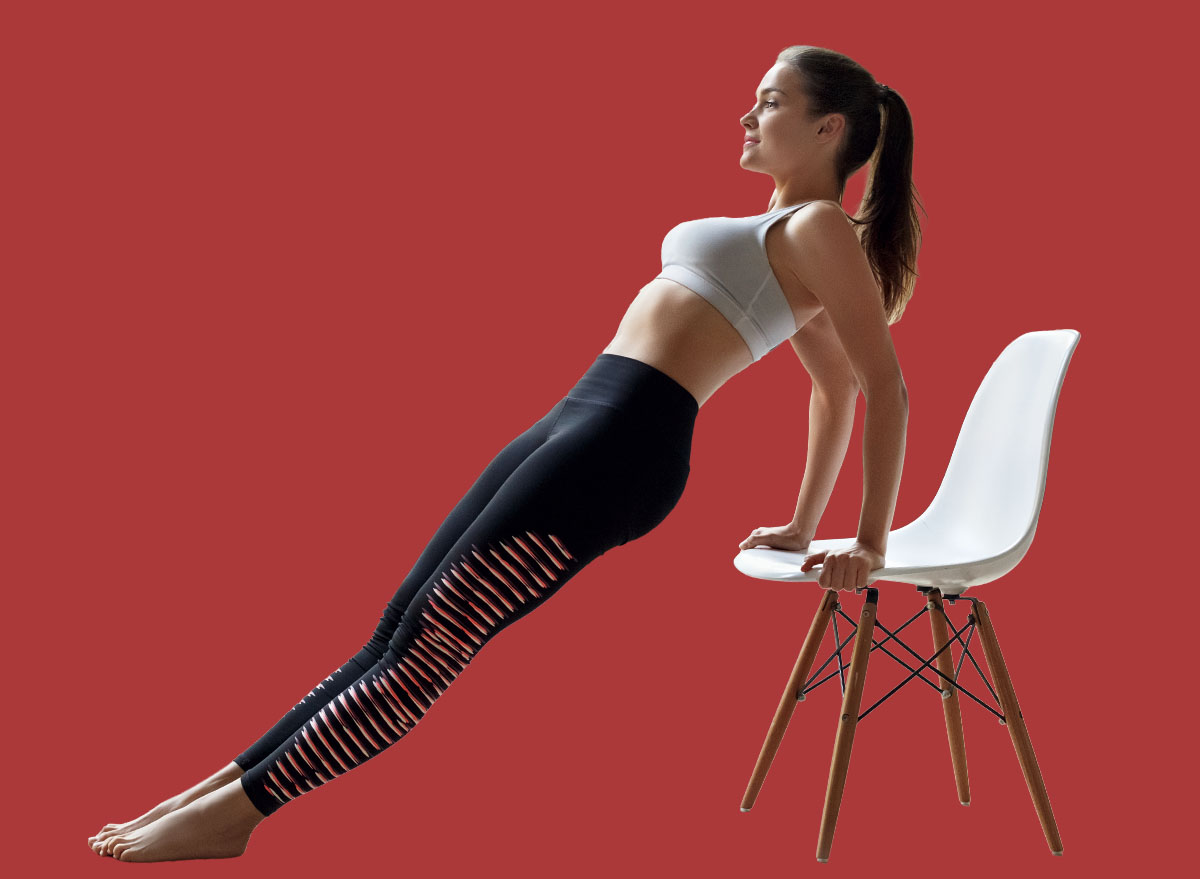
Reverse Plank
A chair reverse plank trains your glutes, hamstrings, upper back, and core while teaching your hips to stay extended. That matters because sitting for long stretches can make the front of the hips feel tight and leave the glutes undertrained. Pressing your hips up helps restore strength through the backside of your body, which supports walking, standing tall, and getting up from seated positions. Hold the top position with purpose and let your glutes do the work.
Muscles Trained: Glutes, hamstrings, core, upper back
How to Do It:
- Sit near the front edge of a sturdy chair.
- Place your hands on the sides of the seat.
- Walk your feet forward until your legs extend comfortably.
- Press through your heels and lift your hips off the chair.
- Squeeze your glutes and hold your body in a straight line.
- Lower your hips back to the chair with control.
Recommended Sets and Reps: Perform 3 sets of 15 to 25 second holds. Rest for 45 seconds between each set.
Best Variations: Bent-knee reverse plank, longer holds, alternating heel lift hold
Form Tip: Squeeze your glutes and keep your chest open.
Banded Leg Abduction
Banded leg abductions train the outer hips and glutes, which help keep your knees and hips steady when you stand, walk, or step sideways. Weak outer hips can cause the knees to drift inward, leaving your lower body feeling less stable. The band provides your hips with resistance in a direction that lunges don’t always target well. Keep constant tension on the band and focus on smooth, controlled reps.
Muscles Trained: Outer hips, glutes, hip stabilizers
How to Do It:
- Sit tall near the front edge of a sturdy chair.
- Place a mini band around your thighs just above your knees.
- Plant your feet flat on the floor.
- Brace your core and keep your chest lifted.
- Press your knees outward against the band.
- Return your knees inward with control.
Recommended Sets and Reps: Perform 3 sets of 12 to 15 reps. Rest for 30 seconds between each set.
Best Variations: Paused abductions, single-leg abductions, slower tempo abductions
Form Tip: Keep your feet planted and move from your hips.
RELATED: If You Can Hold a Plank This Long After 60, Your Core Strength Is Top-Tier
Seated Adduction Hold
Seated adduction holds train the inner thighs, an area that plays a bigger role in hip strength than most people realize. The adductors help control your legs when you walk, shift direction, or bring your feet back under you after a step. Squeezing a pillow, ball, or yoga block between your knees builds strength in the inner hips without requiring you to stand or balance. Hold the squeeze firmly and breathe through the effort.
Muscles Trained: Inner thighs, hip adductors, core
How to Do It:
- Sit tall with your feet flat on the floor.
- Place a pillow, small ball, or yoga block between your knees.
- Brace your core and keep your posture upright.
- Squeeze your knees together against the object.
- Hold the squeeze for the target time.
- Release with control before the next rep.
Recommended Sets and Reps: Perform 3 sets of 15 to 25 second holds. Rest for 30 seconds between each set.
Best Variations: Longer holds, pulsing squeezes, firmer object holds
Form Tip: Keep your feet flat and squeeze from your inner thighs.
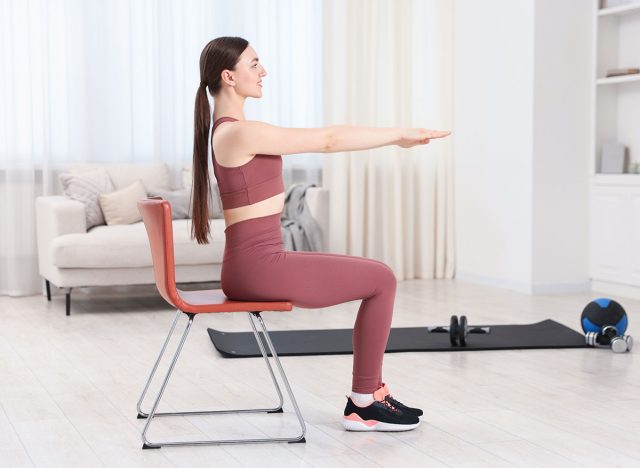
Sit-to-Stand
Sit-to-stands train your glutes, quads, hamstrings, and core while practicing one of the most important movements after 60. Every rep trains your hips and legs to generate force from a seated position, which carries over to getting off the couch, standing from the car, or rising from a dining chair. Compared with lunges, sit-to-stands offer a more stable entry point while still building serious lower-body strength. Control the lowering phase and stand up without rocking for momentum.
Muscles Trained: Glutes, quadriceps, hamstrings, core
How to Do It:
- Sit near the front edge of a sturdy chair.
- Place your feet flat on the floor about hip-width apart.
- Brace your core and lean your torso slightly forward.
- Press through your feet to stand tall.
- Squeeze your glutes at the top.
- Lower back to the chair with control.
Recommended Sets and Reps: Perform 3 sets of 8 to 12 reps. Rest for 45 seconds between each set.
Best Variations: No-hands sit-to-stands, slower tempo sit-to-stands, paused sit-to-stands
Form Tip: Press through your whole foot and avoid dropping into the chair.
How to Rebuild Hip Strength From a Chair
Chair training works best when the movements feel focused instead of easy. The support gives you confidence, but your hips still need to create tension and control each rep. Treat these exercises like strength work: move slowly, own the position, and make the target muscles do their job. A few consistent sessions each week can help your hips feel stronger, steadier, and more reliable during daily movement.
- Train the front, back, inside, and outside of your hips: Hip strength comes from multiple muscles. Marches, reverse planks, abductions, adduction holds, and sit-to-stands cover the main areas your hips need for better movement.
- Use the chair to improve control: Support should help you move better, not make the work disappear. Stay tall, keep your feet planted, and avoid leaning or pulling through your hands unless balance requires it.
- Add pauses when you can: Holds at the top of a reverse plank, during an adduction squeeze, or before sitting down make the muscles work longer. Extra time under tension helps build strength without needing heavy weights.
- Progress gradually: Add a few reps, use a stronger band, hold longer, or slow the lowering phase. Small changes keep your hips improving without making the routine feel overwhelming.
- Practice often enough to feel the carryover: Aim for three to five short sessions per week. Your hips respond well to steady practice, especially when each rep feels controlled and intentional.
References
- Lanza, Marcel Bahia et al. “The Influence of Aging on Hip Abductor Muscle Torque, Power, Velocity and the Association With Lower Limb Physical Function.” Journal of geriatric physical therapy (2001) vol. 48,2 (2025): E129-E137. doi:10.1519/JPT.0000000000000431
- Klempel, Natalie et al. “The Effect of Chair-Based Exercise on Physical Function in Older Adults: A Systematic Review and Meta-Analysis.” International journal of environmental research and public health vol. 18,4 1902. 16 Feb. 2021, doi:10.3390/ijerph18041902