6 Morning Exercises That Firm Waist Thickening Faster Than Ab Workouts After 55

A lot of people chase a firmer waist by doing more ab work, but that’s usually not where the real change comes from. A stronger, tighter midsection shows up when your core actually has to work during movement, not just when you’re lying on your back knocking out reps. That’s the difference most people start to feel once they shift how they train.
From what I’ve seen coaching, the core responds best when it’s asked to stabilize, not just flex. That means bracing, controlling rotation, and holding position while the rest of your body moves. When you train it that way, you don’t just feel your abs working during the exercise; you start to feel your core supporting you throughout the day.
That’s where these morning movements come in. They’re simple, but they force your midsection to stay engaged while your arms and legs do the work. You don’t need a long session. A few minutes of focused reps, done well, go a long way. Stay consistent with it, and you’ll notice your waist feeling tighter, more controlled, and a lot more involved in how you move.
Lunge with Rotation
This one pulls your core in right away because you have to control the twist while staying balanced. As you step into the lunge, your midsection has to brace to keep you from collapsing or over-rotating. When you rotate with control instead of swinging through it, your obliques and deeper core muscles stay engaged the entire time. It’s a good reminder that your core’s job isn’t just to move, it’s to control movement.
Muscles Trained: Glutes, quadriceps, obliques, core
How to Do It:
- Stand tall with your feet together.
- Step forward with your right foot into a lunge.
- Rotate your torso toward your front leg.
- Return your torso to the center.
- Push through your front foot to stand back up.
- Repeat on the other side.
Recommended Sets and Reps: Perform 3 sets of 8 to 10 reps per side. Rest for 45 seconds between each set.
Best Variations: Reverse lunge with rotation, shorter step lunge, slower tempo reps
Form Tip: Brace your core before you rotate and move through your torso.
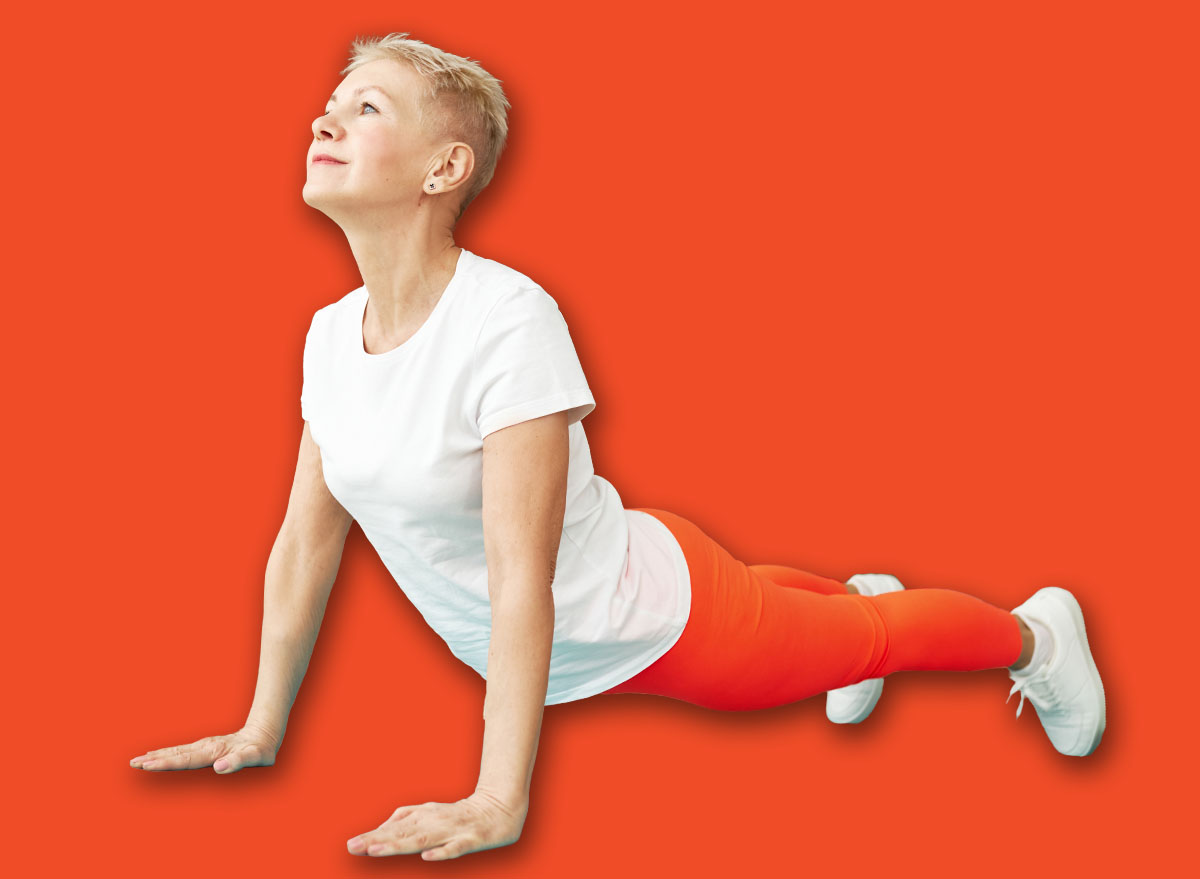
Down Dog to Cobra
Moving between these two positions keeps your core engaged as your body shifts through space. As you transition, your midsection has to stay engaged to control the movement and keep your lower back from taking over. When you move slowly and stay connected, you’ll feel your core working to guide the position instead of just letting your body fall into it. It’s subtle, but it adds up quickly.
Muscles Trained: Core, shoulders, back, hips
How to Do It:
- Start in a plank position with your hands under your shoulders.
- Push your hips back into a down dog position.
- Shift your body forward into a plank.
- Lower your hips and lift your chest into a cobra position.
- Press back into the down dog.
- Repeat the sequence with control.
Recommended Sets and Reps: Perform 3 sets of 6 to 8 controlled reps. Rest for 30 seconds between each set.
Best Variations: Shorter range, slower transitions, elevated hands
Form Tip: Stay braced through your midsection as you move between positions.
Alternating Marching
This one looks simple, but it forces your core to stay locked in while your legs move. As you lift one leg at a time, your midsection has to brace to keep your hips from shifting side to side. When you stay tall and controlled, you’ll feel your core working to keep everything steady. It’s a great way to build that connection early in the day.
Muscles Trained: Core, hip flexors, glutes
How to Do It:
- Stand tall with your feet hip-width apart.
- Lift your right knee toward your chest.
- Lower your foot back to the ground with control.
- Lift your left knee toward your chest.
- Continue alternating your legs in a steady rhythm.
Recommended Sets and Reps: Perform 3 sets of 10 to 12 reps per leg. Rest for 30 seconds between each set.
Best Variations: Slower tempo marching, pause at the top, higher knee drive
Form Tip: Brace your core to keep your hips from shifting.
Incline Push-Ups
Push-ups naturally engage your core because you have to hold your body in a straight line. On an incline, it’s easier to stay in position, allowing you to focus on bracing properly. As you lower and press back up, your midsection has to stay tight to keep your hips from dropping or your lower back from arching. When done right, your core works just as hard as your upper body.
Muscles Trained: Chest, shoulders, triceps, core
How to Do It:
- Place your hands on a bench or elevated surface.
- Step your feet back into a plank position.
- Lower your chest toward the surface by bending your elbows.
- Press through your hands to return to the starting position.
- Keep your body in a straight line throughout each rep.
Recommended Sets and Reps: Perform 3 sets of 10 to 15 reps. Rest for 45 seconds between each set.
Best Variations: Lower incline, staggered hand position, slower tempo reps
Form Tip: Stay braced and avoid letting your hips sag.
Goblet Squat
Holding a weight in front of your body changes how your core has to work right away. That front load pulls you forward, so your midsection has to brace to keep you upright as you squat. When you stay in control on the way down and drive back up, your core works the entire time to hold position, not just at the top or bottom. It also makes it easier to sit into your hips and keep better form, which helps your glutes and legs do their job.
Muscles Trained: Quadriceps, glutes, core
How to Do It:
- Stand with your feet shoulder-width apart.
- Hold a dumbbell or kettlebell at your chest.
- Brace your core and keep your chest up.
- Lower your body by bending your hips and knees.
- Drive through your heels to return to standing.
Recommended Sets and Reps: Perform 3 sets of 10 to 12 reps. Rest for 45 seconds between each set.
Best Variations: Box squats, slower tempo squats, pause at the bottom
Form Tip: Brace your core before you descend and stay upright.
Down Dog Hold with Reach
Holding a down dog while reaching one arm forces your core to work harder to keep you stable. As soon as one arm leaves the ground, your midsection has to brace to prevent rotation. When you stay controlled and don’t rush the reach, you’ll feel your core working to hold everything in place. It’s a simple way to challenge stability without adding complexity.
Muscles Trained: Core, shoulders, upper back
How to Do It:
- Start in a down dog position with your hips lifted.
- Shift your weight evenly through your hands and feet.
- Lift your right hand and reach toward your left foot.
- Return your hand to the ground with control.
- Lift your left hand and reach toward your right foot.
- Continue alternating while keeping your hips steady.
Recommended Sets and Reps: Perform 3 sets of 6 to 8 reps per side. Rest for 30 seconds between each set.
Best Variations: Shorter reach, slower tempo, hold before returning
Form Tip: Brace your core and avoid shifting your hips.
What Helps This Come Together

This is where most people start to feel the difference. These exercises work because your core has to stay engaged throughout the entire rep, not just at the start or end. When you treat each movement like a full-body effort and stay aware of your position, your midsection gets the kind of work it actually responds to.
Keep things simple and stay consistent. A few minutes in the morning, done with focus, adds up quickly. You don’t need to chase fatigue or make it complicated. Just brace, move with control, and repeat often enough for your body to adapt.
- Brace before each rep: Set your core before you move.
- Slow things down: Control keeps your core engaged longer.
- Stay aware of your position: Small shifts can take the work off your midsection.
- Keep it consistent: Daily or near-daily effort makes the difference.
- Carry it into your day: Stay braced during normal movement.
References
- Smrcina, Zachary et al. “A Systematic Review of the Effectiveness of Core Stability Exercises in Patients with Non-Specific Low Back Pain.” International journal of sports physical therapy vol. 17,5 766-774. 1 Aug. 2022, doi:10.26603/001c.37251
- Rodríguez-Perea, Ángela et al. “Core training and performance: a systematic review with meta-analysis.” Biology of sport vol. 40,4 (2023): 975-992. doi:10.5114/biolsport.2023.123319