5 Chair Exercises That Restore Hip Strength Faster Than Yoga After 60
A lot of hip strength shows up in moments that barely register. You pivot in the kitchen, step off a curb, or turn around when someone calls your name, and your hips quietly keep your body centered as your weight shifts. When they’re doing that job well, walking and changing direction feel smoother and more secure.
With clients over 60, I often use a chair early in hip-strength work because it provides a dependable point of contact as they learn the movement. It lets them put attention on where they feel the effort, how their foot connects with the floor, and whether their pelvis stays level as one leg takes on more of the load. Once that feels steady, progress can come from a slightly deeper range, a stronger band, or less help from the chair.
Yoga can be valuable for keeping the hips mobile and helping your body access more comfortable positions. Strength comes from giving the muscles around the hip repeated chances to create force and control movement. A chair routine adds that training stimulus in a practical way, especially for people who want a focused home workout without a complicated setup.
The five exercises below build from stable, controlled positions into more demanding single-leg work. Use them two to three days per week, keep the reps smooth, and give your hips time to get stronger through consistent practice.
Chair-Supported Split Squat
Chair-supported split squats give each hip a direct strength challenge while the chair helps you stay balanced and upright. The front leg handles most of the work as you lower and stand, engaging the glutes, thighs, and hip stabilizers. This is a useful move for building confidence on one leg, which carries over well to stairs, walking, and changing direction.
Muscles Trained: Glutes, quadriceps, hamstrings, hip stabilizers, core.
How to Do It:
- Place a sturdy chair against a wall and stand beside it.
- Rest one hand lightly on the chair back for support.
- Step one foot back into a split stance.
- Bend both knees and lower straight down with control.
- Press through your front foot to stand tall.
- Complete all reps, then switch sides.
Recommended Sets and Reps: Perform 3 sets of 8 to 10 reps per side. Rest for 45 to 60 seconds between sets.
Best Variations: Short-range split squats, pause split squats, slow-tempo split squats.
Form Tip: Keep your front foot firmly planted and let your knee track in the same direction as your toes.
Band-Resisted Sit-to-Stand
Band-resisted sit-to-stands turn a familiar daily task into a stronger hip exercise. The band encourages your hips to stay active as you rise, while the chair gives you a consistent target for depth and control. Your glutes create the lift, your thighs help drive you up, and your outer hips keep your knees in a strong position throughout the rep.
Muscles Trained: Glutes, quadriceps, hamstrings, outer hips, core.
How to Do It:
- Place a light mini band above your knees.
- Sit near the front edge of a sturdy chair with your feet flat on the floor.
- Set your feet about hip-width apart and press gently out against the band.
- Brace your core and lean your chest slightly forward.
- Press through your feet to stand tall.
- Lower back to the chair with control and repeat.
Recommended Sets and Reps: Perform 3 sets of 10 to 12 reps. Rest for 45 to 60 seconds between sets.
Best Variations: Standard sit-to-stands, banded hover squats, slow-tempo sit-to-stands.
Form Tip: Keep light tension on the band from the start of the rep through the return to the chair.
Seated Band Hip Abduction[/slidetitle
Seated band hip abductions target the outer hips, especially the muscles that help keep your pelvis steady when you walk or stand on one leg. A stronger outer hip can help your lower body feel more organized when you step sideways, turn, or climb stairs. The chair keeps the setup simple so you can focus on building tension with each controlled rep.
Muscles Trained: Glute medius, outer hips, glute minimus, core.
How to Do It:
- Sit tall near the front edge of a sturdy chair.
- Place a light mini band above your knees.
- Set your feet flat on the floor about hip-width apart.
- Brace your core and press your knees out against the band.
- Pause briefly at the widest point.
- Return to the starting position with control.
Recommended Sets and Reps: Perform 3 sets of 12 to 15 reps. Rest for 30 to 45 seconds between sets.
Best Variations: Lighter-band hip abductions, pause hip abductions, slow-tempo hip abductions.
Form Tip: Keep both feet rooted and avoid rocking your torso backward as your knees open.
[slidetitle num="4"]Chair-Supported Single-Leg Romanian Deadlift
A chair-supported single-leg Romanian deadlift builds strength through the glutes and hamstrings while teaching each hip to control the pelvis on its own. Holding the chair lightly gives you enough stability to focus on the hinge and feel the work in the back of the standing leg. This exercise also helps build the control needed for longer walks, uneven ground, and stepping off curbs with confidence.
Muscles Trained: Glutes, hamstrings, hip stabilizers, lower back, core.
How to Do It:
- Stand beside a chair with one hand lightly resting on the back.
- Shift your weight onto the leg closest to the chair.
- Soften your standing knee and brace your core.
- Push your hips back as your opposite leg reaches behind you.
- Lower until you feel a stretch through your hamstring.
- Drive through your standing foot to return to a tall posture.
Recommended Sets and Reps: Perform 3 sets of 8 to 10 reps per side. Rest for 45 to 60 seconds between sets.
Best Variations: Staggered-stance hip hinges, bodyweight single-leg Romanian deadlifts, slow-tempo single-leg Romanian deadlifts.
Form Tip: Keep your hips facing forward as you hinge so your standing glute stays in control of the rep.
Chair-Supported Knee Drive
Chair-supported knee drives target the hip flexors and core, while the standing leg helps keep your body steady. The knee lift mirrors part of the motion you use in every stride, which makes it a useful way to build more control for walking and stair climbing. The chair gives you a stable handhold so you can focus on lifting with strength and lowering with control.
Muscles Trained: Hip flexors, glutes, quadriceps, calves, core.
How to Do It:
- Stand facing a sturdy chair with both hands lightly on the back.
- Set your feet hip-width apart and stand tall.
- Shift your weight onto one foot.
- Lift your opposite knee toward hip height.
- Pause briefly at the top.
- Lower your foot with control and repeat before switching sides.
Recommended Sets and Reps: Perform 3 sets of 10 to 12 reps per side. Rest for 30 to 45 seconds between sets.
Best Variations: Supported marches, pause knee drives, slow-tempo knee drives.
Form Tip: Keep your ribs stacked over your hips as the knee lifts.
How to Build Hip Strength With Chair Exercises After 60
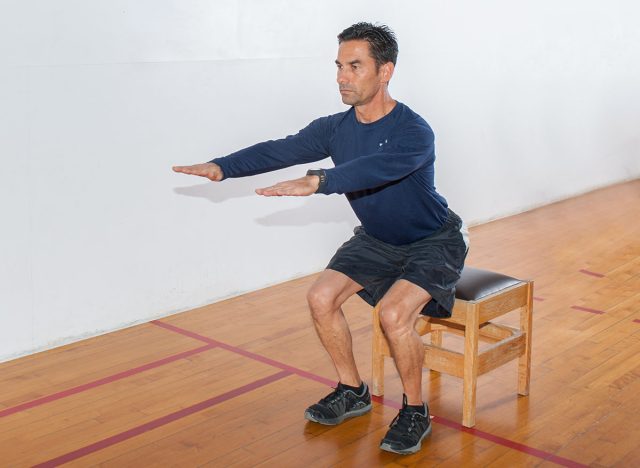
Use these exercises as a circuit or complete all sets of one move before moving to the next. The chair should help you stay focused on clean reps while your hips create the work.
- Start with two rounds: Build to three rounds once you can finish the routine with steady form.
- Progress one detail at a time: Add a few reps, choose a slightly stronger band, lower your split squat a little more, or reduce the support you use from the chair.
- Keep yoga in your week: Mobility sessions can help your hips feel more open between strength days and after longer walks.
- Train both sides evenly: Give each leg the same attention so neither side keeps taking over.
- Pair the routine with regular walking: Walking gives you a chance to use the hip strength you’re building in a practical way.
Strong hips make everyday movement feel more dependable. Keep this routine in your week, progress at a pace you can own, and let the chair help you build the foundation for steadier, stronger steps.
References
- Lanza, Marcel Bahia et al. “The Influence of Aging on Hip Abductor Muscle Torque, Power, Velocity and the Association With Lower Limb Physical Function.” Journal of geriatric physical therapy (2001) vol. 48,2 (2025): E129-E137. doi:10.1519/JPT.0000000000000431
- Anderson DE, Madigan ML. Healthy older adults have insufficient hip range of motion and plantar flexor strength to walk like healthy young adults. J Biomech. 2014 Mar 21;47(5):1104-9. doi: 10.1016/j.jbiomech.2013.12.024. Epub 2014 Jan 10. PMID: 24461576; PMCID: PMC3975833.
- Klempel N, Blackburn NE, McMullan IL, Wilson JJ, Smith L, Cunningham C, O’Sullivan R, Caserotti P, Tully MA. The Effect of Chair-Based Exercise on Physical Function in Older Adults: A Systematic Review and Meta-Analysis. Int J Environ Res Public Health. 2021 Feb 16;18(4):1902. doi: 10.3390/ijerph18041902. PMID: 33669357; PMCID: PMC7920319.