5 Standing Exercises That Restore Hip Strength Faster Than Gym Machines After 60

Your hips serve as the engine behind nearly every step you take. After 60, those powerful muscles naturally lose strength if they aren’t challenged regularly, making everyday activities like climbing stairs, getting out of a chair, or walking long distances feel more demanding. As a trainer, I’ve found that many adults blame aging for slower movement when weak hips often deserve much of the responsibility. Rebuilding strength in this area frequently produces improvements throughout the entire body.
Many people assume they need expensive gym machines to strengthen their hips effectively. While machines isolate individual muscles, they don’t always teach those muscles to work together the way they do during daily life. Standing exercises challenge your hips while also improving balance, posture, and coordination, creating strength that carries over into real-world movement. That’s why I often recommend functional standing exercises before clients ever set foot on a leg machine.
I’ve spent years helping adults over 60 regain confidence in their movement, and stronger hips consistently produce some of the biggest transformations I see. Clients walk farther, climb stairs more comfortably, and recover their balance more quickly after making hip strength a priority. These five standing exercises target the muscles that stabilize your pelvis and power every stride. Perform them a few mornings each week, and you’ll build the kind of strength that helps you stay active for years to come.
Standing Hip Abductions
Whenever someone tells me they feel unsteady while walking, standing hip abductions usually become one of the first exercises I prescribe. The gluteus medius, located along the outside of the hip, stabilizes the pelvis every time one foot leaves the ground. Weakness in this muscle often leads to shorter strides, side-to-side swaying, and unnecessary stress on the knees. Clients frequently notice steadier walking and improved balance after strengthening this often-overlooked area. Few movements isolate these important stabilizers as effectively while remaining gentle on the joints.
How to Do It
- Stand beside a sturdy chair.
- Hold the chair lightly for balance.
- Lift one leg out to the side.
- Keep your torso upright.
- Lower with control.
- Perform 12 to 15 repetitions per leg.
Standing Hip Extensions
Strong glutes power nearly every lower-body movement, yet they often become inactive after years of prolonged sitting. Standing hip extensions directly strengthen these muscles while reinforcing proper hip movement without placing excessive stress on the knees. I frequently include them because they improve walking mechanics, stair climbing, and overall lower-body power. Clients often tell me they feel stronger pushing off with each step after several weeks of consistent practice. Better glute strength also supports healthier posture and reduced lower-back strain.
How to Do It
- Stand behind a sturdy chair.
- Hold the chair lightly.
- Extend one leg straight behind you.
- Keep your back tall.
- Return slowly.
- Complete 12 to 15 repetitions on each leg.
Lateral Step-Outs
The hips rarely move only forward and backward during everyday life. Side-to-side strength becomes just as important when stepping around obstacles, changing direction, or regaining your balance after a stumble. Lateral step-outs strengthen the hips through a different plane of motion while improving coordination and stability. I like using this exercise because it closely mimics the movements people perform throughout the day. Clients often feel more confident navigating uneven ground and crowded spaces after making it part of their routine.
How to Do It
- Stand with your feet together.
- Step one foot out to the side.
- Shift your weight onto that leg.
- Push back to the starting position.
- Alternate sides.
- Perform 10 to 12 repetitions per leg.
Standing Knee Drives
Strong hip flexors play an essential role in maintaining a smooth, confident walking pattern. Standing knee drives strengthen those muscles while also challenging the core and the supporting leg to stabilize the body. I often recommend this movement because it improves both strength and coordination in a single exercise. Clients frequently notice longer strides and easier walking after consistently practicing controlled knee drives. Every repetition reinforces the mechanics your body uses with every step.
How to Do It
- Stand tall with your feet hip-width apart.
- Lift one knee toward your chest.
- Pause briefly.
- Lower under control.
- Alternate sides.
- Continue for 30 to 45 seconds.
Supported Single-Leg Romanian Deadlift
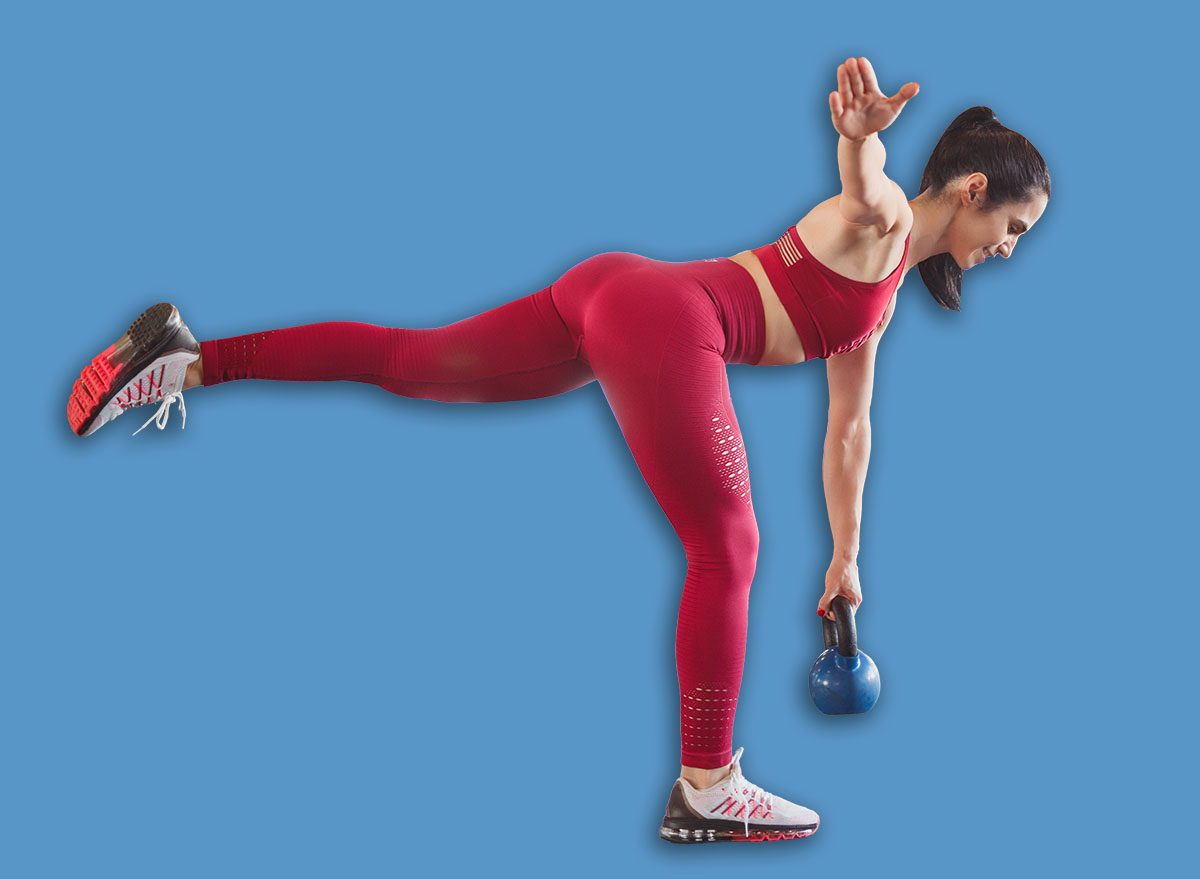
I like finishing hip workouts with an exercise that brings everything together. This movement strengthens the glutes, hamstrings, and core while challenging balance and hip stability at the same time. Holding onto a chair allows you to focus on proper mechanics instead of worrying about falling, making it an excellent option for adults over 60. Clients are often surprised by how effectively it targets the muscles along the back of the hips despite requiring little or no added weight. It’s one of the best functional exercises for building hip strength that translates directly into everyday movement.
How to Do It
- Stand beside a sturdy chair.
- Hold the chair lightly with one hand.
- Shift your weight onto one leg.
- Hinge forward at your hips while extending the opposite leg behind you.
- Return to standing with control.
- Perform 8 to 10 repetitions per leg.