5 Chair Exercises That Restore Glute Strength Faster Than Lunges After 60
There’s a point where weak glutes stop feeling like a “workout problem” and start becoming an everyday movement problem. Standing up takes more effort, stairs feel less powerful, and walks don’t have the same push. After 60, the glutes can lose strength due to too much sitting, less direct lower-body work, or simply not training the hips through enough purposeful movement.
Lunges are useful, but they can ask for more than some people are ready to give right away. Balance, knee comfort, stride control, and hip mobility all have to cooperate before the glutes get a fair shot at doing the work. Chair exercises create a better starting point because they add support, reduce guesswork, and let you focus on the muscles you’re actually trying to rebuild.
I like chair-based glute work because it gives people a way to train hard without feeling like they’re one bad rep away from wobbling across the room. Band abductions target the outer hips; adduction squeezes strengthen the muscles that help control leg position; standing hip extensions train the glutes directly; and sit-to-stands and reverse planks bring everything into larger movement patterns. The setup stays simple, but the work can be surprisingly effective when you slow down and make each rep count.
Seated Band Abduction
Seated band abductions target the outer glutes and hip stabilizers, which help keep your knees and hips aligned when you walk, stand, or climb stairs. Pressing your knees outward against the band provides direct resistance to the glutes without requiring you to stand or balance. Lunges also train the hips, but band abductions target an area that often needs extra attention after 60. Stronger outer glutes can help your lower body feel steadier and more controlled during daily movement.
Muscles Trained: Outer glutes, hip stabilizers, core
How to Do It:
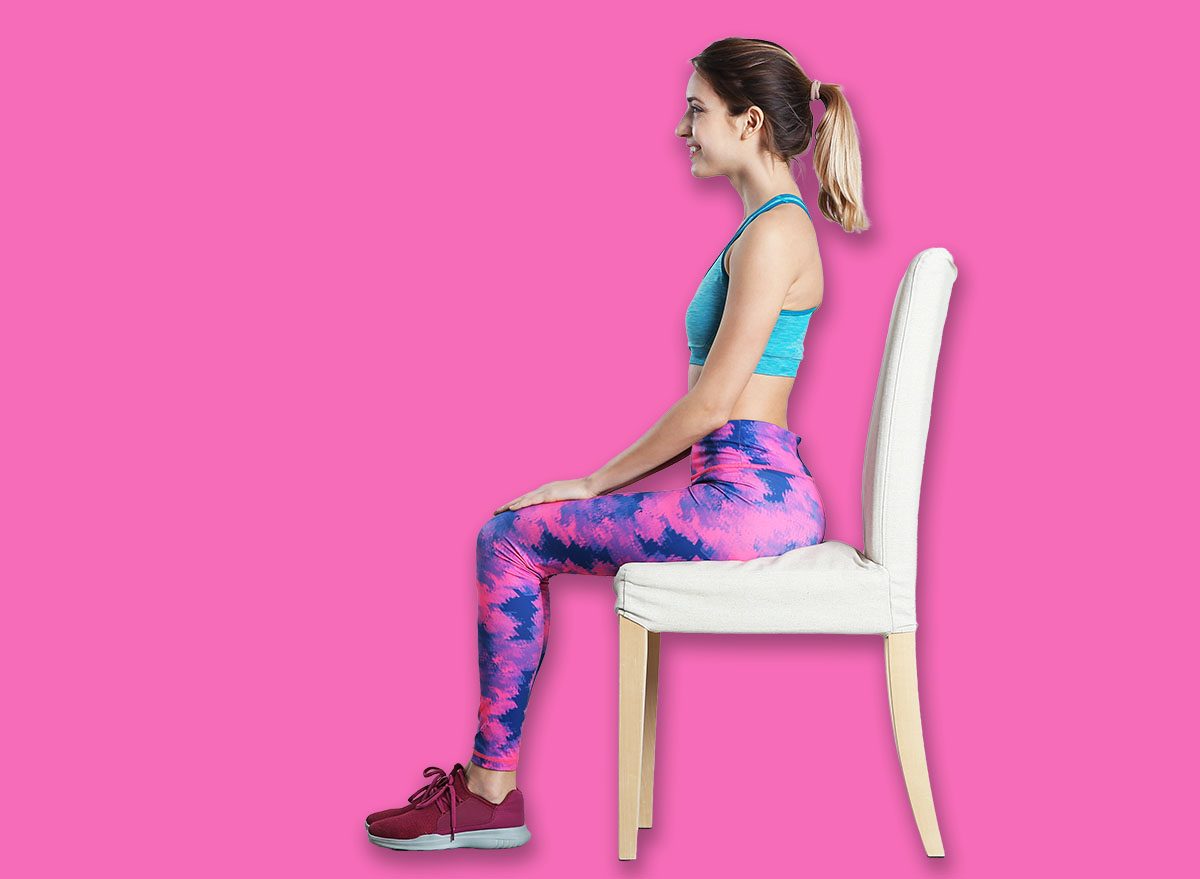
- Sit tall near the front edge of a sturdy chair.
- Place a mini band around your thighs just above your knees.
- Plant your feet flat on the floor about hip-width apart.
- Brace your core and keep your chest lifted.
- Press your knees outward against the band.
- Return your knees inward with control.
Recommended Sets and Reps: Perform 3 sets of 12 to 15 reps. Rest for 30 seconds between each set.
Best Variations: Paused abductions, pulsing abductions, single-leg abductions
Form Tip: Keep your feet planted and move from your hips.
Seated Adduction Squeeze
Seated adduction squeezes train your inner thighs, which help your hips control your legs when you walk, step, and shift direction. Glute strength works better when the muscles around the hips support each other, and the inner thighs play a bigger role than most people realize. Squeezing a pillow, ball, or yoga block between your knees builds strength through a simple, supported position. Better inner-thigh strength helps balance out the hips and gives your lower body more control than glute work alone.
Muscles Trained: Inner thighs, hip adductors, core
How to Do It:
- Sit tall with your feet flat on the floor.
- Place a pillow, small ball, or yoga block between your knees.
- Brace your core and keep your posture upright.
- Squeeze your knees together against the object.
- Hold the squeeze for the target time.
- Release with control before the next rep.
Recommended Sets and Reps: Perform 3 sets of 15 to 25 second holds. Rest for 30 seconds between each set.
Best Variations: Longer holds, pulsing squeezes, firmer object holds
Form Tip: Keep your feet flat and squeeze from your inner thighs.
Standing Hip Extension
Standing hip extensions train your glutes directly by moving your leg behind your body. The chair provides balanced support, so you can focus on squeezing the glute instead of arching your back or wobbling through the rep. Hip extension is one of the glutes’ main jobs during walking, stairs, and standing tall. Training it in a controlled way helps restore the backside strength that lunges can sometimes miss when balance or knee comfort becomes the limiting factor.
Muscles Trained: Glutes, hamstrings, core
How to Do It:
- Stand behind a sturdy chair and place your hands lightly on the backrest.
- Shift your weight into one foot.
- Brace your core and stand tall.
- Extend your opposite leg straight behind you.
- Squeeze your glute at the top.
- Lower your foot with control and switch sides after your reps.
Recommended Sets and Reps: Perform 3 sets of 10 to 12 reps per side. Rest for 30 to 45 seconds between each set.
Best Variations: Banded hip extensions, paused hip extensions, slower tempo hip extensions
Form Tip: Lift from your glute and avoid arching your lower back.
Sit-to-Stand
Sit-to-stands train your glutes, quads, hamstrings, and core while practicing one of the most important movements after 60. Every rep asks your hips and legs to generate force from a seated position, which carries straight into getting off the couch, getting out of the car, or rising from a dining chair. Compared with lunges, the chair gives you a clear target and a more stable way to build strength. Press through your feet, squeeze your glutes at the top, and avoid rocking for momentum.
Muscles Trained: Glutes, quadriceps, hamstrings, core
How to Do It:
- Sit near the front edge of a sturdy chair.
- Place your feet flat on the floor about hip-width apart.
- Brace your core and lean your torso slightly forward.
- Press through your feet to stand tall.
- Squeeze your glutes at the top.
- Lower back to the chair with control.
Recommended Sets and Reps: Perform 3 sets of 8 to 12 reps. Rest for 45 seconds between each set.
Best Variations: No-hands sit-to-stands, slow-tempo sit-to-stands, paused sit-to-stands
Form Tip: Control the descent and avoid dropping into the chair.
Chair Reverse Plank
Chair reverse planks train your glutes, hamstrings, core, and upper back while teaching your hips to stay extended. Sitting can leave the glutes underactive and the front of the hips tight, so holding hip extension gives your backside a needed wake-up call. Pressing your hips up also helps reinforce your posture and hip strength. Stronger reverse planks can make walking, standing, and climbing stairs feel more supported through your hips.
Muscles Trained: Glutes, hamstrings, core, upper back
How to Do It:
- Sit near the front edge of a sturdy chair.
- Place your hands on the sides of the seat.
- Walk your feet forward until your legs extend comfortably.
- Press through your heels and lift your hips off the chair.
- Squeeze your glutes and hold your body in a straight line.
- Lower your hips back to the chair with control.
Recommended Sets and Reps: Perform 3 sets of 15 to 25 second holds. Rest for 45 seconds between each set.
Best Variations: Bent-knee reverse plank, longer holds, alternating heel lift hold
Form Tip: Keep your chest open and finish the hold with your glutes.
How to Rebuild Glute Strength From a Chair
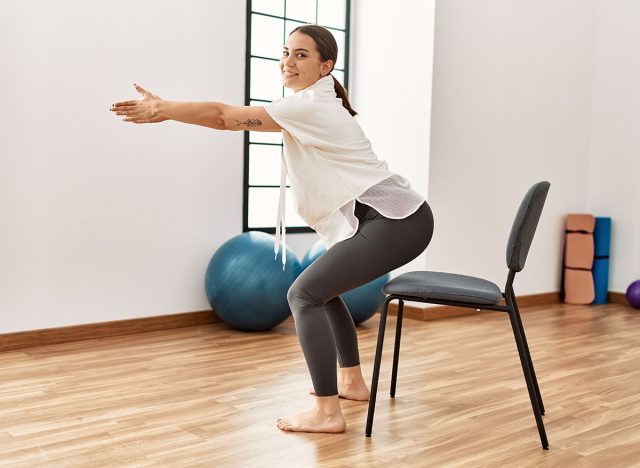
Chair exercises work best when the chair supports your position without stealing the work from your hips. Keep your reps slow, press through your feet, and make the glutes finish each movement. A few focused sessions each week can help your hips feel stronger, steadier, and more useful during everyday movement.
- Train the outer hips: Band abductions strengthen the muscles that help control your knees and pelvis. Better outer-glute strength can improve walking, balance, and lower-body alignment.
- Don’t ignore the inner thighs: Adduction squeezes help your hips control the position of your legs from the inside. Stronger adductors support smoother movement and better lower-body coordination.
- Use pauses for better tension: Hold the top of hip extensions, sit-to-stands, and reverse planks for a second or two. Pauses keep the glutes working longer without needing heavy weight.
- Keep your lower back quiet: Brace your core and keep your ribs down during hip extensions and reverse planks. Your glutes should drive the movement, not your spine.
- Progress with small changes: Add reps, hold longer, use a stronger band, or slow the tempo once the exercises feel easier. Small progressions keep the routine productive without making it overwhelming.
A stronger backside can change how daily movement feels. Build the habit with these chair exercises, and your hips will have more power and control when you stand, walk, climb, and move through the day.
References
- Inacio, Mario et al. “Gluteal muscle composition differentiates fallers from non-fallers in community dwelling older adults.” BMC geriatrics vol. 14 37. 25 Mar. 2014, doi:10.1186/1471-2318-14-37
- Klempel, Natalie et al. “The Effect of Chair-Based Exercise on Physical Function in Older Adults: A Systematic Review and Meta-Analysis.” International journal of environmental research and public health vol. 18,4 1902. 16 Feb. 2021, doi:10.3390/ijerph18041902