4 Daily Exercises That Restore Ankle Strength Faster Than Gym Workouts After 60

Your ankle is a joint you use every single day. It’s where your talus, calf, and shin bones meet, joining your lower leg to your foot. Strong ankles are necessary to keep you mobile, balanced, and stable on your own two feet; they also help you walk, run, climb, and stand up with ease.
“We think of the ankle as an afterthought a lot of times. The thing is, the ankle is not an accessory to the balance system. In fact, it is the front line of the balance system,” explains Terry Tateossian, Founder, Certified Lifestyle Medicine Coach, Trainer, and Nutritionist for Women 40+ at THOR – The House of Rose, who has completed a variety of advanced training to support her work in women’s health and middle-aged weight loss. “When you feel yourself starting to lose balance, the ankle is the first line of defense. The small and fast micro adjustments in the foot and lower leg are what catch you before the bigger hip muscle activates. The specific consequences of reduced ankle stability create a number of issues: Your foot clearance drops, your side-to-side mobility and lateral stability fail, your gait shortens, which creates a fall risk just on its own, and your stability on stairs collapses.”
Essentially, ankle strength is crucial for leading an active, independent life. To get started restoring ankle strength faster than gym workouts, below are four daily exercises you can include in your routine.
Heel Raises With Counter Touch
“Heel raises are a direct exercise for calf strength and posterior ankle stability, which helps strengthen the calf muscles as they are the fastest muscle to atrophy in the body after 60 years old,” Tateossian tells us.
- Begin standing tall, facing a counter with your hands lightly resting on the surface for support.
- Place your feet hip-width apart.
- Slowly rise onto the balls of your feet.
- Hold at the top for 1 second.
- Slowly lower back down.
- Perform 3 sets of 15 to 20 reps, Tempo 3010. Rest for 60 seconds between sets.
Toe Raises
“This is an exercise that is highly underrated, but it’s one I would recommend the most. It trains the tibialis anterior—on the front side of the shin—which is what we use during walking. As we age, and this muscle weakens, the foot starts to drop slightly, and the toes catch on carpets or curbs, which creates tripping hazards for people. Some of the falls I’ve seen in older adults could be very much preventable with daily toe raises,” Tateossian shares.
- Begin standing with your back a few inches from a wall.
- Keep your heels planted on the floor.
- Lift your toes and the balls of your feet off the ground as high as you’re able to.
- Slowly lower.
- Perform 3 sets of 15 to 20 reps, Tempo 3010. Rest for 60 seconds between sets.
Single-Leg Balance Hold
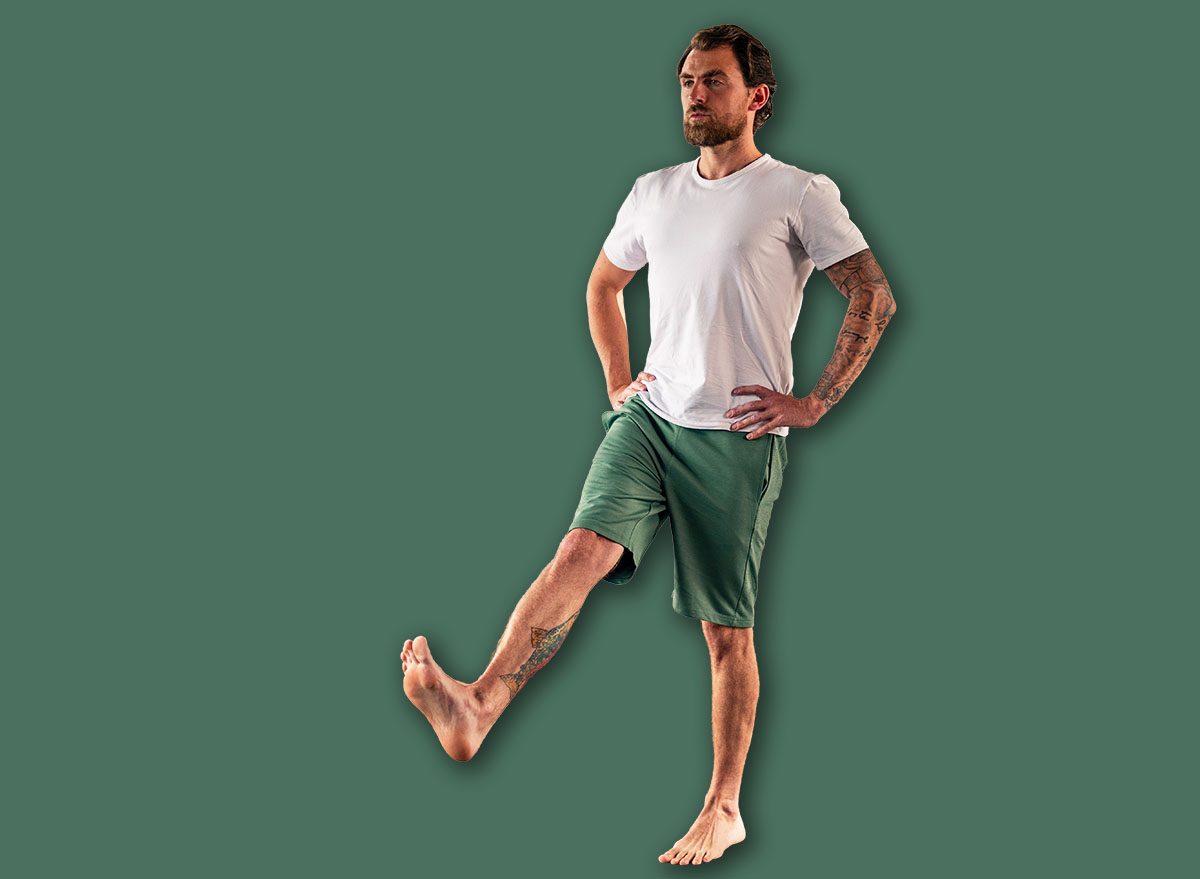
“This exercise directly trains proprioception, which is the sense of where our bodies are in space. It helps prevent falls, which is the number one injury for people over 60,” Tateossian explains.
- Begin standing near a countertop for balance.
- Lift one foot slightly off the ground.
- Hold your balance on the standing leg for about 15 to 30 seconds.
- Perform 3 sets per side.
RELATED: Over 45? If You Can Hold These 3 Positions, You’re Stronger Than Most
Ankle Alphabets
“This is simple enough to do daily, and it moves the ankle through its full range of motion in every direction. The muscles targeted here are the ones that prevent sideways ankle rolls, which are the most serious cause of ankle injuries in adults over 60,” Tateossian points out.
- Begin sitting tall in a chair.
- Lift one foot off the ground.
- Slowly draw the letters of the alphabet in the air with your big toe.
- Switch sides.