5 Dumbbell Exercises That Restore Core Strength Faster Than Planks After 60
Core training tends to get boxed into one category after 60. Most people default to planks, hold on as long as they can, and call it a day. That can help, but it often leaves a lot on the table. Your core is responsible for far more than just holding a static position. It stabilizes your spine, transfers force between your upper and lower body, and keeps you balanced through real-world movement. When you train it dynamically with resistance, you tap into strength that actually carries over into how you move and feel every day.
This is where dumbbells shine. They let you load your core in multiple directions while staying upright and moving naturally. From my experience coaching clients over the years, especially those looking to rebuild strength and confidence in their 60s and beyond, the biggest breakthroughs come when we shift away from static holds and start training the core through motion. Anti-rotation, loaded carries, and controlled movement patterns light up your core in a way planks simply can’t match.
If your goal is to restore strength and feel more stable in everything you do, your core training needs to reflect that. The exercises below build strength through movement, challenge your balance, and reinforce how your core is meant to function. Let’s get into the moves that make a real difference.
Suitcase Carry
This is one of the most effective ways to train your core without ever getting on the floor. Holding a weight on one side forces your core to resist bending and twisting with every step you take. That anti-lateral flexion demand lights up your obliques and deep stabilizers immediately. It also reinforces posture, which becomes increasingly important as you age. Over time, this builds a strong, resilient core that supports everything from walking to lifting.
Muscles Trained: Obliques, transverse abdominis, rectus abdominis, and grip
How to Do It:
- Hold a dumbbell in one hand at your side.
- Stand tall with your shoulders level and core braced.
- Begin walking forward with controlled, steady steps.
- Keep your torso upright and avoid leaning to one side.
- Maintain tight core engagement throughout the walk.
- Switch hands after completing your distance or time.
Recommended Sets and Reps: Perform 3 to 4 sets of 20 to 40 seconds per side. Rest for 45 to 75 seconds between each set.
Best Variations: Farmer carry, offset carry, rack carry
Form Tip: Imagine balancing a glass of water on your head and keeping your posture tall.
Dumbbell Dead Bug
The dead bug teaches your core how to stabilize your spine while your limbs move, which is exactly how your body functions in real life. Adding a dumbbell increases the challenge and forces your core to work harder to maintain control. You’ll feel your deep core muscles engage as you resist the urge to arch your lower back. This builds strength and coordination at the same time. It’s a foundational movement that pays off quickly.
Muscles Trained: Transverse abdominis, rectus abdominis, hip flexors, and shoulders
How to Do It:
- Lie on your back holding a dumbbell with both hands above your chest.
- Raise your legs into a tabletop position.
- Press your lower back into the floor.
- Extend one leg while keeping the other bent.
- Return to the starting position and alternate legs.
- Keep the dumbbell steady throughout the movement.
Recommended Sets and Reps: Perform 3 sets of 10 to 12 reps per side. Rest for 45 to 75 seconds between each set.
Best Variations: Single-arm dead bug, alternating reach dead bug, tempo dead bug
Form Tip: Keep your lower back pressed firmly into the floor throughout.
RELATED: If You Can Hold a Plank This Long After 50, Your Core Strength Is Stronger Than 90% of Peers
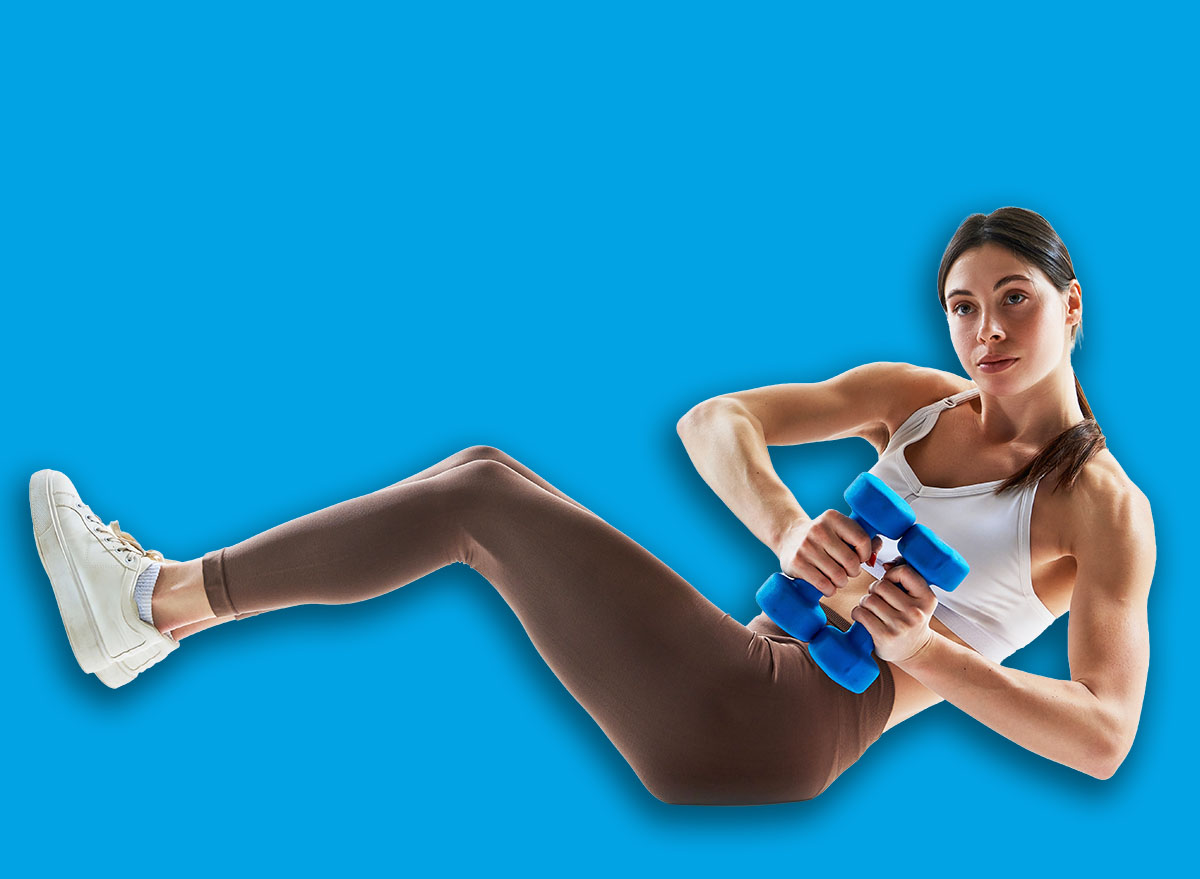
Dumbbell Russian Twist
Rotational strength is often overlooked, but it plays a major role in maintaining mobility and coordination. The Russian twist trains your core to control rotation rather than just create it. Holding a dumbbell adds resistance, which increases the demand on your obliques. This helps improve how your body transfers force and maintains balance. It’s a great way to bring more complete core development into your routine.
Muscles Trained: Obliques, rectus abdominis, and hip flexors
How to Do It:
- Sit on the floor holding a dumbbell with both hands.
- Lean back slightly while keeping your chest lifted.
- Lift your feet off the ground if comfortable.
- Rotate your torso to one side, bringing the dumbbell across your body.
- Rotate to the opposite side in a controlled manner.
- Continue alternating sides with steady control.
Recommended Sets and Reps: Perform 3 sets of 12 to 16 reps per side. Rest for 45 to 75 seconds between each set.
Best Variations: Feet-down twist, slow tempo twist, pause twist
Form Tip: Rotate through your torso, not just your arms.
Dumbbell Front Carry
Holding a dumbbell in front of your body forces your core to brace and resist extension. This position challenges your deep stabilizers while reinforcing strong posture. It also engages your upper body and teaches your core how to support load in a functional position. You’ll notice how quickly your core fatigues while still staying upright. That’s exactly the kind of strength that carries over into daily life.
Muscles Trained: Rectus abdominis, transverse abdominis, shoulders, and upper back
How to Do It:
- Hold a dumbbell at chest height with both hands.
- Stand tall with your core braced.
- Begin walking forward in a controlled manner.
- Keep your elbows slightly tucked and your chest upright.
- Maintain steady breathing throughout the movement.
- Continue for the desired time or distance.
Recommended Sets and Reps: Perform 3 sets of 20 to 40 seconds. Rest for 45 to 75 seconds between each set.
Best Variations: Double dumbbell front carry, alternating carry, offset front carry
Form Tip: Avoid letting the weight pull your torso forward.
Dumbbell March
The dumbbell march challenges your core in a subtle but powerful way. Each step forces your body to stabilize as you shift weight from side to side. This builds balance, coordination, and core strength all at once. It also mimics real-world movement, which makes it incredibly useful for maintaining independence and confidence. Over time, it helps reinforce a strong, stable foundation.
Muscles Trained: Core stabilizers, hip flexors, glutes, and obliques
How to Do It:
- Hold a dumbbell in one or both hands.
- Stand tall with your core engaged.
- Lift one knee up to hip height.
- Lower it back down with control.
- Alternate legs in a marching pattern.
- Maintain balance and posture throughout.
Recommended Sets and Reps: Perform 3 sets of 10 to 14 reps per leg. Rest for 45 to 75 seconds between each set.
Best Variations: Suitcase march, front-loaded march, slow tempo march
Form Tip: Move slowly and avoid leaning side to side.
The Best Actions for Restoring Core Strength After 60

Restoring core strength after 60 comes down to training your body to move the way it’s meant to. Your core isn’t just there for aesthetics or holding static positions. It’s the center of everything you do, from standing and walking to lifting and reaching. When you train it through movement and resistance, you build strength that actually supports your daily life. Dumbbells make this process simple, effective, and easy to adjust as you improve. Stick with it, and you’ll notice better posture, improved balance, and a stronger, more capable body.
Here’s how to maximize your results:
- Train your core through movement: Focus on carries, marches, and controlled rotations rather than static holds.
- Prioritize posture: Keep your torso tall and your ribs stacked over your hips during every exercise.
- Use manageable loads: Choose weights that challenge you without breaking your form.
- Stay consistent with volume: Aim for 8 to 12 total working sets per week.
- Control your tempo: Slow, controlled reps improve muscle engagement and stability.
- Breathe with intention: Exhale during effort to reinforce core bracing.
Build your core with purpose, and you’ll feel the difference in everything you do.
References
- Bustos Carvajal, Juan Sebastian, and Florencio Arias Coronel. “Exploring the role of the core in sports performance: a systematic review of the effects of core muscle training.” Frontiers in sports and active living vol. 7 1630584. 30 Sep. 2025, doi:10.3389/fspor.2025.1630584
- Zhong, Yuanji et al. “Effects of core training on balance performance in older adults: a systematic review and meta-analysis.” Frontiers in public health vol. 13 1661460. 9 Oct. 2025, doi:10.3389/fpubh.2025.1661460