If You Can Hold a Farmer’s Carry This Long After 60, Your Full-Body Strength Is Top-Tier
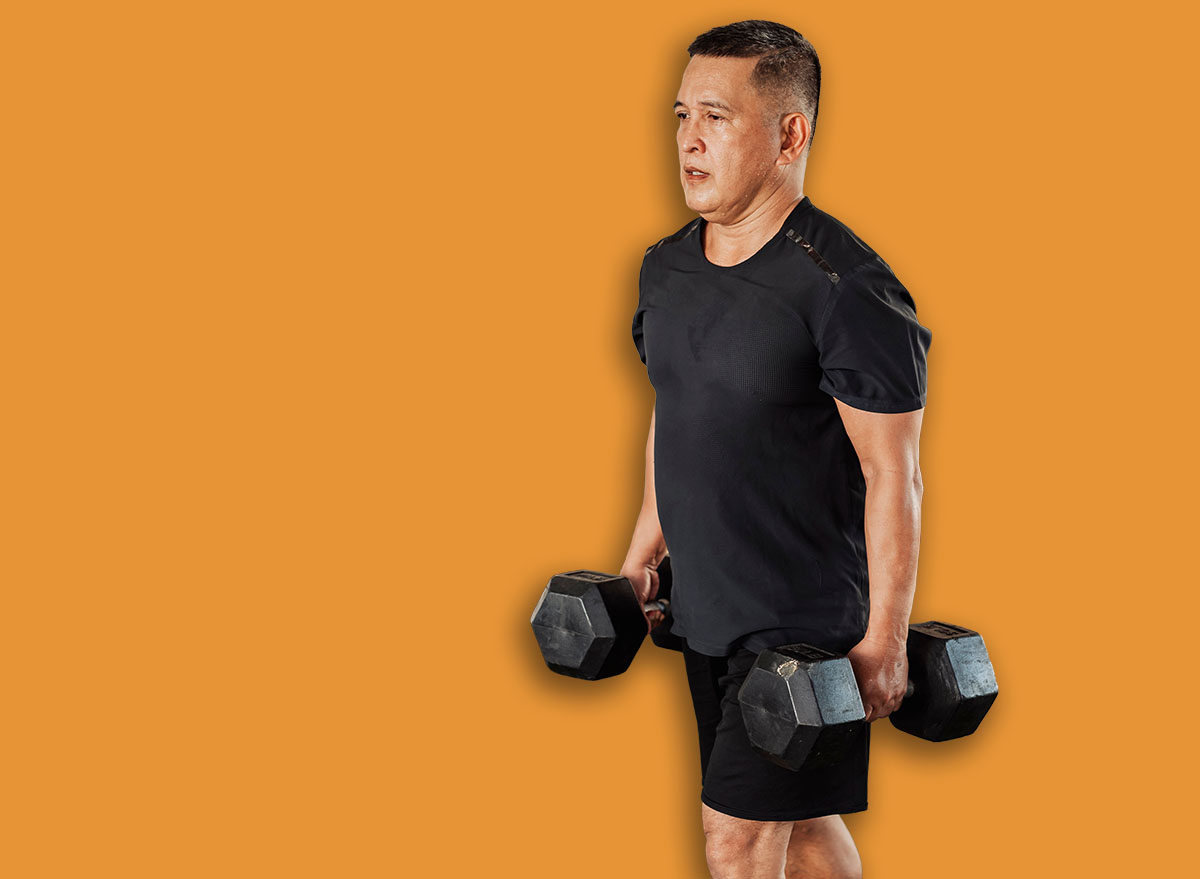

The farmer’s carry is a powerful strength builder—any actual farmer can attest to that! The functional strength exercise gets its name from the vigorous everyday tasks of farmers, like carrying heavy weight in the form of hay bales, buckets of water, and farm equipment in each hand. A gym workout would involve carrying heavy kettlebells or dumbbells, and it’s a surefire way to build full-body strength—especially in the upper back, grip, and overall conditioning. The movement also emphasizes stability and upright posture while carrying heavy weights.
We spoke with Rob Moal, CPT with Train Like Rob who’s based in Vancouver, BC, and Life Time Edina Personal Trainer Karina Wait, who break down the benefits of the exercise for those who want to build and maintain strength. Moal has more than 20 years of experience under his belt helping clients build strength, shed fat, and move without pain. He holds certifications in personal training, nutrition, TRX, FMS, CAFS (Grey Institute), kettlebell training, corrective exercise, Twist Conditioning, and CrossFit, specializing in strength, mobility, and recovery for individuals 35+.
Why Is the Farmer’s Carry Such an Effective Test of Total-Body Strength and Endurance?
According to Moal, the farmer’s carry is essentially a moving plank under load, where grip, core anti-rotation, shoulder and hip stability, and single-leg loading all occur at once. As he puts it: “Nothing is isolated, and nothing gets to rest.” This exercise translates to everyday strength after 60, from carrying grocery bags to luggage.
“[The farmer’s carry] is a fundamental movement because it forces your body to act as one solid piece while you’re in motion,” Wait adds. “Your grip and forearms do the heavy lifting, but your upper back and shoulders are the anchors that keep your arms from being pulled out of position. To stay upright, your abs and obliques wrap around your spine like a tight corset, preventing the weights from wobbling you side-to-side. Meanwhile, your hips and glutes keep your foundation steady with every step. If any of these parts get lazy, the whole movement falls apart, which is why it’s such a perfect way to build ‘functional’ strength.”
If You Can Hold a Farmer’s Carry This Long After 60, Your Full-Body Strength Is Top-Tier
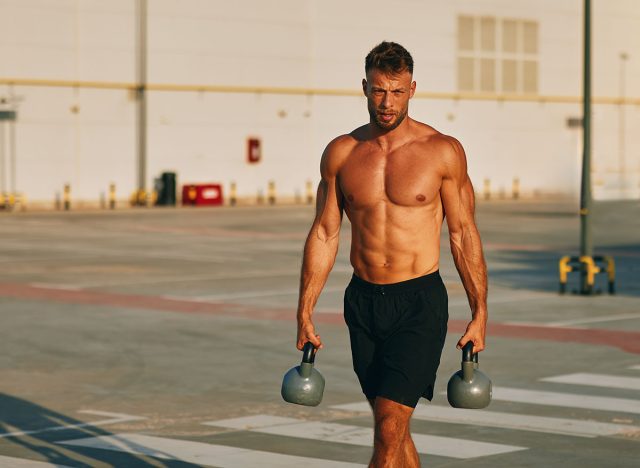
If you’re over 60, working your way up to 50% of your body weight for a farmer’s carry is a solid place to start. In Moal’s experience working with clients 60+, top-tier means carrying more than 50% of your body weight for roughly 98 to 131 feet while maintaining proper posture. For instance, for a 180-pound person, that means carrying 90 pounds or more.
“But honestly, the numbers matter less than the quality,” Moal stresses. “Grip doesn’t fail before posture, no forward lean, smooth controlled steps, and you can repeat sets. That combination is genuinely rare after 60.”
What Strong Performance Indicates About Your Balance, Posture, and Core Stability
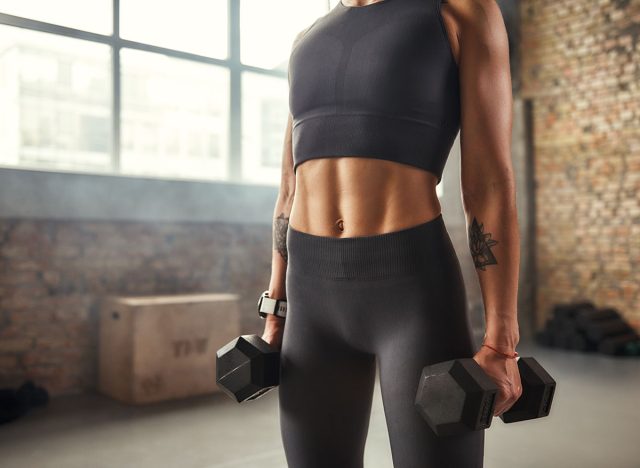
If you’re able to carry well after 60, that signals solid functional strength.
“The carry demands the core resist being pulled sideways under load, and that’s the exact same thing that keeps you from going down when you trip,” Moal explains. “Every step is a single-leg event, so if you can do it well, your hips and balance are working the way they should. It tells you more about real-world strength than most gym tests.”
According to Wait, completing a heavy farmer’s carry is proof that your body’s “built to last.” Your posture and upper back are solid enough to resist the constant pull of the weight, helping you to stand tall rather than slouch.
“Your core has to stay locked in—from your abs all the way to your spine—to keep you upright and rock-steady,” Wait adds. “Most importantly, it’s a masterclass in balance; since you’re moving one foot at a time, your hips and midsection act like a car stabilizer bar, keeping you level no matter how much the load tries to tip you over. As an added bonus, this total-body tension teaches your muscles to ‘clamp down’ and support your frame, which takes the jarring pressure off your joints and puts the work where it belongs.”
How To Improve and Progress
In order to achieve a rock-solid carry, mastering stillness before moving is key, Wait says. She recommends kicking things off with static suitcase holds, where you’ll stand tall, holding a dumbbell or kettlebell only in one hand for 3 to 4 sets of 30 seconds on each side. Once you complete all sets without leaning or your grip slipping, move on to the double-arm hold.
“Because the load is now balanced, your body can handle much more—start with your suitcase weight in both hands and aim to increase the total load by 25 to 50%. For example, if you mastered a 30-pound suitcase hold, jump to 40 pounds in each hand for your double-arm hold. Stay at this level until you can stand tall for 3 to 4 sets of 60 seconds,” Wait instructs. “Mastering this static ‘capacity test’ proves your posture can handle the weight before you add the instability of walking. When you finally transition to the farmer’s carry, start with that same heavy weight for 30 seconds. As it becomes manageable, push the time to 60 seconds before increasing the weight by another 5 to 10 pounds. and resetting the clock. This ensures your grip and joints are just as ready as your muscles for heavier loads.”