4 Floor Exercises That Rebuild Core Strength Faster Than Planks After 60

If you’re passionate about improving your fitness and overall well-being, you know that your core deserves extra TLC. After all, your core provides power to your abdominal muscles, hips, pelvis, and lower back. A strong core also supports your spine, keeps you balanced, and allows you to bend, lift, reach, and more with ease.
We learned how to rebuild core strength faster than planks after 60. Dr. Akanni Salako, a Doctor of Physical Therapy, Personal Trainer, and the Founder and Head Wellness Coach of The Wellness Lab, who is a passionate advocate for women’s health and well-being, shares four floor exercises you can do to get started.
“There’s nothing wrong with planks, but a plank primarily asks you to hold one position and resist movement,” Dr. Salako explains. “These four exercises give you more variety. The dead bug teaches you to stabilize while your limbs move. The Russian twist trains controlled rotation. The reverse crunch trains controlled trunk and pelvic movement. And the bird dog challenges stability while opposite sides of the body work together. So instead of asking, ‘Can you hold your core tight for 30 seconds?’ we’re asking, ‘Can your core stay strong and controlled while the rest of your body moves?'”
The best part about these exercises is you only need a mat, some space, and your body weight to get started.
Dead Bug
“The dead bug is one of my go-to core exercises after 60 because it trains core stability, coordination, and control simultaneously. You’re learning to keep your trunk and pelvis stable while moving your arms and legs independently. That ability to control your midsection while your limbs are moving carries over directly into everyday movement,” Dr. Salako says.
- Lie flat on your back with your arms extended toward the ceiling and knees lifted in a tabletop position.
- Press your back into the mat and brace your core.
- Lower one arm and the opposite leg.
- Return to the start position.
- Repeat on the other side and continue to alternate.
Russian Twists
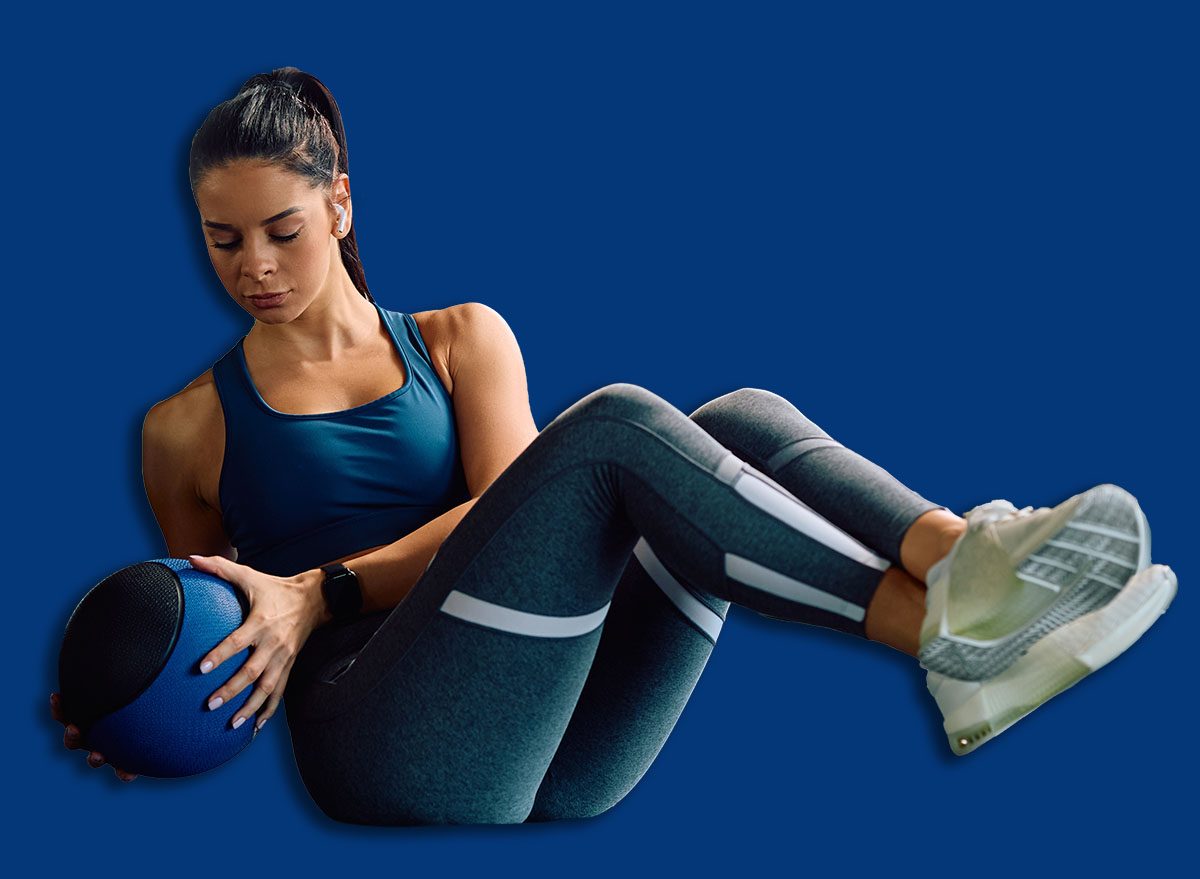
“Russian twists introduce something a traditional plank doesn’t give you: rotation. They target the obliques and teach you to control your trunk as you rotate from side to side. I would start with body weight and a comfortable range of motion before adding resistance—especially for someone who hasn’t trained their core consistently,” Dr. Salako explains.
- Begin seated on a workout mat.
- Bend both knees and lift your feet off the floor.
- Lean back slightly so your upper body forms a 45-degree angle with the ground.
- Keep your hands clasped at the front of your chest.
- Engage your abs as you twist to your left side, then back to the center, then to the right.
Reverse Crunch
“I like reverse crunches because they train the abdominals while requiring you to control the position of your pelvis. Rather than simply holding your body still, you’re actively moving the pelvis toward the rib cage under control. This can be done with one leg at a time like a march, or with both legs simultaneously. I generally prefer these over straight-leg raises for many adults over 60 because they’re easier to modify and don’t require as much hip-flexor involvement,” Dr. Salako points out.
- Lie flat on your back with bent knees and feet flat on the ground, hip-width apart.
- Place your hands at your sides, palms facing down.
- Brace your core and gradually curl your tailbone off the floor, bringing your knees to your chest with control.
- Hold at the top for a moment before lowering without letting your feet touch the ground.
Bird Dog
“Bird dogs are excellent because they combine core stability with balance, coordination, and cross-body movement. You’re reaching with the opposite arm and leg while trying to prevent your trunk and pelvis from rotating. That’s much closer to how your core actually has to function when you’re walking and performing everyday activities,” Dr. Salako notes.
- Start on all fours.
- Extend your left arm and right leg.
- Hold for a moment before returning to the start position.
- Switch sides and continue to alternate.