4 Daily Exercises That Rebuild Glute Strength Faster Than Squats After 55
Squats build strong legs, but they don’t always give the glutes enough direct work. Many people feel squats mostly in their thighs, lower back, or knees, especially when hip strength has started to fade. Rebuilding the glutes requires exercises that engage the hips to extend, stabilize, and press outward against resistance.
The quickest correction I make with clients is getting them to feel the glutes work before adding more load. A solid glute rep should feel controlled through the hips, with the low back quiet and the knees steady. Once that connection improves, strength builds faster because the right muscles are finally doing the job.
These four daily exercises target the glutes from the floor and a seated position. Use them as a short routine, move with control, and keep the resistance light enough to feel the hips working cleanly.
Dumbbell Glute Bridge
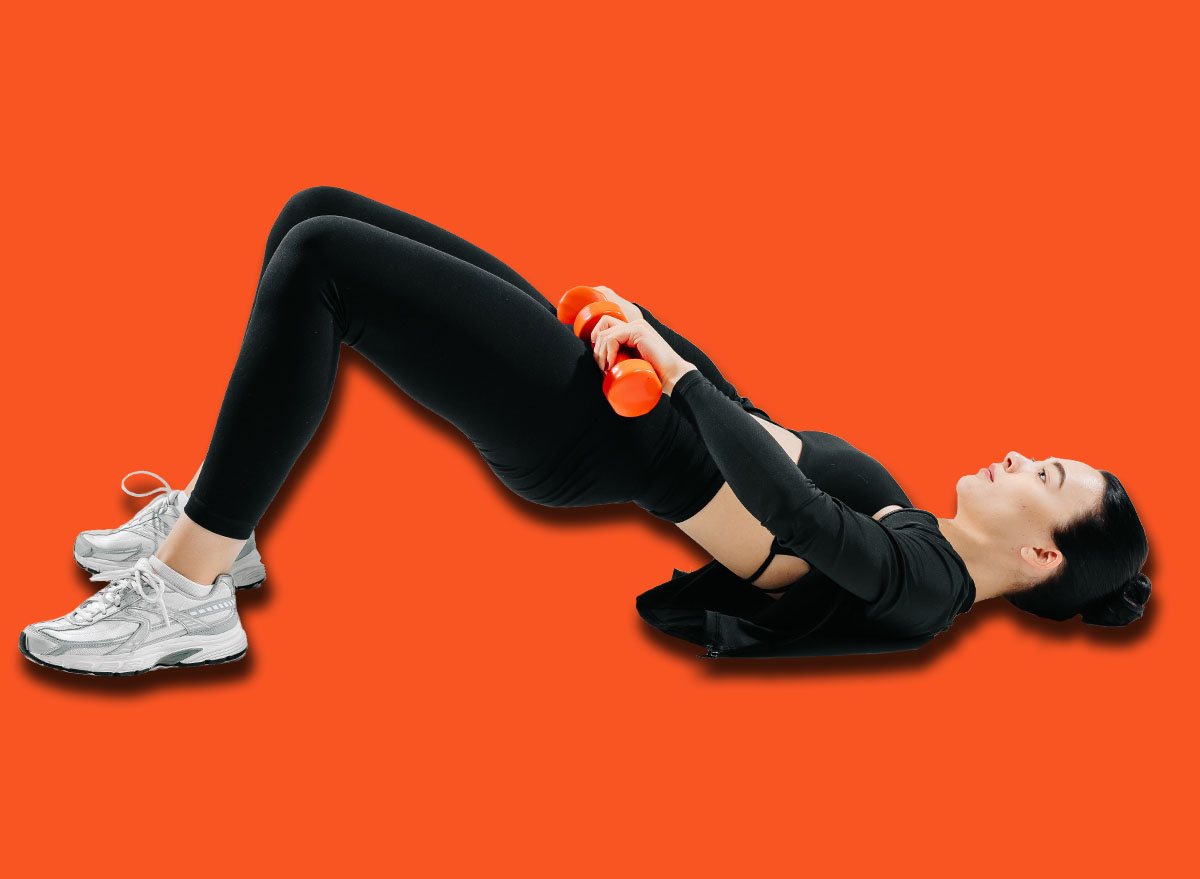
The dumbbell glute bridge targets hip extension, one of the glutes’ main functions. Adding a light dumbbell across your hips increases the challenge without complicating the movement. Pause at the top and have the glutes do the lifting.
Muscles Trained: Glutes, hamstrings, hips, core.
How to Do It:
- Lie on your back with your knees bent and feet flat on the floor.
- Place a dumbbell across your hips and hold it steady.
- Brace your core and press through your heels.
- Lift your hips until your glutes tighten.
- Pause for one second at the top.
- Lower with control and repeat.
Recommended Sets and Reps: Perform 3 sets of 10 to 12 reps. Rest for 45 seconds between sets.
Best Variations: Bodyweight glute bridges, bridge holds, slow-tempo glute bridges.
Form Tip: Keep your ribs down so your glutes lift your hips, not your lower back.
Single-Leg Glute Bridge Hold
The single-leg glute bridge hold builds glute strength one side at a time. Holding the top position forces the working hip to stay active while your core keeps the pelvis level. This is a strong option for rebuilding strength and fixing side-to-side differences.
Muscles Trained: Glutes, hamstrings, hips, core.
How to Do It:
- Lie on your back with your knees bent and feet flat.
- Lift one foot off the floor.
- Brace your core and press through the heel of your working leg.
- Lift your hips into a bridge.
- Hold the top position while keeping your hips level.
- Lower with control, then switch sides.
Recommended Sets and Reps: Perform 3 sets of 10 to 20-second holds per side. Rest for 30 to 45 seconds between sides.
Best Variations: Two-leg bridge holds, single-leg-assisted holds, slow-tempo single-leg bridges.
Form Tip: Keep both hip bones facing the ceiling as you hold.
Banded Clamshell
Banded clamshells strengthen the outer glutes, which help control the hips and knees during walking, climbing stairs, and squats. The movement is small, but it should feel precise. Use a light band and avoid rolling your hips backward as the knee opens.
Muscles Trained: Glute medius, glute minimus, outer hips, core.
How to Do It:
- Lie on your side with your knees bent.
- Place a light mini band above your knees.
- Stack your hips and keep your feet together.
- Brace your core and open your top knee.
- Pause briefly at the top.
- Lower with control and repeat before switching sides.
Recommended Sets and Reps: Perform 3 sets of 12 to 15 reps per side. Rest for 30 seconds between sides.
Best Variations: Bodyweight clamshells, pause clamshells, slow-tempo clamshells.
Form Tip: Keep your hips stacked so the outer glute does the work.
Seated Band Abduction
Seated band abductions provide direct resistance to the outer hips from a simple position. Pressing the knees outward against the band helps strengthen the glutes, which keep the lower body aligned. Sit tall and control the return so the band doesn’t pull your knees back in.
Muscles Trained: Glute medius, glute minimus, outer hips, core.
How to Do It:
- Sit tall near the front edge of a sturdy chair.
- Place a light mini band above your knees.
- Set your feet flat on the floor about hip-width apart.
- Brace your core and press your knees out against the band.
- Pause briefly at the widest point.
- Return with control and repeat.
Recommended Sets and Reps: Perform 3 sets of 15 to 20 reps. Rest for 30 to 45 seconds between sets.
Best Variations: Lighter-band abductions, pause abductions, slow-tempo abductions.
Form Tip: Keep your feet planted and avoid leaning back as your knees move.
How to Use These Exercises to Rebuild Glute Strength After 55
Use this routine five to seven days per week as a short glute-strength block. Keep the effort moderate if you perform it daily. Push harder two to three days per week, then use lighter tension on the other days.
- Start with clean contractions: Feel the glutes working before adding weight or band tension.
- Keep the low back quiet: Reduce the range if your lower back starts taking over during bridges.
- Train both sides evenly: Single-leg holds and clamshells help each hip build strength on its own.
- Progress gradually: Add a few reps, extend the hold, use a slightly stronger band, or add a light dumbbell once the current version feels solid.
- Use the strength in daily movement: Walk, climb stairs, and stand up from chairs with more awareness of driving through your hips.
Stronger glutes can make your lower body feel more stable and powerful. Keep the routine simple, repeat it consistently, and let better hip strength build one controlled rep at a time.
References
- Jeong, Ui-Cheol et al. “The effects of gluteus muscle strengthening exercise and lumbar stabilization exercise on lumbar muscle strength and balance in chronic low back pain patients.” Journal of physical therapy science vol. 27,12 (2015): 3813-6. doi:10.1589/jpts.27.3813
- Inacio, Mario et al. “Gluteal muscle composition differentiates fallers from non-fallers in community dwelling older adults.” BMC geriatrics vol. 14 37. 25 Mar. 2014, doi:10.1186/1471-2318-14-37
- Krause Neto, Walter et al. “The impact of resistance training on gluteus maximus hypertrophy: a systematic review and meta-analysis.” Frontiers in Physiology vol. 16 1542334. 10 Apr. 2025, doi:10.3389/fphys.2025.1542334