If You Can Do This Many Pushups After 50, Your Upper Body Is Elite
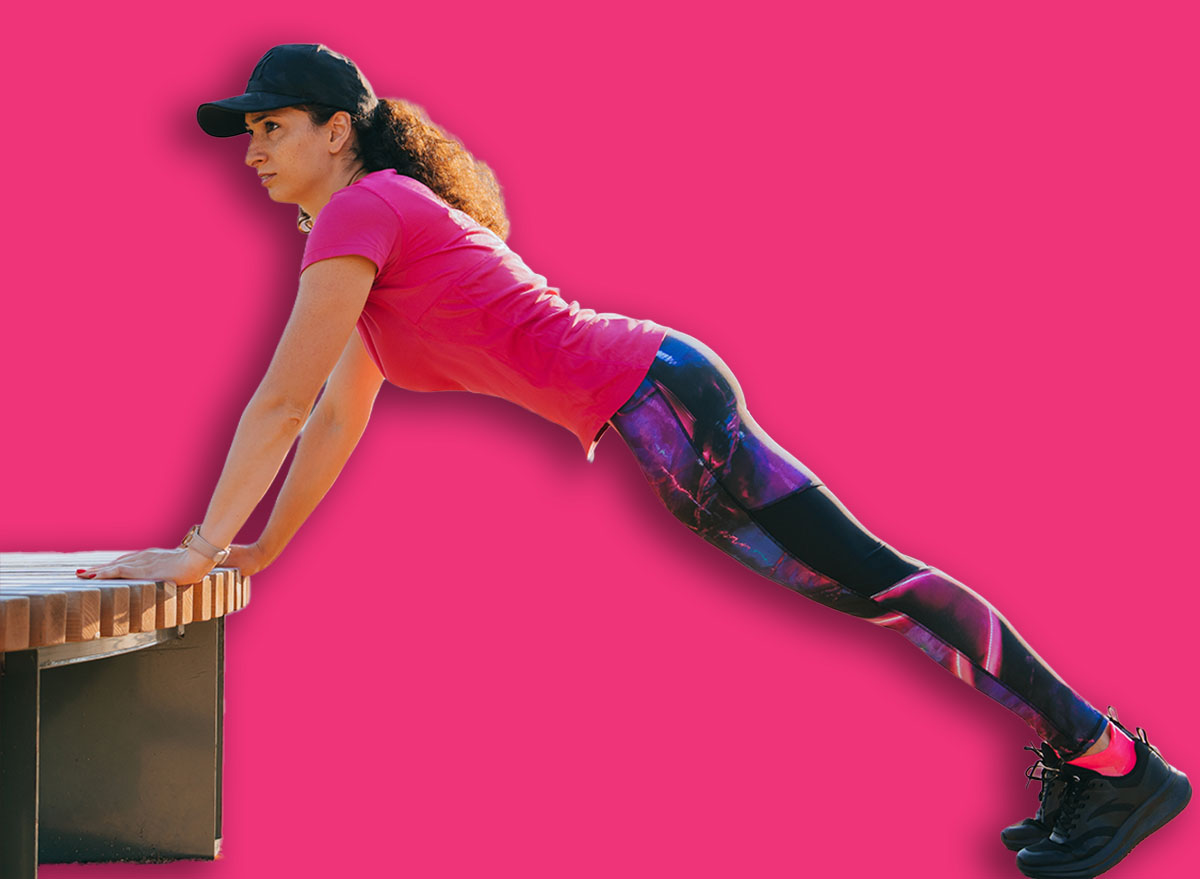

Pushups don’t lie. After 50, you can tell a lot about someone’s strength, joint health, and overall fitness by how many they can perform. And unlike machine exercises that guide your movements, pushups require raw strength that research shows puts your chest, triceps, shoulders, and core to the test. That means if you can crank out a high number of pushups with good form, your upper body is elite for your age group.
We spoke with James Brady, a certified personal trainer at OriGym, who tells us, “For people over 50, being able to perform 30 or more pushups for men and 20 or more for women puts you in the elite range. These numbers show exceptional upper body and core strength for your age group.”
Brady explains that hitting those reps not only exemplifies real strength, but also reflects muscle endurance, coordination, and excellent joint stability. He adds, “Hitting those reps means you’ve maintained muscle mass, coordination, and cardiovascular health well beyond the average, showing that your body is aging exceptionally well.”
Research published in JAMA Internal Medicine found that better muscular strength is linked to lower all-cause mortality risk. Additionally, pushups specifically have been shown to be a benchmark for healthy aging. According to a 2019 study, men who could complete 40 or more pushups had a 96 percent lower risk of cardiovascular events, compared to those who could do fewer than 10. While this particular study focused on men, the takeaway applies to all gender identifications, which is that upper-body endurance is an excellent indicator of metabolic and heart health.
But pushups are only part of the picture. To reach (or surpass) the elite rep range Brady suggests, you need balanced strength across your entire upper body and core. The following five exercises work together to help you build the pressing power, shoulder stability, posterior-chain strength, and core power that make high pushup numbers possible after 50.
Read on for the step-by-step instructions. Then, when you’re finished, check out these 4 Daily Standing Moves That Reverse Muscle Loss Faster Than Gym Machines After 50.
Incline Pushups
If you’re aiming to increase your pushup count, this is the foundational movement to master. Incline pushups reduce the load while allowing you to perfect form and gradually build joint resilience and chest and tricep strength. Also, they strengthen the same muscles as floor pushups but in a safer, more controlled way for beginners.
How to do it:
- Place your hands on a countertop, bench, or sturdy table.
- Step your feet back until your body forms a straight line.
- Lower your chest toward the surface while keeping elbows at roughly 45-degree angles.
- Push back to the starting position with control.
- Perform three sets of 10 to 15 reps.
- Rest for 60 to 90 seconds between sets.
Standing Chest Press with Bands
Incorporating resistance bands into your pushup exercises will add constant tension, helping you build strength throughout the entire movement. Resistance band presses also reinforces the scapular stability you need for pain-free pushups after 50.
How to do it:
- Loop a resistance band around a sturdy pole at chest height.
- Hold the handles and step forward to create tension.
- Press your hands forward until your arms are fully extended.
- Slowly return to the starting position.
- Complete three sets of 12 to 15 reps.
- Rest for 60 to 90 seconds between sets.
Plank Holds
It goes without saying that elite pushup performers have elite core strength. If your midsection collapses during pushups, everything else collapses with it. That’s why including planks in your workouts will help strengthen the deep core stabilizing muscles that keep your spine aligned so your arms can generate maximum force for doing as many pushups as possible.
How to do it:
- Set your elbows under your shoulders and step your feet back.
- Engage your core without allowing your hips to sag or lift too high.
- Hold for 20 to 40 seconds.
- Repeat three times with 60 to 90 seconds of rest between holds.
Bent-Over Dumbbell Rows
It sounds counterintuitive, but pushup strength requires a strong back. Dumbbell rows balance your push muscles, reinforce shoulder mechanics, and prevent rounded posture, all of which can help improve pushup endurance and help you do a few more.
How to do it:
- Hold dumbbells at your sides and hinge forward slightly.
- Pull the weights toward your ribcage (imagine pulling the dumbbell toward your back pocket) while squeezing your shoulder blades.
- Lower the dumbbell back down to the starting position with control.
- Aim for three sets of 10 to 12 reps.
- Rest for 60 to 90 seconds between sets.
RELATED: 6 Simple Moves That Rebuild Lost Muscle Faster Than Gym Workouts After 50
Tricep Dips (Chair or Bench)
Your triceps (back of your upper arm) are engaged big time during pushups. Doing tricep dips will strengthen that lockout phase and build arm endurance so you don’t fatigue early during pushups.
How to do it:
- Sit on the edge of a sturdy bench with your hands beside your hips.
- Slide off the edge of the bench and lower your body down by bending your elbows.
- Push back to the starting position while keeping your shoulders down.
- Perform three sets of 10 to 12 reps.
- Rest for 60 to 90 seconds between sets.