5 Morning Exercises That Improve Balance Faster Than Yoga After 60

Middle age is a time to be mindful of balance. It’s common to fall and endure injuries, making balance exercises important. These issues start to develop in this stage of life because of the natural loss of muscle that occurs, known as sarcopenia, in addition to stiff joints and declined sensory capabilities.
Falling is the #1 cause of injuries for adults over the age of 65, and proper training can help boost muscle memory and your neural pathway—which helps prevent mis-stepping, tripping, and stumbling. One huge advantage of developing good balance is maintaining your ability to perform daily tasks and keeping your overall independence.
We spoke with Elizabeth ‘Liz’ Hilliard, Certified Pilates Instructor and Owner of Hilliard Studio Method, who shares an ideal routine. Hilliard helps women of all age groups and in any phase of life build strong, healthy bodies.
Below are five morning exercises that will improve balance faster than yoga after 60. According to Hilliard, these exercises cover three essential functions: proprioception, vestibular, and muscular strength.
“Yoga primarily develops proprioception and mobility, but underloads the vestibular system and builds insufficient strength for reactive recovery,” she explains.
Single-Leg Stand With Eyes Closed
“Standing on one foot can be common in yoga, but closing your eyes forces your
vestibular system and proprioception to work which are generally the first systems to fail with age,” Hilliard tells us.
- Stand tall on a flat surface with your feet hip-width apart and arms at your sides.
- Shift your body weight onto your left foot.
- Lift your right foot off the floor.
- Activate your core while keeping your shoulders stacked over your ribs and your hips level.
- The time begins once your leg comes off the floor and stops when your foot touches the ground.
- Hold the single-leg balance with your eyes closed.
- Repeat on the other side.
Heel-to-Toe Tandem Walk
“Narrowly walking by stacking your steps challenges how you support your body. Walking heel-to-toe directly trains gait stability to help prevent falling. It challenges the narrow base of support your body actually uses when walking, not a static wide stance,” Hilliard explains.
- Stand tall.
- Begin walking straight, placing one foot right in front of the other, heel to toe.
- Take 10 steps without losing your balance.
RELATED: 4 Chair Exercises That Strengthen Legs Faster Than Squats After 55
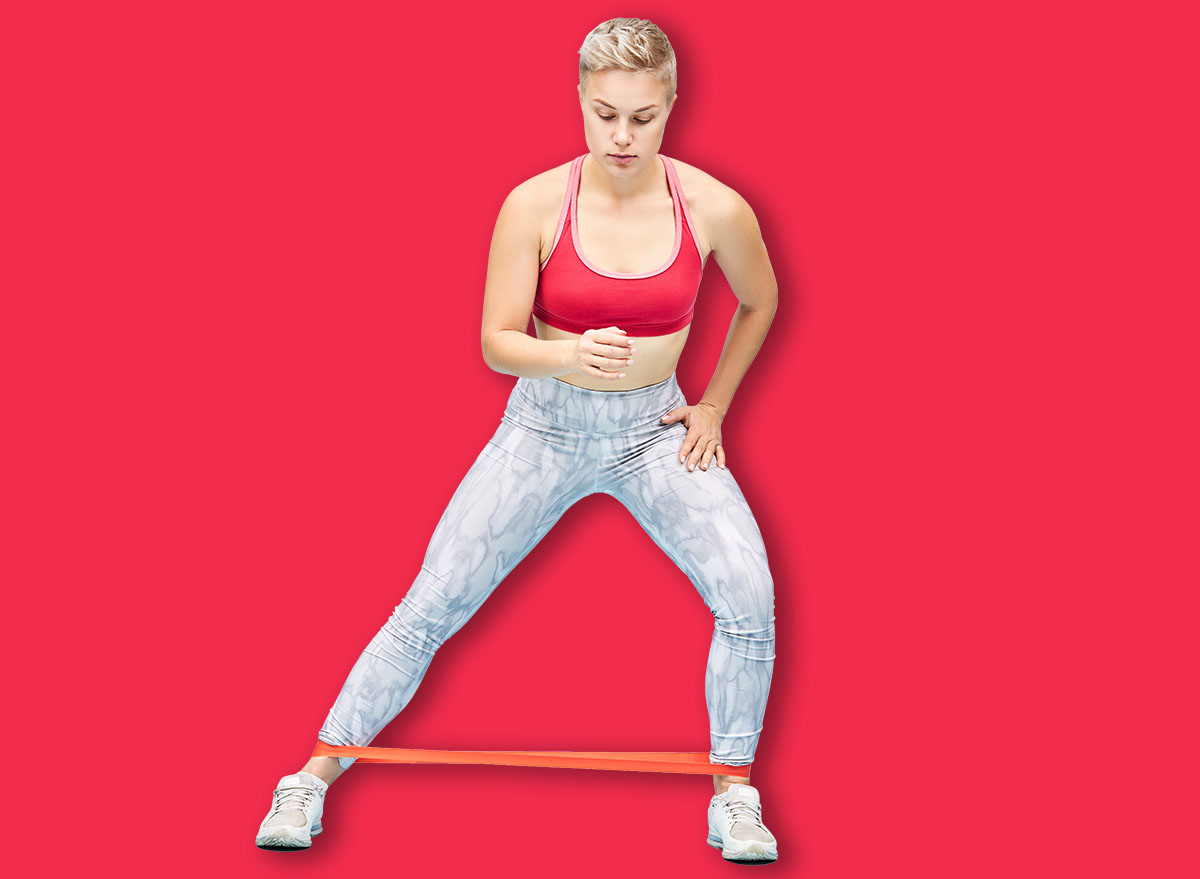
Lateral Band Walk
“Improved strength in the lower body is one of the best ways to improve balance. Creating resistance with a loop band around the thighs while side stepping strengthens the hip abductors. Yoga rarely loads these muscles under enough resistance,” Hilliard points out.
- Begin by placing a resistance band around your ankles or thighs.
- Slightly bend your knees and step sideways, keeping your movement controlled.
- Repeat in the opposite direction.
Calf Raises
“Standing on a step and letting the heel hang stretches the back of the leg and then pressing into the ball of the foot on the step to engage the calf works multiple muscles that are integral for balance,” Hilliard says. “Ankle strength and plantar flexor power are among the strongest predictors of fall prevention. This exercise builds stability.”
- Begin by standing tall with your feet hip-width apart, facing a sturdy chair with your hands lightly resting on the backrest.
- Engage your core.
- Rise onto your toes slowly.
- Hold for 2 to 3 seconds at the top.
- Lower back down with control.
Sit-to-Stand
“The sit-to-stand exercise is one of the most functional movement patterns for independence,” Hilliard tells us. “Lowering the body into a chair and then standing again without using your hands to press off the chair involves eccentric quad control, hip strength, and momentum management simultaneously, a loaded exercise you won’t typically find in a yoga class.”
- Begin seated at the front of a sturdy chair, feet under your knees.
- Lean forward just a bit.
- Try to stand up without using your knees, hands, or additional support.
- Use control to slowly sit back down.