5 Morning Exercises That Restore Stair-Climbing Power Faster Than Gym Machines After 55

After nearly 40 years as a personal trainer, and for the last 25 years I’ve been training the next generation of fitness professionals at TRAINFITNESS, the pattern I see most often in people over 55 isn’t weakness or injury. It’s low energy in the morning that drags through the entire day. Most people accept it as normal aging. It isn’t. Movement in the morning activates systems that have been dormant during sleep and kickstarts your metabolism in ways that last all day. These five exercises can help you restore that power without a gym membership or a single piece of equipment.
Why Morning Movement Matters After 55
After 55, cortisol and other hormones are produced more slowly. Cortisol has a bad reputation, but it’s what wakes us up in the morning. Our metabolism takes more time to shift from a sleep state into an active one. Blood flow to the muscles and brain takes longer, too.
Movement forces this whole process to wake up faster. Heart rate goes up, oxygen gets distributed better, muscles start using stored energy, and the nervous system becomes more active. Your body has no choice but to respond to physical demand.
The first 30 to 60 minutes of movement can make the rest of the day better. Research in circadian rhythms backs this up: early exercise helps regulate your internal clock, which improves morning energy and sleep at night. Better sleep improves your mornings, which helps your sleep. The cycle works in your favor.
What I see with clients is that people who skip morning movement often feel sluggish until lunch or later. Their bodies eventually wake up, but they’ve lost half the day operating at 60%. People who move first thing report feeling sharper mentally, more physically capable, and more motivated throughout the day.
Bodyweight Squats
Squats are the single most effective morning movement because they engage the largest muscle groups in your body simultaneously. When your quads, glutes, and hamstrings all activate at once, they demand significant oxygen and energy, which forces your cardiovascular and metabolic systems to respond immediately.
Muscles Trained: Quadriceps, glutes, hamstrings
How to Do It:
- Stand with feet shoulder-width apart, toes pointed slightly outward
- Keep your chest up and your weight distributed evenly across your whole foot
- Lower yourself by pushing your hips back first, as if sitting into a chair, then bend your knees
- Go as low as comfortable — ideally until your thighs are parallel to the floor, but depth matters less than control
- Push through your whole foot to stand back up, squeezing your glutes at the top
Avoid These Mistakes:
- Don’t let your knees cave inward — they should track in line with your toes throughout the movement
- Don’t rise onto your toes — keep your heels planted
- Don’t lean too far forward, which shifts the work away from your legs and into your lower back. If you feel it primarily in your back, adjust your form
Recommended Sets and Reps: 2 sets of 10 reps. Rest 30–60 seconds between sets. As this becomes easier, add a third set or increase to 15 reps.
Wall Push-Ups
Wall push-ups wake up your upper body and core without the intensity of floor push-ups, making them a good fit for morning when your muscles are still tight.
Muscles Trained: Chest, shoulders, triceps, core
How to Do It:
- Stand facing a wall, about arm’s length away
- Place your hands on the wall slightly wider than shoulder-width, at chest height
- Keep your body in a straight line from head to heels
- Bend your elbows to lower your chest toward the wall, then push back to the starting position
- Keep your elbows at roughly a 45-degree angle to your body, not straight out to the sides
Avoid These Mistakes:
- Don’t stand too close to the wall — it makes the exercise too easy and provides minimal benefit
- Don’t stand so far away that you can’t maintain good form, which creates shoulder strain
- Don’t let your hips sag or stick out — your entire body should move as one unit, not just your arms
Recommended Sets and Reps: 2 sets of 12 reps. Rest 30 seconds between sets.
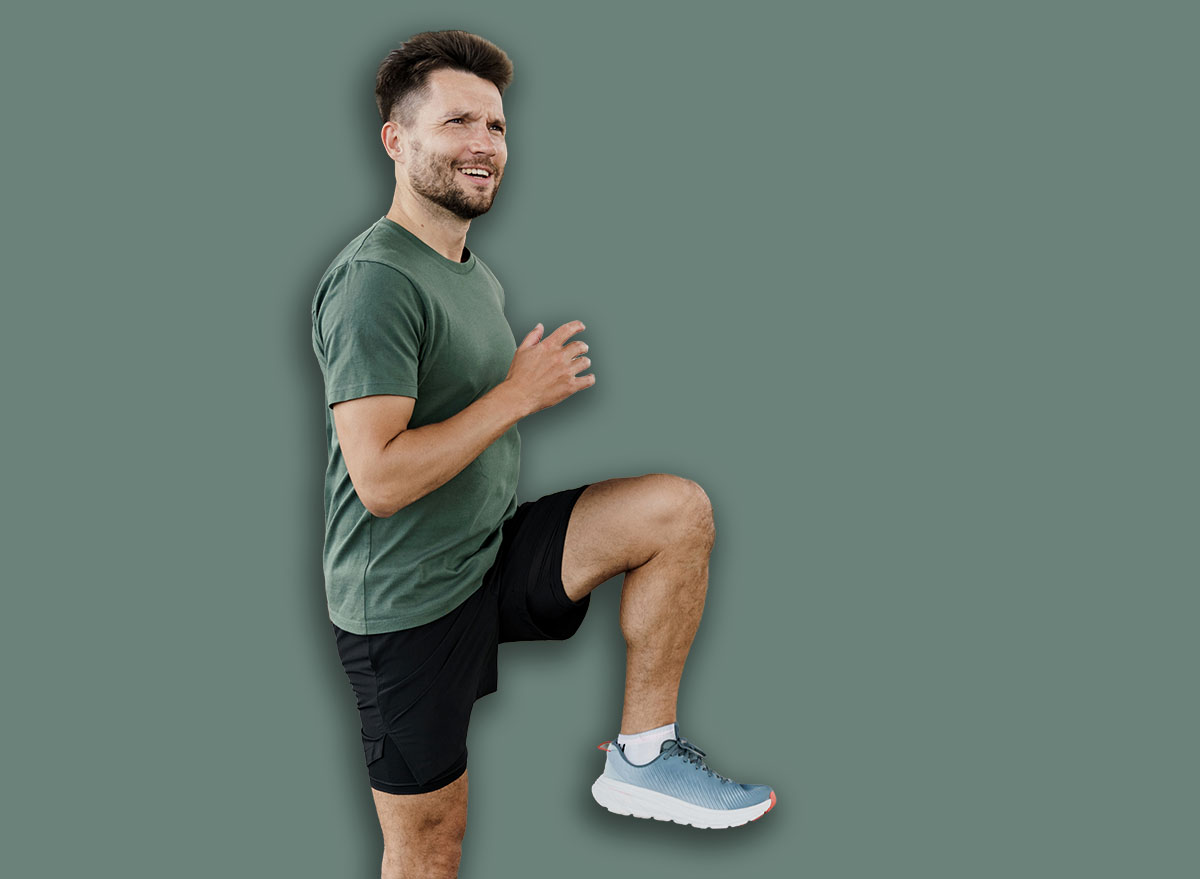
Standing Knee Raises
This movement activates your hip flexors and core while improving balance — all of which decline significantly after 55 if not actively maintained.
Muscles Trained: Hip flexors, core, glutes (stabilizing leg)
How to Do It:
- Stand next to a wall or sturdy surface for light support if needed
- Keep your standing leg slightly bent, not locked
- Lift one knee up toward your chest, aiming to bring your thigh parallel to the floor
- Hold for one second at the top, then lower with control
- Keep your standing leg stable throughout — don’t shift your weight or lean to the side
Avoid These Mistakes:
- Don’t lean backward as you lift your knee — keep your torso upright
- Don’t rush through the movement — the control on the way down matters as much as the lift up
- If you’re wobbling excessively, use more support from the wall until your balance improves
Recommended Sets and Reps: 2 sets of 10 reps per leg.
Standing Arm Circles
Arm circles mobilize your shoulders and upper back — areas that get incredibly stiff overnight, especially in people over 55 who might have some shoulder restrictions or previous injuries.
Muscles Trained: Shoulders, upper back, rotator cuff
How to Do It:
- Stand with feet hip-width apart, arms extended out to your sides at shoulder height
- Make small circles forward for 10 rotations, then reverse for 10 rotations backward
- Gradually increase the size of your circles as your shoulders warm up
- Keep your core engaged and don’t let your ribcage flare forward
Avoid These Mistakes:
- Don’t start with large circles before the shoulders are warm — build up gradually
- Don’t shrug your shoulders toward your ears — keep them down and relaxed
- If you feel pinching or pain, reduce the size of your circles and stay within a comfortable range
Recommended Sets and Reps: 2 sets of 10 circles forward and 10 circles backward. Rest 20 seconds between sets.
Heel Raises
Calf raises strengthen your lower legs and improve ankle stability, both of which are essential for balance and preventing falls.
Muscles Trained: Calves, ankles
How to Do It:
- Stand with feet hip-width apart, hands resting lightly on a wall or counter for balance
- Rise up onto the balls of your feet, lifting your heels as high as comfortable
- Hold at the top for one second, then lower back down with control
- Keep your legs straight but not locked, and don’t let your ankles roll inward or outward
Avoid These Mistakes:
- Don’t bounce up and down — each rep should be deliberate, not momentum-driven
- Don’t lean too heavily on your support surface. Use it for balance only, not to take weight off your legs
- Don’t grip with your toes — push through the balls of your feet. If you feel cramping, that’s usually the cause
Recommended Sets and Reps: 2 sets of 15 reps. Rest 30 seconds between sets.
How Fast You’ll Notice a Difference

The first changes happen faster than most people expect.
Within the first week, you’ll notice you’re waking up more easily and your morning energy will be noticeably higher. Your metabolism is already responding to regular morning movement.
After two weeks, everyday movements start feeling less challenging. Getting out of a chair takes less effort. You’re not as out of breath going up the stairs.
By the end of the second month, your body is starting to change. Legs feel more solid, your core feels tighter, and you’re standing taller without thinking about it.
By three months, other people will have started to notice. Friends and family will comment on how you’re moving better or simply looking healthier.
The key is consistency. Doing these five exercises every morning beats a longer workout three times a week. Your body responds to regular signals, not occasional intense ones.
Morning Habits That Amplify the Results

The exercises do the work, but a few habits make them more effective.
Hydrate first. Drink 300–500ml of water before starting. After 7 to 8 hours without liquids, your blood volume is lower and your muscles are receiving less oxygen. Pre-loading water primes your body to respond better to exercise.
Get light exposure early. Within 30 minutes of waking, expose yourself to sunlight or a bright window. This suppresses melatonin and regulates your morning cortisol spike, which helps energy during the day and sleep at night.
Eat protein within 90 minutes. Aim for 20–30g. Protein stabilizes blood sugar and provides the amino acids your muscles need after an overnight fast. It also digests more slowly than carbohydrates, giving you a longer, steadier flow of energy. Eggs, yogurt, or a protein shake all work.
Keep a consistent sleep schedule. Your body clock works best with regularity, weekends included. Research shows people with consistent sleep schedules feel more energetic in the morning regardless of total hours slept.
Delay your first coffee. If you enjoy coffee or tea, try waiting 90 to 120 minutes after waking before your first cup. This lets your natural cortisol surge run its course. Reaching for caffeine immediately can dampen cortisol production over time and increase dependence. Let movement wake you up first.