5 Morning Exercises That Restore Knee Strength Faster Than Yoga After 60
Yoga can be excellent for mobility, breathing, body awareness, and easing into movement. It helps many people feel looser, calmer, and more connected to their bodies’ movement. Knee strength, though, usually needs a more direct signal. The muscles around the knee need to load, hold, control, and produce force in positions that carry over to stairs, chairs, curbs, and daily movement.
After 60, knees often feel less reliable when the quads, glutes, hamstrings, calves, and hips stop pulling their weight. The joint itself gets most of the attention, but the muscles above and below the knee shape how well it handles stress. Stronger legs can help the knee feel more supported, especially when you practice controlled squatting, stepping, holding, and hamstring work.
I’ve coached plenty of people who wanted stronger knees but didn’t need a more complicated routine. They needed a few movements they could perform well, repeat often, and progress slowly. Morning exercise works well here because it gives your legs a clean first dose of strength before the day gets moving.
Think of this routine as a knee support session, not a full workout that crushes your legs before breakfast. Box squats and step-ups build practical strength for sitting, standing, and stairs. Split squat holds improve control around the knee. Slider leg curls and extended glute bridge holds strengthen the hamstrings and glutes, which help support the knee from the back side.
Box Squats
Box squats train your quads, glutes, hamstrings, and core while giving your knees a clear target and a controlled range of motion. Sitting back toward the box helps you practice the squat pattern without guessing how low to go or dropping into a position you can’t own. Compared with yoga, box squats give your legs a more direct signal for strength building because your muscles have to lower, pause, and stand back up under control. Stronger box squats carry over to getting out of chairs, climbing stairs, and moving with more confidence throughout the day.
Muscles Trained: Quadriceps, glutes, hamstrings, core
How to Do It:
- Stand in front of a sturdy box or chair with your feet shoulder-width apart.
- Brace your core and keep your chest lifted.
- Push your hips back and bend your knees.
- Lower until your hips lightly touch the box.
- Press through your feet to stand tall.
- Repeat without relaxing fully onto the box.
Recommended Sets and Reps: Perform 3 sets of 8 to 12 reps. Rest for 45 to 60 seconds between each set.
Best Variations: Higher box squats, bodyweight box squats, goblet box squats
Form Tip: Tap the box lightly and stand back up without rocking.
Split Squat ISO Hold
Split squat ISO holds train your quads, glutes, hips, and core while teaching your knee to stay steady in a staggered stance. Holding the position builds strength without requiring much movement, which can feel more approachable if regular lunges bother your knees or balance. Your front leg has to support the position while your hips and midsection keep everything aligned. That control carries into stairs, stepping, walking, and any moment when one leg has to handle more of the work.
Muscles Trained: Quadriceps, glutes, hamstrings, core
How to Do It:
- Stand in a split stance with one foot forward and one foot back.
- Brace your core and keep your torso tall.
- Lower into a comfortable split squat position.
- Hold the position without letting your front knee drift inward.
- Press through your front foot to return to standing.
- Switch sides after each hold.
Recommended Sets and Reps: Perform 3 sets of 15 to 25 second holds per side. Rest for 45 seconds between each set.
Best Variations: Assisted split squat hold, higher hold position, longer ISO hold
Form Tip: Keep your front knee tracking over your toes and your weight centered.
Slider Leg Curls
Slider leg curls train your hamstrings while your glutes and core hold your hips in a strong bridge position. The hamstrings help support the knee from the back, so strengthening them gives the joint greater balance and control. As your heels slide away, your hamstrings have to work hard to control the lengthening phase, then pull your feet back in. That kind of direct hamstring work is a valuable component that many yoga routines lack.
Muscles Trained: Hamstrings, glutes, core
How to Do It:
- Lie on your back with your heels on sliders, towels, or a smooth surface.
- Press through your heels and lift your hips into a bridge.
- Brace your core and keep your hips lifted.
- Slide your heels away from your body with control.
- Pull your heels back toward your glutes.
- Lower your hips after completing the set.
Recommended Sets and Reps: Perform 3 sets of 6 to 10 reps. Rest for 60 seconds between each set.
Best Variations: Short-range slider curls, eccentric-only slider curls, single-leg slider curls
Form Tip: Move slowly on the way out and keep your hips from dropping.
Extended Glute Bridge Hold
The extended glute bridge holds train your glutes and hamstrings while building posterior-chain strength that supports the knees. Walking your feet farther away from your hips increases hamstring involvement, making the backs of your legs work harder than in a standard bridge. Holding the top position also helps keep your hips active rather than letting your lower back take over. Stronger glutes and hamstrings can help your knees feel more supported during walking, stairs, and standing.
Muscles Trained: Glutes, hamstrings, core
How to Do It:
- Lie on your back with your knees bent and feet flat on the floor.
- Walk your feet farther away from your hips.
- Brace your core and press through your heels.
- Lift your hips until your body forms a straight line from shoulders to knees.
- Hold the top position while squeezing your glutes.
- Lower your hips with control when the hold is complete.
Recommended Sets and Reps: Perform 3 sets of 20 to 30 second holds. Rest for 45 seconds between each set.
Best Variations: Standard glute bridge hold, single-leg bridge hold, mini-band bridge hold
Form Tip: Press through your heels and stop if your lower back takes over.
Low Box Step-Ups
Low box step-ups train your quads, glutes, calves, and core while giving your knees a practical way to build strength through stepping. A low box keeps the movement approachable, but your lead leg still has to control the lift and lower. Step-ups train the same strength you use for stairs, curbs, and getting around uneven ground. Compared with yoga, the movement gives your legs more direct strength practice in a pattern you use every day.
Muscles Trained: Quadriceps, glutes, calves, core
How to Do It:
- Stand facing a low box, step, or sturdy stair.
- Place your whole foot on the step.
- Brace your core and keep your chest lifted.
- Press through your lead foot to stand tall.
- Step back down with control.
- Complete all reps, then switch sides.
Recommended Sets and Reps: Perform 3 sets of 8 to 10 reps per leg. Rest for 45 seconds between each set.
Best Variations: Assisted step-ups, slower step-downs, slightly higher step-ups
Form Tip: Let your lead leg lift you instead of pushing hard off the floor.
How to Build Stronger Knees in the Morning
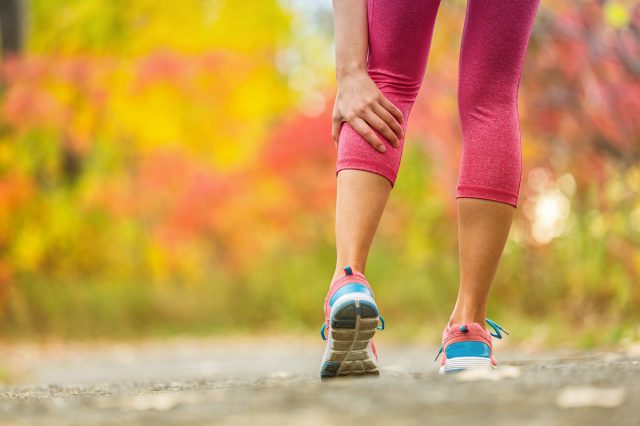
Knee strength improves when your legs practice control before the day piles on more steps, stairs, and random movement. These exercises train the muscles that support the knee from multiple angles: quads in squats and holds, hamstrings in curls and bridges, glutes in nearly every movement, and calves during step-ups. Keep the range comfortable, move smoothly, and let the muscles around the knee do their job.
- Use a controlled range of motion: Box squats, split squat holds, and step-ups should stay inside a range your knees tolerate well. A clean partial range gives you more benefit than forcing depth you can’t control.
- Strengthen the back of the legs: Slider curls and extended bridge holds train the hamstrings and glutes. Those muscles help balance the knee and support smoother movement.
- Slow down the lowering phase: Lower into the box squat, split squat, and step-up with control. Slower reps teach your legs to absorb force, which matters for stairs and curbs.
- Use support when needed: Hold a wall, rail, or chair if balance is limited. Light support keeps the focus on strength instead of wobbling through the set.
- Progress gradually: Add a few reps, extend your holds, raise the box slightly, or add a light dumbbell when the movement feels easy. Small changes help strengthen your knees without turning the session into a grind.
Give your knees a few minutes of smart strength work before the day gets rolling. Yoga can still support mobility and recovery, but these moves give your legs the direct strength practice your knees need to feel steadier and more capable.
References
- Park, Soo Yeon et al. “Aging-related changes in knee flexor muscle strength and cross-sectional area.” Medicine vol. 101,42 (2022): e31104. doi:10.1097/MD.0000000000031104
- Sadeghi, Alireza et al. “Effectiveness of muscle strengthening exercises on the clinical outcomes of patients with knee osteoarthritis: A randomized four-arm controlled trial.” Caspian journal of internal medicine vol. 14,3 (2023): 433-442. doi:10.22088/cjim.14.3.433