5 Morning Exercises That Restore Full-Body Mobility Faster Than 30 Minutes of Stretching After 55

Thirty minutes of passive stretching every morning won’t restore mobility if the body never learns to control new range. After 55, stiffness usually stems from reduced joint circulation, slower neuromuscular activation, and long hours spent sedentary, not simply “tight muscles.” I’ve coached adults over 55 for years, and the clients who move best in the morning don’t lie on the floor holding stretches. They perform controlled, dynamic movements that wake up the joints and retrain coordination.
Mobility requires strength through range, not just length. When you move actively, you pump synovial fluid into the joints, activate stabilizers, and reestablish posture before the day starts. That combination restores fluid motion faster than static stretching alone. The goal isn’t to force flexibility. The goal is to reclaim control.
The five exercises below take about eight to ten minutes total. Perform them in sequence with steady tempo and intentional breathing. Stay consistent and you’ll feel looser, stronger, and more balanced before breakfast.
Standing Arm Circles With Thoracic Rotation
Shoulder and upper-back stiffness often dominate mornings after 55. Instead of stretching the chest passively, this drill restores active range while teaching the spine to rotate smoothly. I use this movement early in sessions because it immediately improves posture and breathing mechanics.
Stand tall and create large, controlled circles with your arms. Add gentle thoracic rotation as the arms move backward. Keep your ribs stacked over your hips and avoid arching your lower back. Controlled repetition wakes up the shoulder blades and mid-spine quickly.
How to Do It
- Stand tall with feet hip-width apart
- Extend arms out to sides
- Perform slow forward circles
- Reverse direction
- Add gentle upper-body rotation.
Hip Hinge to Overhead Reach
Full-body mobility depends heavily on hip function. This movement combines a hinge with an overhead reach to connect lower and upper body mechanics. I’ve seen clients dramatically improve morning stiffness once they integrate this pattern daily.
Push your hips back into a controlled hinge. As you stand, sweep your arms overhead and lengthen through your torso. Coordinate breath with movement to increase control. This drill restores both hip and shoulder range simultaneously.
How to Do It
- Stand with feet shoulder-width apart
- Push hips back into hinge
- Keep spine neutral
- Drive hips forward to stand
- Sweep arms overhead
- Repeat slowly.
Standing Alternating Knee Hugs
Walking stiffly in the morning often signals limited hip mobility. Alternating knee hugs gently move the hip joint through flexion while challenging balance. I use this frequently with adults over 55 because it restores stride length and coordination without strain.
Lift one knee toward your chest and hold briefly. Keep your torso upright and core braced. Lower with control and switch sides. Smooth, balanced reps restore fluid hip movement quickly.
How to Do It
- Stand tall near support if needed
- Lift one knee toward chest
- Hold briefly
- Lower with control
- Alternate sides.
Bodyweight Reverse Lunge With Reach
Mobility improves when joints move under control through usable range. The reverse lunge with reach opens the hips while activating glutes and improving balance. Unlike static hip flexor stretches, this drill strengthens the movement pattern.
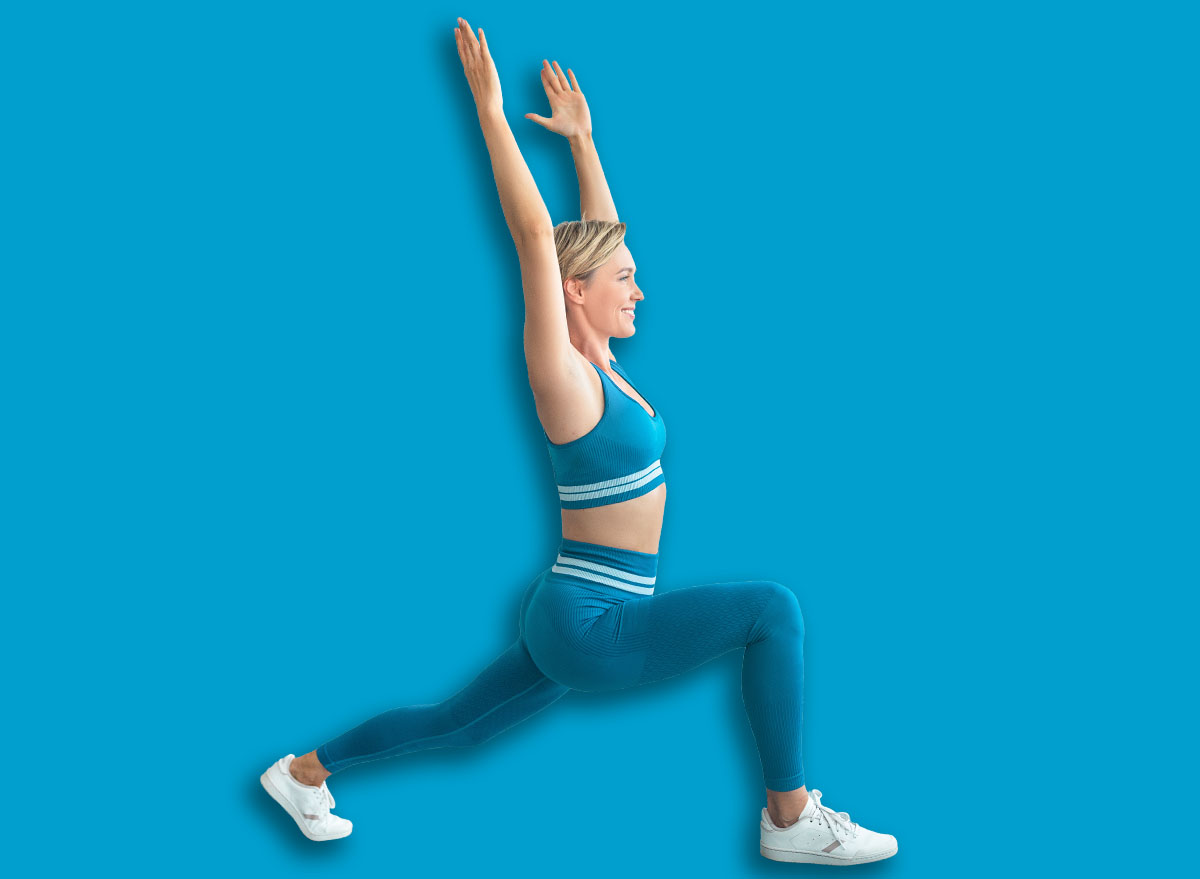
Step back into a lunge and reach both arms overhead. Maintain tall posture and steady tempo. Drive through the front heel to stand. Controlled motion enhances both mobility and stability.
How to Do It
- Stand tall with feet hip-width apart
- Step one leg back
- Lower into lunge
- Reach arms overhead
- Return to standing
- Alternate sides.
Standing Torso Rotations With Control
Spinal rotation decreases steadily after 55 unless trained intentionally. Controlled standing rotations restore mobility without forcing end ranges. I program this movement for clients who wake up feeling stiff through the midsection and lower back.
Stand tall and rotate your torso gently side to side. Keep hips stable and movement smooth. Avoid jerking or bouncing. Consistent controlled reps improve rotational capacity and coordination within minutes.
How to Do It
- Stand with feet shoulder-width apart
- Place hands across chest
- Rotate torso slowly to one side
- Return to center
- Rotate to opposite side
- Continue alternating.