If You Can Master These 4 Standing Exercises at 55, You’re Stronger Than Most 45-Year-Olds

Having solid strength is truly everything as you age. It determines what daily life will be like. Will you need someone to help you do tasks, or can you continue to complete them independently? You start to lose lean muscle naturally as you age, so it’s essential to exercise regularly and stay fit. But how can you really gauge your strength? We’ve simplified the process by reaching out to the experts for a test. If you can master these four standing exercises at 55, you’re stronger than most 45-year-olds.
“After 55, the standing position is not about strength. The standing position also needs coordination, balance, stability, muscle endurance, and nervous system control,” explains Felicia Hernandez, NASM-Certified Personal Trainer and Community Engagement Lead at Eden Health Club. “In my experience, when a person can stay still under tension, with form on one leg or while resisting rotation, the result shows how well the core works. The core does not just contract muscles. The core also manages full-body alignment in real‑world positions. The level of control is high.”
According to Hernandez, without training the core from a standing position, you may lose the reflexive control your body needs. “The body needs that control to keep [you] strong and safe,” she stresses.
Standing Strength Test at 55
Each of the following exercises promotes deep stability while challenging neurological and muscular control at the same time. Complete 2 to 3 sets of 30 to 45 seconds on each side.
Single-Leg Stand With Eyes Closed
“This exercise removes visual feedback, so your core must take full control. Huge challenge for your deep stabilizers,” Hernandez points out.
- Begin by standing tall with your shoulders back.
- Lift one foot a few inches off the floor.
- Close your eyes and hold the position.
- Perform 2 to 3 sets of 30 to 45-second holds.
- No wobbling means “elite” strength.
Standing Band Pallof Hold (Anti-Rotation)
“The standing band Pallof hold teaches your core to resist twisting, [which is] vital for spine health, posture, and fall prevention,” explains Hernandez.
- Begin by tying a resistance band to a fixed anchor point at chest level.
- Stand sideways to the band with your hands clasped in front and arms extended out straight.
- Maintain tension in the band without allowing your torso to rotate.
- Hold for 30 seconds on each side.
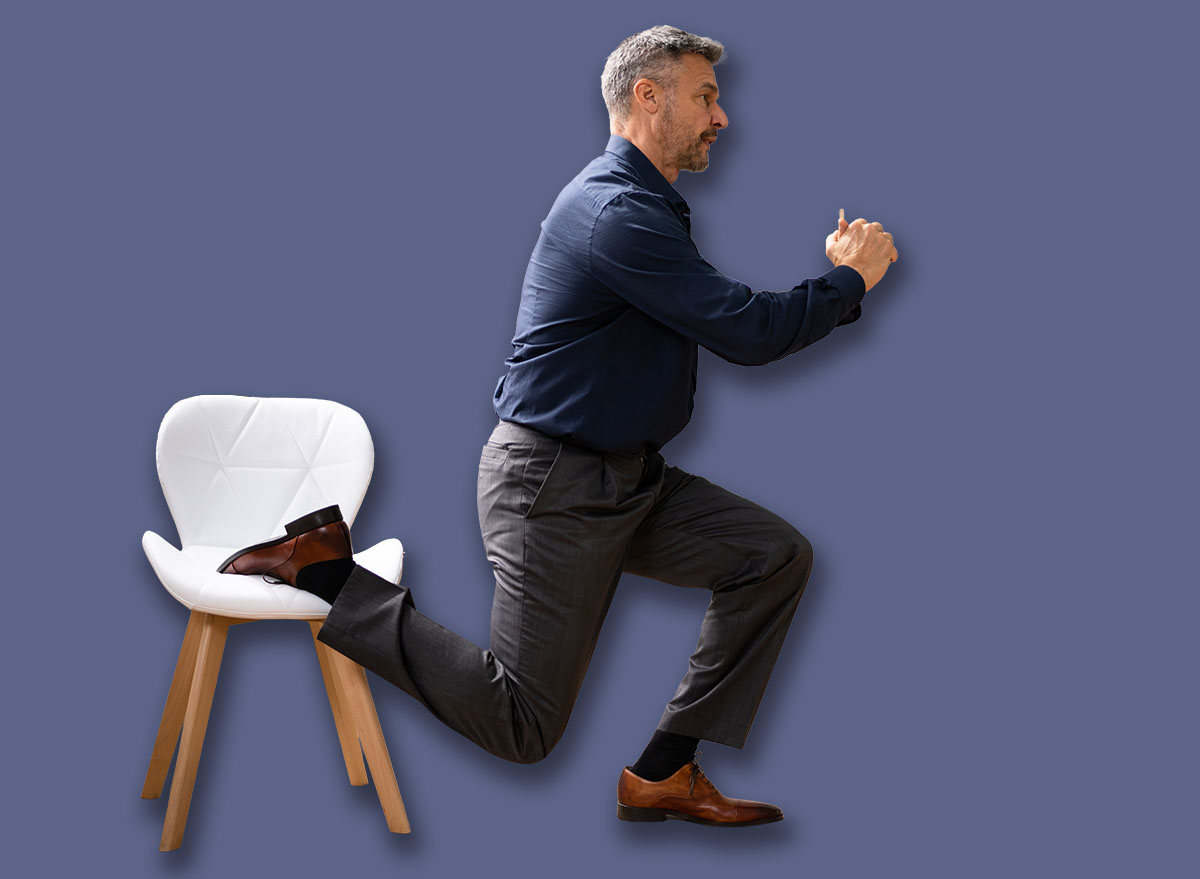
Elevated Split-Stance Hold
“The elevated split-stance hold mimics walking, climbing stairs, and shifts your core’s load into real-life motion,” Hernandez points out.
- Begin by stepping one foot forward into a lunge position with your back heel raised.
- Bring your ribcage down.
- Hold the position with your core braced.
- Repeat on the other side.
Weighted Overhead March Hold
“Overhead load recruits full-body tension and balance,” Hernandez tells us.
- Begin by standing tall, holding a light dumbbell in each hand overhead.
- Lift one knee up to hip level, and hold.
- Maintain a neutral spine and tight abs.
- Lower.
- Lift the other knee up to hip height, and hold.
- Continue to alternate legs.