4 Bodyweight Moves That Build Core Strength Better Than Ab Machines After 40
Walk through most gyms, and you will see ab machines that make core work feel neat and contained. After 40, your body rarely asks your core to move in a tidy, contained way. Your core’s real job is to keep your spine and pelvis steady while your arms and legs do work, whether you are carrying groceries, bracing for a heavy set, or moving fast enough to catch yourself before a trip turns into a whole highlight reel.
Bodyweight training nails that job because it forces you to stabilize in real time. You have to manage your posture, control rotation, and keep tension where it matters without leaning on the seatback or relying on a fixed path. That carries over to daily life and training because you learn to create stiffness and control as your body moves, not when it is locked in one angle.
A 2024 paper in the Journal of Functional Morphology and Kinesiology measured trunk muscle thickness with ultrasound during common core stability exercises using different activation cues, including bracing and hollowing. The researchers examined the deep core and spinal stabilizers, including the transversus abdominis and lumbar multifidus, across moves such as the plank, dead bug, and side plank. That is the exact kind of muscle strategy you want after 40: deep stability first, then strength on top of it.
Planks with Shoulder Taps
Planks with shoulder taps turn a basic plank into a dynamic stability challenge. As soon as one hand leaves the floor, your core must fight rotation and shifting weight. This lights up the deep stabilizers that protect your spine, especially the transverse abdominis and obliques. Over time, this movement improves coordination between your upper body and trunk, which carries over to pushing, pulling, and loaded carries. After 40, that added stability helps reduce back strain during daily tasks and workouts.
Muscles Trained: Rectus abdominis, transverse abdominis, obliques, shoulders
How to Do It:
- Set your hands under your shoulders and extend your legs into a high plank.
- Brace your core as if you were about to be lightly punched in the stomach.
- Tap your right hand to your left shoulder while keeping your hips steady.
- Return your hand to the floor with control.
- Repeat on the opposite side and continue alternating.
Recommended Sets and Reps: Knock out 3 sets of 10 to 16 total taps. Rest for 45 to 60 seconds between each set.
Best Variations: Slow tempo shoulder taps, feet wide shoulder taps for beginners, elevated shoulder taps using a bench
Form Tip: Keep your hips level and move only the arm. If your hips sway, slow the reps down.
Dead-bugs
Dead bugs train your core to stabilize the spine while your arms and legs move independently. This pattern mimics real-life movement patterns like walking, running, and lifting. The exercise emphasizes control over momentum, which becomes increasingly important as joint tolerance decreases with age. It also reinforces proper breathing mechanics, helping you maintain intra-abdominal pressure without over-bracing.
Muscles Trained: Transverse abdominis, rectus abdominis, hip flexors, lower back stabilizers
How to Do It:
- Lie on your back with your arms extended toward the ceiling and knees bent to ninety degrees.
- Press your lower back gently into the floor and brace your core.
- Extend your right arm and left leg toward the floor while staying controlled.
- Return to the start position without losing lower back contact.
- Switch sides and continue alternating.
Recommended Sets and Reps: Perform 3 sets of 8 to 12 controlled reps per side. Rest for 45 seconds between each set.
Best Variations: Heel tap dead bugs, banded dead bugs, straight leg dead bugs
Form Tip: If your lower back arches, shorten the range of motion until control improves.
Side Plank Holds
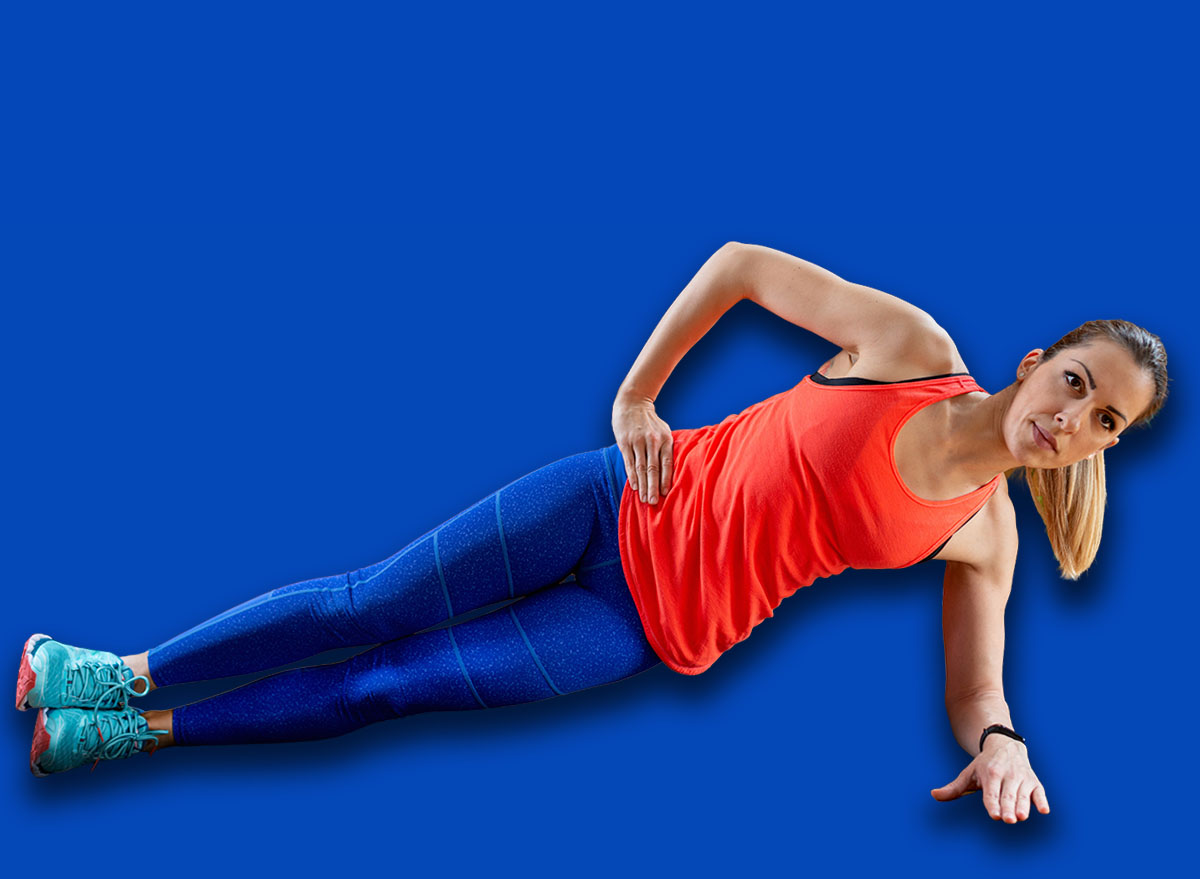
Side plank holds target the often neglected lateral core muscles that protect your spine from side bending and rotation. Strong obliques improve balance and reduce stress on the lower back when handling uneven loads, such as carrying bags or lifting awkward objects. This exercise also challenges shoulder stability, adding extra value without extra time. Consistent side plank work supports better posture and fewer aches as the years add up.
Muscles Trained: Obliques, quadratus lumborum (QL), glutes, shoulders
How to Do It:
- Lie on your side with your elbow directly under your shoulder.
- Stack your feet and straighten your body from head to heels.
- Lift your hips and brace your core.
- Hold the position while breathing steadily.
- Lower with control and switch sides.
Recommended Sets and Reps: Perform 3 sets of 20 to 45 second holds per side. Rest for 45 seconds between each set.
Best Variations: Bent knee side plank, side plank with leg lift, side plank with reach through
Form Tip: Think about pushing the floor away with your elbow to stay tall through the shoulder.
Hollow Hold
The hollow hold teaches full-body tension and spinal control in a supine position. This movement strengthens the anterior core while reinforcing proper pelvic positioning. It also builds awareness of how to maintain tension without excessive strain. For adults over 40, this skill helps protect the lower back during lifting and athletic movements.
Muscles Trained: Rectus abdominis, transverse abdominis, hip flexors, upper back stabilizers
How to Do It:
- Lie on your back with arms extended overhead and legs straight.
- Brace your core and press your lower back into the floor.
- Lift your shoulders and legs slightly off the ground.
- Hold the position while breathing under control.
- Lower slowly and reset before the next rep.
Recommended Sets and Reps: Knock out 3 sets of 20 to 40 second holds. Rest for 60 seconds between each set.
Best Variations: Tucked hollow hold, alternating hollow rocks, hollow hold with arms by your sides
Form Tip: If your lower back lifts off the floor, bend your knees or shorten the hold.
Best Core Training Tips After 40

Building a stronger core after 40 comes down to consistency, quality, and progressions. These principles help you get more results without beating up your joints.
- Prioritize control over speed: Slower reps improve muscle activation and reinforce proper movement patterns.
- Train anti-movement patterns regularly: Exercises that resist rotation and extension protect your spine during daily tasks.
- Breathe with intention: Controlled breathing improves trunk stability and reduces unnecessary tension.
- Progress gradually: Increase time under tension or complexity before adding volume.
- Pair core work with full body training: Strong cores perform best when integrated into squats, hinges, pushes, and carries.
Stick with these bodyweight movements and principles, and your core strength will feel more useful, resilient, and athletic well beyond your forties.
References:
- Tsartsapakis, Ioannis et al. “A Comparison between Core Stability Exercises and Muscle Thickness Using Two Different Activation Maneuvers.” Journal of functional morphology and kinesiology vol. 9,2 70. 11 Apr. 2024, doi:10.3390/jfmk9020070