If You Can Master These 4 Standing Moves at 60, You’re Fitter Than Most 40-Year-Olds

Challenging yourself at the gym is an excellent way to stay motivated and reach your best physical condition. Pushing past limits can help you break through plateaus while giving your self-confidence and focus a solid boost. One trainer favorite when it comes to testing yourself is standing work, which is a stellar assessment of functional fitness. By weaving standing exercises into your routine, you’ll improve posture, metabolism, balance, coordination, core strength, and more.
“Since most important activities in your daily life occur while you’re standing, exercises performed while standing tend to be more translatable to those situations,” says Domenic Angelino, CPT, with International Personal Trainer Academy, which offers NCCA-accredited Personal Trainer (CPT) and Certified Nutrition Specialist (CNS) programs. “Activities like taking the groceries in, reaching a high shelf, and showering are all things that people take for granted. But, performing exercises that are similar to those movement patterns will help you retain those abilities for many more years.”
Below, Angelino shares four standing moves to try at 60. If you can master them, kudos to you! It means you’re fitter than most 40-year-olds.
According to Angelino, these exercises aren’t recommended with beginners who have no prior training, as they’re quite difficult
“It won’t be safe to jump into trying all of them unless you’ve gradually worked your way up to them,” Angelino points out. “That being said, if you can do all four, you’re in pretty decent shape.”
One-Arm Dumbbell Push Press
“This displays that you have the ability to produce a lot of power and to move in a highly coordinated way quickly over a short period of time—all while keeping your body stable in a situation where you’re unevenly loading your body,” Angelino tells us. He recommends practicing this exercise without any weight, if needed.
- Begin by standing tall with your feet hip-distance apart.
- Hold a dumbbell in one hand at shoulder level with your palm facing forward or inward.
- Activate your core, maintain a tall chest, and have a slight bend in your knees.
- Drive through your legs as you explode in an upward motion, pressing the weight overhead until your arm is completely extended.
- Use control to lower the dumbbell to shoulder height.
- Perform 3 sets of 6 to 8 reps on each side.
Single-Leg Bodyweight Deadlift
Performing the single-leg bodyweight deadlift with proper form means you have stellar stability and balance in your lower body, which is essential for preventing falls—especially as you age. Angelino recommends using a wall for extra support, if needed, and starting with a small range of motion if new to the exercise.
- Start by standing tall with your feet hip-width apart. Shift your body weight to your right leg.
- Bend your right knee slightly and activate your core.
- Hinge at the hips, pressing your right hip back as your torso moves forward. At the same time, extend your left leg straight behind you, ensuring it stays aligned with your torso.
- Keep your back flat as you reach both arms toward the ground or ahead of you to stay balanced.
- Lower until your torso becomes parallel to the ground.
- Drive through the standing heel to rise back up to the start position.
- Perform 3 sets of 6 to 8 reps on each side.
Dumbbell Farmers Walks
“The dumbbell farmers walk will help you with important activities that require grip strength, and is a sign that you’ll be able to continue doing things like carrying in groceries for a long time,” Angelino tells us. He recommends starting with a lighter weight and working your way up from there.
- Hold a heavy dumbbell or kettlebell—20% of your body weight—in each hand at your sides.
- Start walking forward, keeping your torso still.
- Complete 3 sets of 45 to 60-second walks.
Standing Cow Face Pose
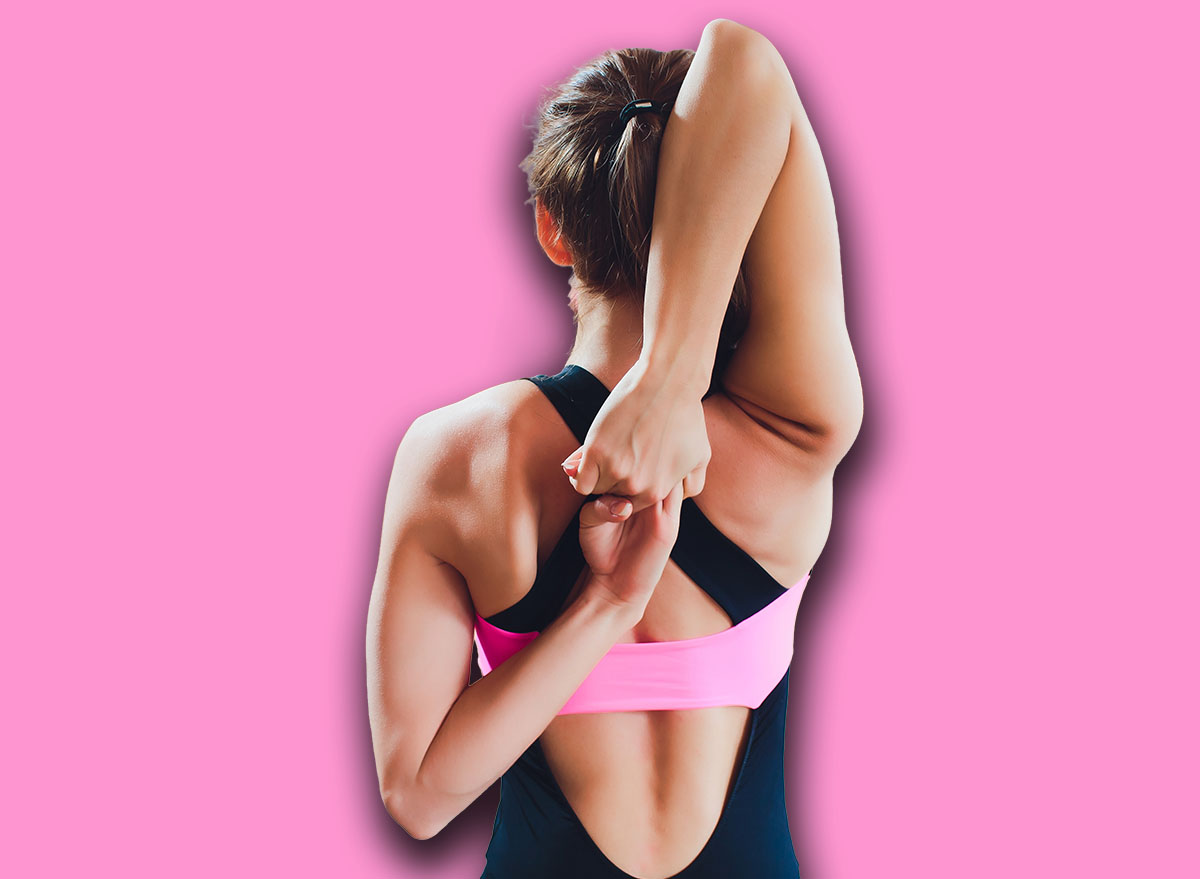
Being able to complete the standing cow face pose is a telltale sign of great shoulder mobility, which is key for injury prevention. Angelino notes that your hands don’t need to touch if you’re new to the exercise—gradually progress.
- Begin standing tall with your feet hip-width apart, shoulders relaxed, and core braced.
- Lift your left arm overhead, then bend your elbow so your hand reaches down your back.
- Bring your right arm behind your lower back, bending that elbow so your right arm reaches upward to meet your left.
- Attempt to clasp your hands behind you.
- Keep your chest lifted and your neck elongated.
- Hold for 30 to 45 seconds before releasing. Perform 3 sets in total on each side.