This 5-Minute Evening Routine Builds Muscle Better Than Morning Workouts After 50

You’ve likely heard that the best time to build muscle is first thing in the morning, before breakfast or work, and the day gets away from you. But while morning workouts are certainly beneficial, evening strength training can be just as helpful for older adults in building muscle.
What’s more, you don’t need sixty minute long intense gym sessions to benefit from evening exercise. Even short routines (when done consistently) can prime your muscles, reinforce healthy movement patterns, and make regular training feel more achievable. That’s because studies show that after 50, staying consistent with your exercise becomes one of the most critical factors of healthy aging.
To learn more, we chatted with Kris Herbert, CPT, a certified personal trainer and owner of The Gym Venice, who shares a stellar five-minute evening routine to help you build muscle better than morning workouts after 50. However, Herbert explains that, “A five-minute routine will not replace full strength training, and it is not a magic shortcut. That said, short, consistent evening sessions can help keep muscles active, maintain joint mobility, and reinforce the habit of training.” In other words, even if you’re exhausted at the end of the day, those few minutes of exercise are still worth doing as they keep your body active and help keep you consistent.
The following five-minute evening routine cycles between five movements for 30 seconds each, with 15 to 30 seconds between transitions for a total of five minutes. “As strength and confidence improve, gradually increasing challenge is what delivers meaningful gains in muscle, function, and healthy aging,” says Herbert.
Read on to find out exactly how to do it. Then, when you’re finished, be sure to check out these 7 Quick Standing Exercises That Deliver More Results Than Hour-Long Workouts After 45.
Glute Bridge
The glute bridge kickstarts your glutes and hamstrings, which after a long day of sitting, often become underactive and can contribute to lower back pain, weak hips, and poor posture. Fortunately, doing just 30 seconds of controlled glute bridges regularly can help restore strength in these weakened muscles.
How to do it:
- Lie on your back with your knees bent and your feet flat on the floor.
- Press through your heels and lift your hips until your body forms a straight line from your shoulders to your knees.
- Hold briefly at the top then lower with control.
- Continue for the full 30 seconds.
Why it works:
- Activates the largest lower body muscles
- Supports hip stability and reduces strain on your lower back
- Prepares your body for more advanced strength training
Progressions
- Pause for two to three seconds at the top
- Lift your toes slightly to increase heel drive
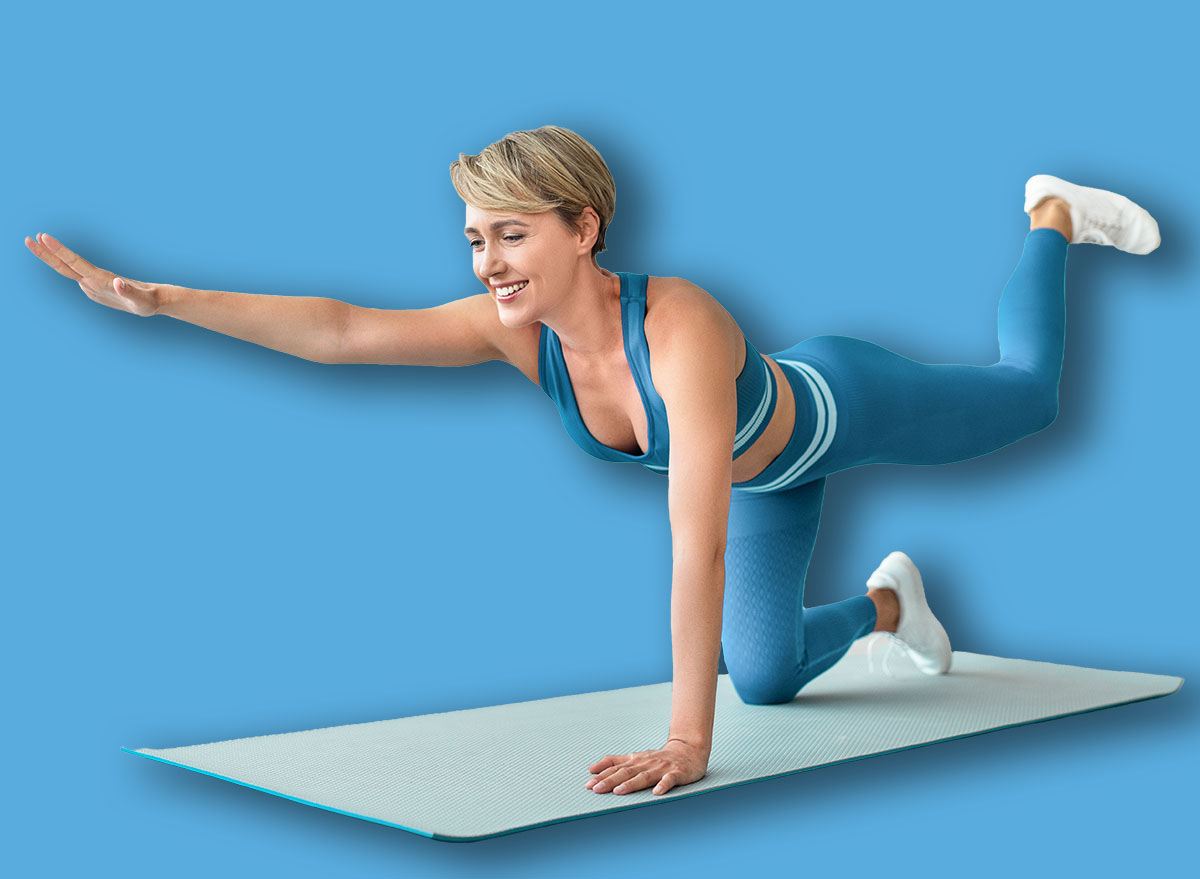
Bird Dog
The bird dog is a unique core-stability exercise that’s widely recommended for reducing lower back pain by boosting coordination between spinal stabilizers. Also, this exercise helps strengthen the deep core muscles that protect your spine and improve balance, which are crucial for healthy aging and longevity.
How to do it:
- Get down on your hands and knees.
- Extend one arm forward and the opposite leg back.
- Hold briefly, then return to the starting position.
- Switch sides and continue alternating for 30 seconds.
Why it works:
- Strengthens deep core stabilizers
- Improves balance and cross-body coordination
- Reduces compensations that strain your lower back
Progressions
- Hold each extension for two to three seconds
Wall Sit
The wall sit is an isometric hold (where you hold a specific position without moving) that fires up your quads, glutes, and core without requiring movement that stresses sore or stiff joints. This exercise also builds muscle endurance, improves joint control, and reinforces proper alignment for everyday activities like squatting, climbing stairs, or standing up from a chair.
How to do it:
- Stand with your back against a wall and slide down until your knees are bent to a comfortable angle.
- Hold for 15 to 20 seconds.
- Stand briefly to reset, then repeat until the 30-second window ends.
Why it works:
- Builds strength in major leg muscles
- Improves core stability and posture
- Supports balance and knee control
Progressions
- Lower deeper into the sit
- Hold the entire 30 seconds without standing
RELATED: If You Can Complete These 3 Morning Exercises After 55, You’re Stronger Than Most People Your Age
Wall Angels
After hours of slouching, driving, and looking down at screens, shoulders and upper backs can stiffen like crazy. Fortunately, wall angels help counteract this stiffness by strengthening the upper-back muscles while enhancing shoulder mobility. Over time, this can reduce the rounded posture that becomes more common with age.
How to do it:
- Stand with your back against a wall, your elbows bent, and your arms raised to shoulder height.
- Slide your arms up the wall as high as comfortable.
- Return to the starting position.
- Continue slowly for 30 seconds.
Why it works:
- Increases shoulder mobility
- Strengthens upper-back muscles
- Supports better posture and overhead movement
Progressions
- Keep your wrists touching the wall throughout the entire movement.
Plank Shoulder Taps
Plank shoulder taps are a full-body stability drill that improve core strength, balance, and stability, which are crucial skills that help protect the spine and carry over to daily movements that involve lifting and carrying.
How to do it:
- Start in a plank position on your hands (either on the floor or elevated).
- Widen your feet slightly for better balance.
- Tap one hand to the opposite shoulder.
- Switch sides and continue alternating for 30 seconds.
Why it works:
- Strengthens deep core stabilizers
- Enhances shoulder stability
- Builds anti-rotation control
Progressions
- Move to a lower surface or the floor