The 8-Minute Standing Routine That Restores Leg Muscle Faster Than Gym Machines After 60
Some clients light up when I tell them the whole leg session is only eight minutes. Then they do the first round of goblet squats and Romanian deadlifts and realize the time isn’t the easy part. The right two exercises can make a short workout feel pretty serious, pretty fast.
When it’s time to rebuild leg muscle after 60, I’d rather keep the plan simple and make the reps count. A squat trains the thighs and glutes. A hinge trains the hamstrings and backside of the hips. Pair them, and you get a standing routine that hits the lower body hard without bouncing from machine to machine.
Gym machines can be useful, especially when you want a fixed path and a controlled setup. This routine brings the work to your feet, where your legs have to support you through each rep. That makes the session feel closer to how strength is used during the day.
Below is a full breakdown of the 8-minute routine, how to set up the timing, and how to perform each exercise with the right form. You’ll also get simple ways to adjust the workout so it feels strong, safe, and repeatable.
The 8-Minute Standing Leg Muscle Routine
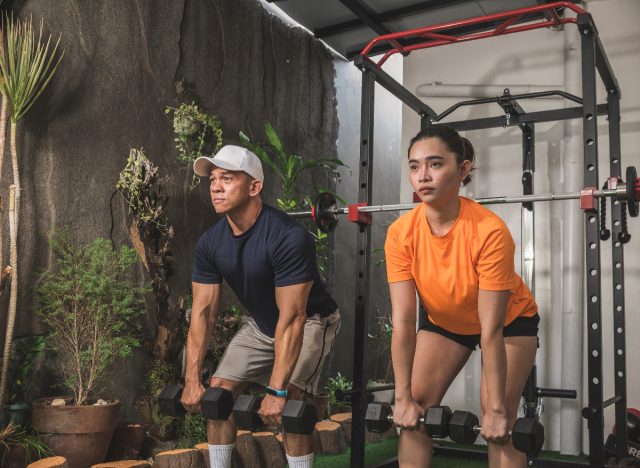
What you need: One dumbbell or kettlebell for goblet squats, one or two dumbbells for Romanian deadlifts, and enough space to stand and hinge comfortably.
The Routine:
- Dumbbell Goblet Squat: 4 rounds of 20 seconds
- Dumbbell Romanian Deadlift: 4 rounds of 20 seconds
Directions
Set a timer for 8 minutes. Perform the goblet squat for 20 seconds, then rest for 40 seconds. Perform the Romanian deadlift for 20 seconds, then rest for 40 seconds. Repeat the sequence until you complete 4 total rounds of each exercise.
Use a weight you can move with control for the full 20 seconds. The work interval is short, so every rep should look clean. The 40-second rest gives your legs enough time to reset before the next set. Read on for the detailed instructions.
Dumbbell Goblet Squat
This is the strength anchor of the routine. The goblet position helps you stay upright while your thighs and glutes handle the work. For clients who struggle to carry machine work into daily movement, this squat often feels more useful quickly because the pattern looks a lot like standing up from a low seat. Keep the depth comfortable, and make each rep smooth from bottom to top.
Muscles Trained: Quads, glutes, hamstrings, core.
How to do it:
- Stand with your feet about shoulder-width apart.
- Hold one dumbbell or kettlebell at chest height.
- Brace your core lightly.
- Push your hips back and bend your knees.
- Lower to a comfortable depth.
- Press through your feet to stand tall.
Best Variations: Bodyweight squat, box squat, lighter goblet squat.
Form Tip: Keep the weight close to your chest to keep your torso strong.
Dumbbell Romanian Deadlift
After the squat hits the front of the legs, the Romanian deadlift shifts the work to the glutes and hamstrings. That pairing balances the routine and helps restore muscle through the full lower body. The hinge also teaches your hips to load and extend with control, which shows up every time you bend to pick something up. Start with a light pair of dumbbells and slow the lowering phase.
Muscles Trained: Hamstrings, glutes, lower back, core.
How to do it:
- Stand tall with a dumbbell in each hand.
- Hold the weights in front of your thighs.
- Soften your knees.
- Push your hips back as the weights lower.
- Stop when you feel tension through the back of your legs.
- Drive your hips forward to stand tall.
Best Variations: Bodyweight good morning, kettlebell Romanian deadlift, single-dumbbell Romanian deadlift.
Form Tip: Keep the weights close to your legs as your hips move back.
How to Make the 8 Minutes Count

A short routine works when you stay focused on the reps. Pick a weight you can control, use the full rest period, and avoid turning the 20 seconds into rushed movement. The goal is to make each round strong enough that your legs feel worked without leaving you drained for the rest of the day. Run this routine three to four days per week, and pair it with walking or light activity on the other days.
- Use the first round to find your rhythm: Start with a smooth pace before adding more reps in later rounds.
- Choose a manageable weight: The load should challenge your legs without pulling you out of position.
- Keep the rest honest: The 40-second break helps the next set stay strong.
- Progress slowly: Add a few pounds, squat deeper, or slow the lowering phase once the routine feels steady.
- Walk after the session: A short walk can help your legs feel looser and keep daily movement in the plan.
- Support muscle with protein: Protein-forward meals help your body maintain the muscle you’re training to rebuild.
References
- Frith, Emily, and Paul D Loprinzi. “The Association between Lower Extremity Muscular Strength and Cognitive Function in a National Sample of Older Adults.” Journal of lifestyle medicine vol. 8,2 (2018): 99-104. doi:10.15280/jlm.2018.8.2.99
- Strollo, S E et al. “A review of the relationship between leg power and selected chronic disease in older adults.” The journal of nutrition, health & aging vol. 19,2 (2015): 240-8. doi:10.1007/s12603-014-0528-y