4 Wall Exercises That Trim Belly Sag Faster Than Crunches After 60

A clear wall can turn a few spare minutes into useful core work. It gives you a steady surface, an easy setup, and a simple way to train your midsection while staying upright. For someone over 60, that can make strength work feel easier to start and easier to keep up during the week.
Trimming belly sag comes from the bigger picture. Regular movement, strength training, protein-focused meals, steady sleep, and a calorie intake you can maintain all help move you toward that goal. Wall exercises fit into that plan because they make short sessions feel accessible and productive.
Household surfaces can be powerful training tools when you use them with purpose. A wall, kitchen counter, sturdy chair, or couch gives you support and a clear place to position your body. That opens the door for quick workouts during normal parts of the day.
The exercises below use the wall to train your core from standing and inclined positions. You’ll work through knee drives, pressing, plank control, and lower-body movement so your abs stay involved while the rest of your body helps raise the effort.
Wall Mountain Climbers
Start here when you want the workout to feel active right away. Wall mountain climbers bring your knees forward one at a time while your hands stay planted, which keeps the movement more approachable than the floor version. Your abs help hold your body position as your legs move. Keep the pace steady first, then add speed once every knee drive feels clean.
Muscles Trained: Abs, hip flexors, shoulders, glutes.
How to Do It
- Stand facing a wall.
- Place both hands on the wall at about chest height.
- Step your feet back until your body leans forward slightly.
- Brace your core.
- Drive one knee toward your chest.
- Step that foot back and switch sides.
Recommended Sets and Reps: Perform 2 to 3 sets of 20 to 40 seconds.
Best Variations: Slower wall mountain climbers, wall knee drives, counter mountain climbers.
Form Tip: Keep your hands planted and move at a pace you can control.
Wall Push-Up
The wall push-up brings your upper body into the session while your midsection holds the line. Think of it as a moving plank with a press built in. Your chest and arms do the pushing, and your abs keep your ribs and hips from drifting. Step farther from the wall only when the reps stay smooth.
Muscles Trained: Chest, shoulders, triceps, abs.
How to Do It
- Stand facing a wall.
- Place your hands slightly wider than shoulder-width.
- Step your feet back to a comfortable incline.
- Brace your core.
- Bend your elbows and lower your chest toward the wall.
- Press through your hands to return to the starting position.
Recommended Sets and Reps: Perform 2 to 3 sets of 8 to 12 reps.
Best Variations: Closer wall push-up, slower wall push-up, counter push-up.
Form Tip: Keep your body moving as one long line from shoulders to heels.
Wall Plank Shoulder Tap
This move works well when you want more control through the waist. Each shoulder tap creates a small shift, so your abs have to keep your torso steady while one hand leaves the wall. Slow taps are best here. Place your hand back with control before switching sides.
Muscles Trained: Abs, shoulders, chest, upper back.
How to Do It
- Stand facing a wall.
- Place both hands on the wall at shoulder height.
- Step your feet back until your body forms a straight line.
- Brace your core.
- Lift one hand and tap the opposite shoulder.
- Place it back on the wall and switch sides.
Recommended Sets and Reps: Perform 2 to 3 sets of 8 to 12 taps per side.
Best Variations: Wall plank hold, slower shoulder taps, counter plank shoulder taps.
Form Tip: Keep your hips still as each hand lifts.
Wall Sit March
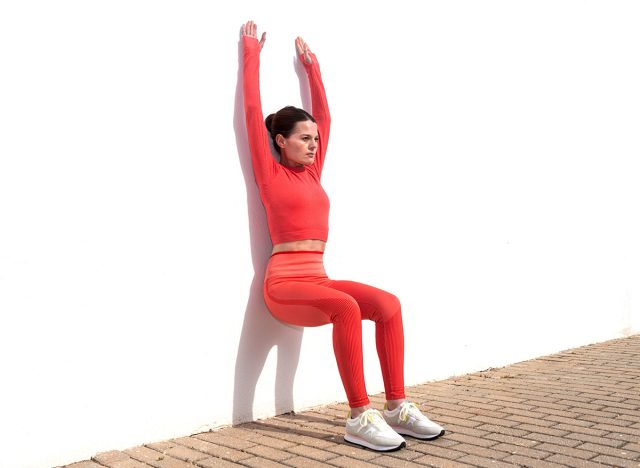
A wall sit march gives the routine a stronger lower-body finish. Hold the wall sit with your thighs while your core keeps your hips level with each small lift. Stay higher on the wall if your knees prefer a gentler angle. A controlled march with steady breathing will do more than rushing through a deeper position.
Muscles Trained: Quads, glutes, abs, hip flexors.
How to Do It
- Stand with your back against a wall.
- Walk your feet forward and slide down into a comfortable wall sit.
- Keep your back against the wall.
- Brace your core.
- Lift one foot a few inches off the floor.
- Lower it, switch sides, and continue marching.
Recommended Sets and Reps: Perform 2 to 3 sets of 20 to 30 seconds.
Best Variations: Higher wall sit march, regular wall sit, wall sit with heel lifts.
Form Tip: Keep the march small enough to keep your hips level.
How to Dial In Belly-Sag Progress After 60
Wall exercises can help you build a stronger midsection and make short workouts easier to repeat. For visible change around the belly, pair them with habits that support fat loss across the week. Walk most days, build meals around protein, and keep the workout close enough that you’ll actually do it. Progress feels more manageable when the plan is simple, and the work keeps showing up.
- Use the wall as a daily cue: Pick a wall you pass often and attach one short exercise block to a routine you already have.
- Walk most days: Daily walking adds low-stress movement and supports the calorie burn behind belly-fat loss.
- Build meals around protein: Protein helps preserve muscle while you work toward a firmer waistline.
- Keep the first set smooth: Start at a pace that lets you feel your abs working before you add speed.
- Plan your snacks: A little structure around snacks can make calorie control feel easier.
- Repeat the work often: Short, consistent sessions can support better strength, better movement, and stronger follow-through.
References
- Alley, Dawn E et al. “A research agenda: the changing relationship between body weight and health in aging.” The journals of gerontology. Series A, Biological sciences and medical sciences vol. 63,11 (2008): 1257-9. doi:10.1093/gerona/63.11.1257
- Binmahfoz, Ahmad et al. “The effects of a home-based resistance training program on body composition and muscle function during weight loss in people living with overweight or obesity: a randomised controlled pilot trial.” Nutrition & metabolism vol. 22,1 90. 4 Aug. 2025, doi:10.1186/s12986-025-00986-1