If You Can Do These 4 Balance Exercises After 60, You’re in Good Shape
Balance gives you a quiet but powerful look at how well your body works as a whole. After 60, it shows up every time you step off a curb, walk across grass, climb stairs, or shift your weight to reach for something. Strong balance comes from more than steady feet. Your hips, core, ankles, eyes, and nervous system all have to communicate quickly so your body can stay controlled.
I’ve coached enough movement sessions to know balance usually shows itself in the small details first. The way someone stands on one leg, controls a step-down, or catches themselves when their center of mass shifts can reveal plenty. Those small details point to strength, coordination, mobility, and body awareness all at once. A person can train hard in the gym and still miss these pieces if every workout stays too predictable.
The four exercises below give you a simple way to check where you stand. Each one challenges balance from a slightly different angle. You’ll test single-leg stability, walking coordination, hip control, and lower-body strength. Perform them with control, move with intention, and use the results as a guide for what to keep building.
Single-Leg Stand
The single-leg stand looks basic, yet it reveals a lot. Every step you take puts your body on one leg for a brief moment, so this drill mirrors something you do all day. Your foot and ankle have to make small adjustments, your hip has to keep your pelvis level, and your core has to help you stay tall. After 60, this simple hold can give you a clear snapshot of balance, stability, and lower-body control.
Muscles Trained: Glutes, hips, calves, ankles, core.
How to Do It:
- Stand tall with your feet under your hips.
- Shift your weight onto one leg.
- Lift your opposite foot slightly off the floor.
- Keep your hips level and your chest tall.
- Hold the position while breathing steadily.
- Switch sides and repeat.
Recommended Sets and Time: Hold for 20 to 45 seconds per side. Complete 2 to 3 rounds.
Best Variations: Supported Single-Leg Stand, Eyes-Closed Single-Leg Stand, Foam Pad Single-Leg Stand, Single-Leg Stand with Toe Taps.
Form Tip: Keep a soft bend in your standing knee so your leg can make small adjustments.
Heel-to-Toe Walk
The heel-to-toe walk challenges balance as you move, giving it a different feel from standing in place. You have to place each foot carefully, control your posture, and keep your eyes forward as your base of support narrows. This drill can help improve walking confidence, especially on sidewalks, trails, crowded spaces, or uneven surfaces. It also trains coordination without needing speed or impact.
Muscles Trained: Calves, ankles, hips, glutes, core.
How to Do It:
- Stand tall with your arms relaxed at your sides.
- Step forward and place one heel directly in front of your opposite toes.
- Shift your weight onto the front foot with control.
- Bring your back foot forward and repeat the same heel-to-toe placement.
- Keep your eyes forward instead of looking straight down.
- Continue for the full distance with slow, steady steps.
Recommended Sets and Distance: Walk for 10 to 20 steps. Complete 2 to 3 rounds.
Best Variations: Line Walk, Backward Heel-to-Toe Walk, Supported Heel-to-Toe Walk, Heel-to-Toe Walk with Pause.
Form Tip: Move slowly enough to own each step before starting the next one.
Single-Leg Romanian Deadlift
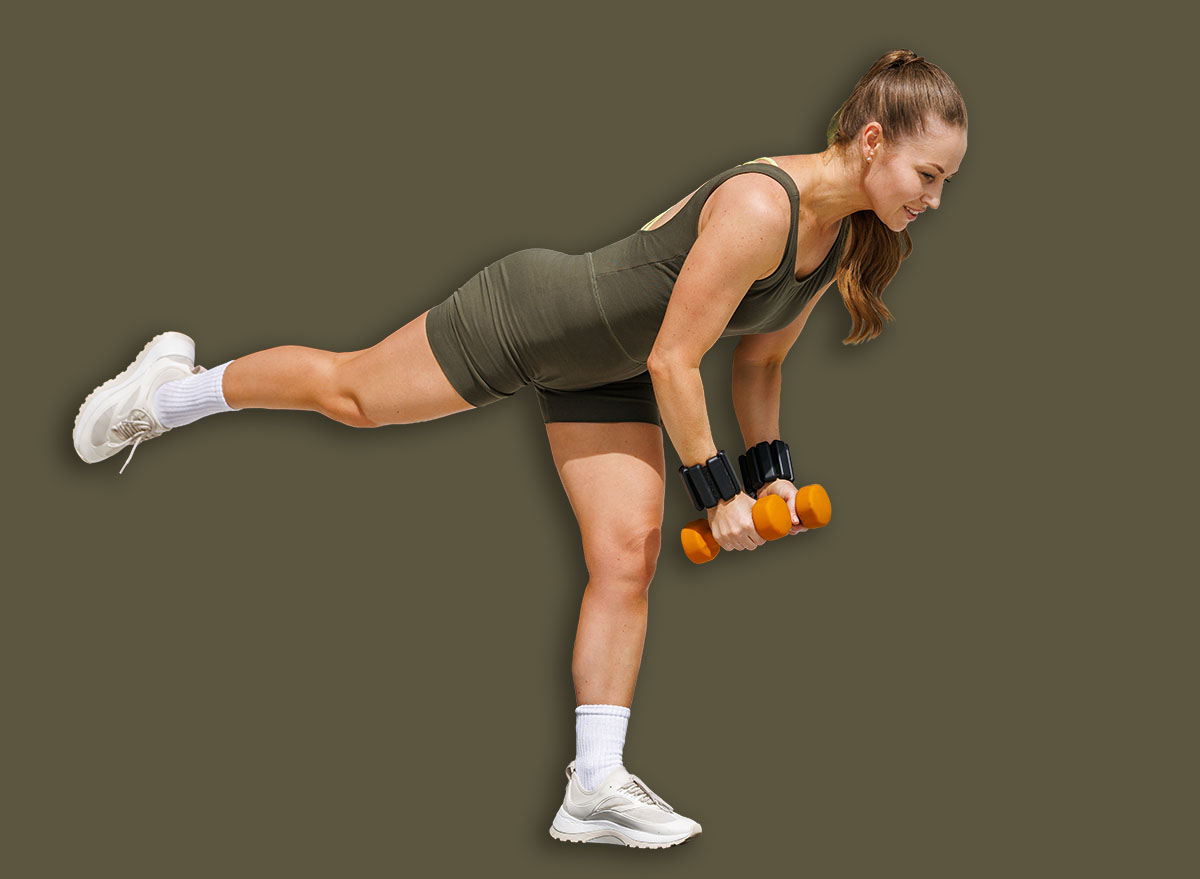
The single-leg Romanian deadlift builds balance and strength simultaneously. It teaches your hips to stay steady while your torso moves, which carries over well to bending, reaching, and stepping. Your glutes and hamstrings do the heavy lifting, while your core helps prevent rotation. This one also quickly exposes side-to-side differences, making it a great exercise to keep in the rotation.
Muscles Trained: Glutes, hamstrings, hips, calves, core.
How to Do It:
- Stand on one leg with a slight bend in your knee.
- Brace your core and keep your hips square.
- Hinge at your hips as your opposite leg reaches behind you.
- Lower your torso until you feel tension in your glute and hamstring.
- Drive through your standing foot to return to the start.
- Complete all reps on one side before switching legs.
Recommended Sets and Reps: Complete 2 to 3 sets of 6 to 10 reps per side.
Best Variations: Supported Single-Leg RDL, Dumbbell Single-Leg RDL, Kickstand RDL, Bodyweight RDL.
Form Tip: Reach your back foot behind you instead of letting your hip open to the side.
Box Step-Down
The box step-down trains one of the most useful balance skills: controlling your body as you lower. Stairs, curbs, and uneven ground all require this same ability. Your quad has to slow the descent, your hip has to keep your knee tracking well, and your foot has to stay planted. A smooth step-down shows strong lower-body control and confidence through a real-life movement pattern.
Muscles Trained: Quads, glutes, hamstrings, calves, hips, core.
How to Do It:
- Stand on a low box or step with one foot near the edge.
- Shift your weight onto the working leg.
- Reach your opposite foot toward the floor.
- Lower with control until your heel lightly taps down.
- Press through your working foot to return to the top.
- Repeat for all reps before switching sides.
Recommended Sets and Reps: Complete 2 to 3 sets of 8 to 12 reps per side.
Best Variations: Supported Step-Down, Lateral Step-Down, Low Box Step-Down, Weighted Step-Down.
Form Tip: Keep your knee tracking over your toes as you lower and stand back up.
How to Improve Balance After 60
Improving balance after 60 comes down to giving your body regular chances to practice control. You want your feet, ankles, hips, core, and eyes working together instead of treating balance like a random skill that only shows up when you need it. These exercises help because they challenge stability in different ways: standing still, walking in a narrow line, hinging on one leg, and controlling your body as you lower. The more consistently you train those patterns, the more confident your movement starts to feel. Small doses work well here, especially when the reps stay clean and intentional.
- Practice balance several times per week: Short sessions add up quickly. Even 5 to 10 minutes a few days per week can improve control.
- Start near support: Use a wall, countertop, chair, or railing when needed. Light support lets you practice better positions without rushing.
- Move slowly: Balance improves when you control each position instead of speeding through the exercise.
- Train both sides evenly: Single-leg work often exposes side-to-side differences. Give each leg the same attention.
- Keep your eyes forward: Looking straight ahead helps your posture stay tall and trains your body to balance without staring at the floor.
- Strengthen your hips and ankles: Glute bridges, calf raises, step-ups, and band walks help build the support system behind better balance.
- Progress one variable at a time: gradually add time, reps, distance, or light resistance. Don’t change everything at once.
- Use real-life carryover: Practice controlled step-downs, steady walking, and single-leg holds so your balance improves in ways you’ll actually use.
- Retest every few weeks: Come back to the same four exercises and see how they feel. Better control, smoother reps, and longer holds all count as progress.
If you can perform these four balance exercises with control after 60, you’re in a strong place. You’re showing the stability, strength, and coordination that help keep movement smooth, confident, and reliable.
References
- Marchesi G, De Luca A, Squeri V, De Michieli L, Vallone F, Pilotto A, Leo A, Casadio M, Canessa A. A Lifespan Approach to Balance in Static and Dynamic Conditions: The Effect of Age on Balance Abilities. Front Neurol. 2022 Feb 21;13:801142. doi: 10.3389/fneur.2022.801142. PMID: 35265025; PMCID: PMC8899125.
- Dunsky A. The Effect of Balance and Coordination Exercises on Quality of Life in Older Adults: A Mini-Review. Front Aging Neurosci. 2019 Nov 15;11:318. doi: 10.3389/fnagi.2019.00318. PMID: 31803048; PMCID: PMC6873344.