5 Chair Exercises That Restore Glute Strength Faster Than Yoga After 60
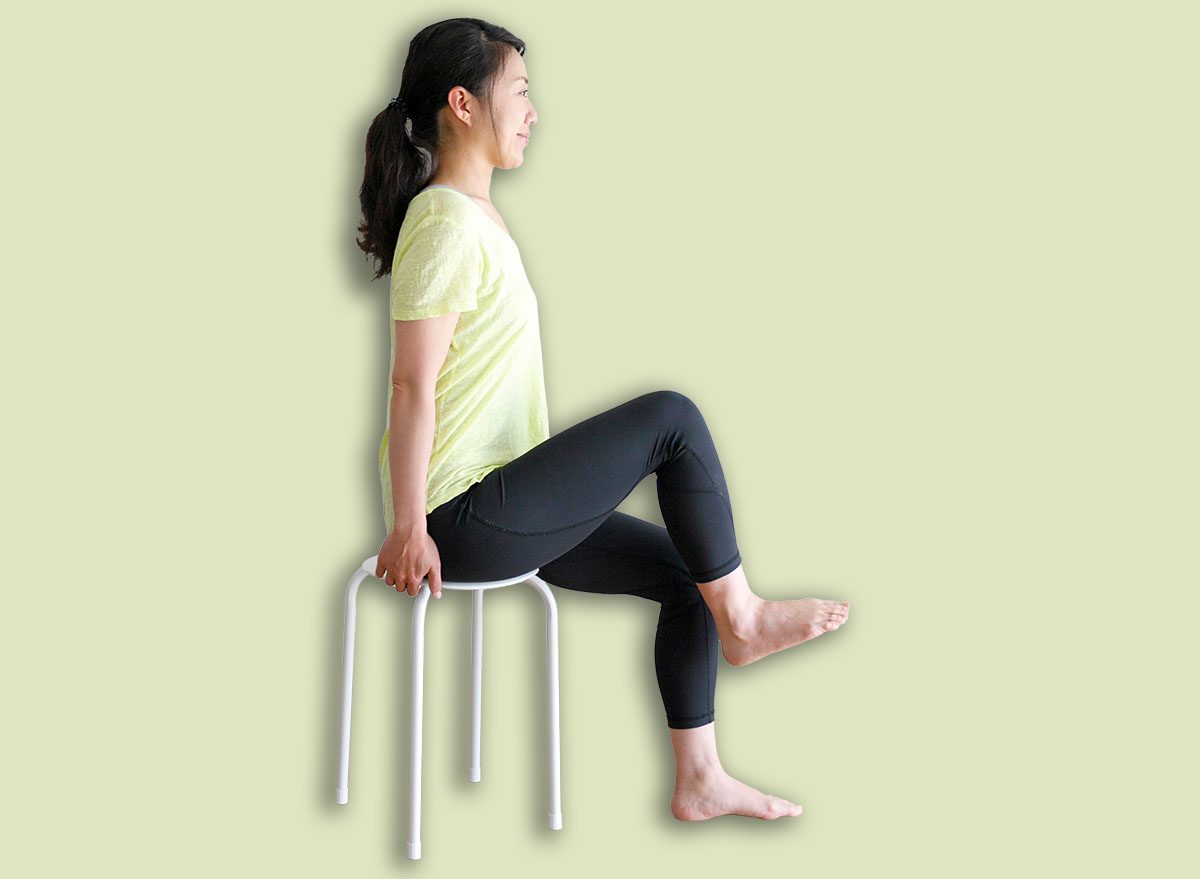

If your goal is to strengthen your gluteal muscles, you’re thinking ahead. Everything you do now to preserve muscle strength is a step closer to staying mobile and flexible as you age. Now, when it comes to the glutes, your first thought may be to perform sets on leg machines at the gym. But we’re here to say you can do chair exercises right at home, and they’re excellent for restoring glute strength.
What makes this modality so effective is the ability to isolate and activate the glute muscles while keeping your lower back and knees safe. Chair workouts are the perfect stable base to work on posterior strength safely.
We spoke with Terry Tateossian, Founder, Certified Lifestyle Medicine Coach, Trainer, and Nutritionist for Women 40+ at THOR – The House of Rose, who has completed a variety of advanced training to support her work in women’s health and middle-aged weight loss, and learned five chair exercises that can help restore glute strength faster than yoga after 60.
Before we dive in, you shouldn’t write off yoga altogether. It’s an incredible form of movement to weave into a well-rounded fitness routine.
In fact, according to Tateossian, “[Yoga is] one of the most beneficial physical practices for adults over 60, and I recommend it to almost every client where applicable. [That said,] traditional yoga is not designed to build strength through progressive overload. Chair exercises like the ones I mentioned deliberately concentrate the load on the glutes, which is how you strengthen and rebuild them. In addition, yoga sustains and gently stresses the muscle—like in the warrior pose. Chair exercises overload it progressively.”
Below, Tateossian shares five chair exercises to add to your routine.
Sit-to-Stand
“This is the single most important glute exercise for adults over 60 as it delivers independence as we get older. Sit to stand without using your arms directly loads the glutes in the exact patterns needed to stand up from a couch, the bathroom or a car. It directly transfers to real life movement,” Tateossian shares.
- Begin seated at the front of a sturdy chair, feet under your knees.
- Lean forward just a bit.
- Try to stand up without using your knees, hands, or additional support.
- Then, use control to slowly sit back down for a count of 3.
- Perform 3 sets of 10 to 12 reps, sticking with tempo 3010.
RELATED: If You Can Do These 8 Lower-Body Moves, Your Leg Strength Is Elite
Chair-Supported Standing Hip Extensions
“This is a great isolation exercise for the gluteus maximus that targets the glutes through a pure hip extension without any help from the quads,” Tateossian says.
- Begin standing tall behind the chair with your hands resting on the back for balance and feet hip-width apart.
- Slowly kick one leg straight behind you.
- Squeeze the glute of the working leg, holding for 1 second at the top.
- Return it to the start position.
- Perform 3 sets of 10 to 15 reps per side, sticking with tempo 3010.
Chair-Supported Standing Side Leg Lifts
“This is a great exercise to help with a ‘waddling’ gait while walking. It also stabilizes the standing leg and helps restore lateral hip stability for adults over 60,” Tateossian tells us.
- Begin standing tall behind the chair with your hands resting on the back for balance and feet hip-width apart.
- Lift one leg out to the side, keeping your toes pointed forward.
- Hold for 1 second at the top.
- Return it to the start position.
- Perform 3 sets of 10 to 15 reps per side, sticking with tempo 3010.
Seated Glute Squeeze Hip Abductions
“When we spend all day sitting, our glutes become ‘sleepy,’ and our bodies unlearn how to activate them. Isometric squeezes like this can turn the switch back on,” Tateossian says.
- Begin sitting tall on the chair with your feet flat on the floor.
- Squeeze your glutes as hard as you can, holding for 10 seconds.
- Release.
- Repeat 18 to 20 times for 3 sets.
Seated Pilates Chair Marches With Glute Engagement
“This trains the glute-and-hip-flexor coordination that regular walking depends on. The pattern of ‘one glute fires while the other side lifts’ is exactly what happens with every step, and rebuilding that coordination in the chair transfers directly to a stronger, more stable gait,” Tateossian notes.
- Begin sitting tall at the edge of a sturdy chair with your feet flat on the floor.
- Slowly lift one knee up toward the ceiling while pressing the opposite glute into the chair.
- Use control to lower.
- Perform 3 sets of 12 to 18 reps on each side, sticking with a slow tempo.