5 Morning Exercises That Restore Core Strength Faster Than Gym Machines After 60
Morning exercise has a nice little advantage: it happens before the day starts stealing your time. A short core routine first thing can loosen up stiffness, wake up your hips and trunk, and give your body a cleaner start before you spend hours sitting, driving, or moving through errands. It also builds consistency. You don’t have to wait for the gym, claim a machine, or hope you still have energy later. You roll out of bed, give your body a few focused minutes, and stack the kind of small wins that actually add up.
Core strength after 60 deserves its own spotlight. A stronger midsection helps support your lower back, improves balance, makes walking feel more stable, and gives your arms and legs a better base to move from. Your core also plays a big role in twisting, reaching, standing tall, getting out of chairs, and carrying things without feeling pulled out of position. That’s a lot more useful than simply making your abs burn for a few minutes.
Gym machines can train your abs, but they often guide the movement for you. Morning core exercises ask your body to control its position on its own. You have to brace, breathe, resist rotation, keep your pelvis steady, and coordinate your arms and legs. That’s the kind of core work I like coaching because it teaches the midsection to support real movement, not just push against a pad or pull on a handle.
For this routine, think controlled and crisp. You’ll use bird dogs to connect your shoulders, hips, and core; dead bugs to train lower belly control; side planks to strengthen your waist; plank shoulder taps to challenge stability; and glute bridge marches to tie your core and hips together. None of these needs a machine, but every one of them asks your core to do its job.
Bird Dogs
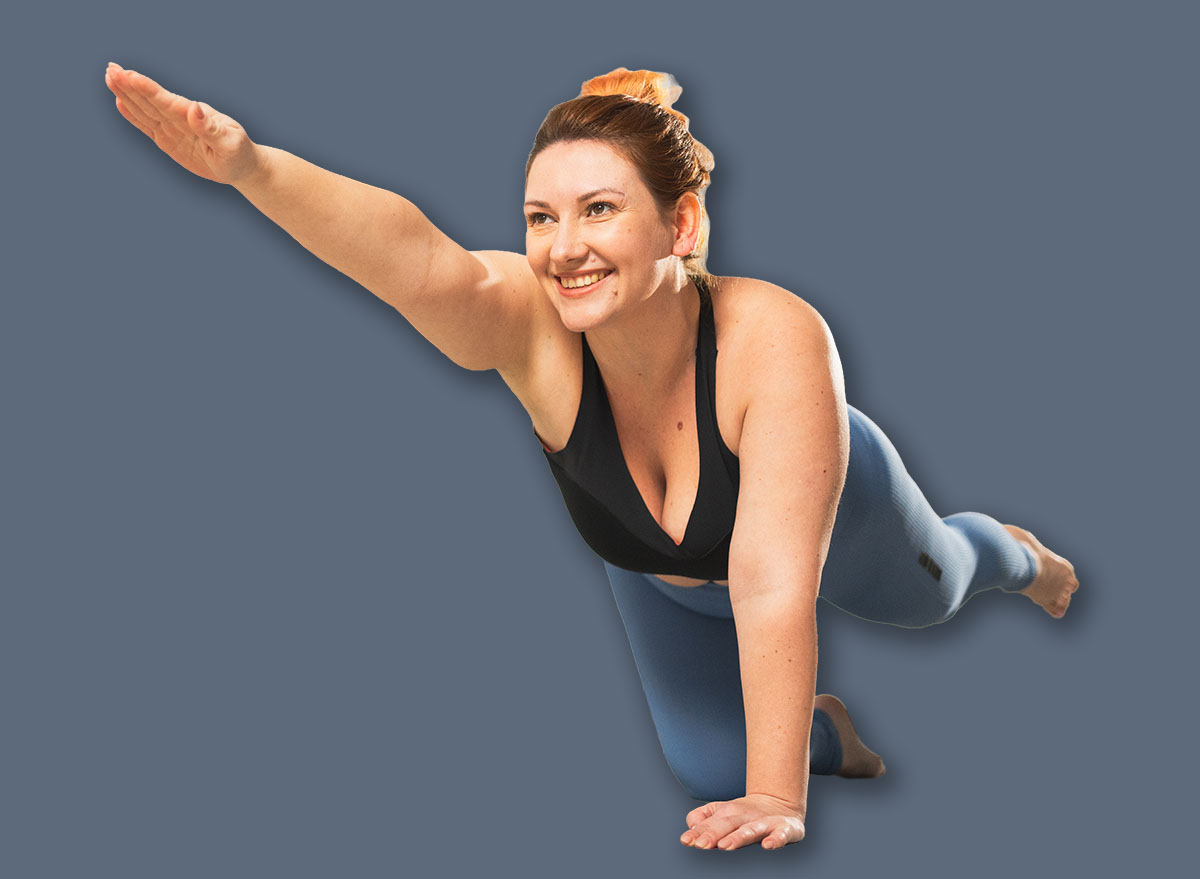
Bird dogs train your core, glutes, shoulders, and lower back while your body stays steady on all fours. As one arm and the opposite leg reach away from your body, your midsection has to brace to keep your hips from shifting or your lower back from arching. That makes bird dogs useful after 60 because they build coordination between your core and limbs, which supports walking, reaching, lifting, and balance. Move slowly and treat each rep like a control drill, not a race.
Muscles Trained: Core, glutes, lower back, and shoulders.
How to Do It:
- Start on all fours with your hands under your shoulders and your knees under your hips.
- Brace your core and keep your back flat.
- Extend your right arm forward and your left leg straight back.
- Hold briefly while keeping your hips level.
- Return to the starting position with control.
- Repeat on the opposite side.
Recommended Sets and Reps: Perform 3 sets of 8 to 10 reps per side. Rest for 30 seconds between each set.
Best Variations: Paused bird dogs, elbow-to-knee bird dogs, and slower bird dogs.
Form Tip: Reach long through your arm and leg without twisting your hips.
Alternating Dead Bugs
Alternating dead bug trains your lower abs and deep core while your arms and legs move away from your body. Your midsection has to keep your ribs and pelvis steady, which teaches your core to support your spine instead of letting your lower back take over. This gives you more carryover than many gym machines because your core has to control movement rather than follow a fixed path. Slow reps make the exercise more effective, especially when your goal is restoring strength and control.
Muscles Trained: Lower abs, deep core, hip flexors, and shoulders.
How to Do It:
- Lie on your back with your arms reaching toward the ceiling.
- Lift your knees over your hips and bend them to 90 degrees.
- Press your lower back gently into the floor.
- Extend your right arm and left leg away from your body.
- Return to the starting position with control.
- Repeat on the opposite side.
Recommended Sets and Reps: Perform 3 sets of 8 to 10 reps per side. Rest for 30 seconds between each set.
Best Variations: Heel tap dead bugs, same side dead bugs, paused dead bugs.
Form Tip: Move only as far as your core can control without your lower back lifting.
Side Plank Holds
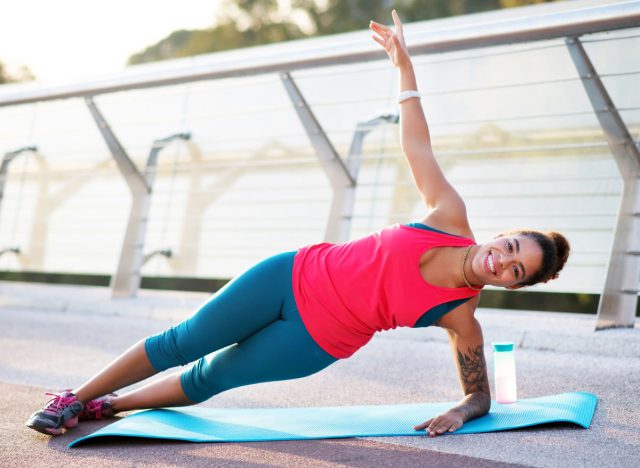
Side plank holds train your obliques, deep core, shoulders, and hips while your body resists dropping toward the floor. The muscles along your waist help keep your trunk steady when you walk, turn, carry groceries, or shift your weight. That side-body strength becomes more important with age because balance and posture rely on more than just your abs. Start with the bent knee version if needed, then build your hold time as your strength improves.
Muscles Trained: Obliques, core, shoulders, outer hips.
How to Do It:
- Lie on your side with your forearm under your shoulder.
- Stack your feet or stagger them for more support.
- Brace your core and lift your hips off the floor.
- Keep your body in a straight line from head to heels.
- Hold the position while breathing steadily.
- Lower with control, then switch sides.
Recommended Sets and Reps: Perform 3 sets of 20 to 30 seconds per side. Rest for 30 seconds between each set.
Best Variations: Bent knee side planks, staggered foot side planks, side plank with top leg lift.
Form Tip: Press your forearm into the floor and keep your hips lifted.
Plank Shoulder Taps
Plank shoulder taps train your core, shoulders, chest, triceps, and glutes while your body fights rotation. Each time one hand leaves the floor, your midsection has to brace harder to keep your hips from rocking. That makes this exercise a strong choice for restoring core strength because your abs have to stabilize while your upper body moves. It also helps with balance, posture, and the kind of control you need when one side of your body works harder than the other.
Muscles Trained: Core, shoulders, chest, triceps, glutes.
How to Do It:
- Start in a high plank position with your hands under your shoulders.
- Set your feet slightly wider than hip width.
- Brace your core and squeeze your glutes.
- Tap one hand to your opposite shoulder.
- Place your hand back on the floor with control.
- Alternate sides while keeping your hips steady.
Recommended Sets and Reps: Perform 3 sets of 8 to 12 taps per side. Rest for 45 seconds between each set.
Best Variations: Incline shoulder taps, wider stance shoulder taps, and slower shoulder taps.
Form Tip: Move your hand slowly and keep your hips quiet.
Glute Bridge Marches
Glute bridge marches train your glutes, hamstrings, lower abs, and deep core while your hips stay lifted. Every time one foot leaves the floor, your midsection has to keep your pelvis from shifting side to side. This ties your core and hips together, which matters for walking, climbing stairs, standing up, and supporting your lower back. The movement also wakes up the backside of your body in the morning, which helps counter all the sitting that usually follows.
Muscles Trained: Glutes, hamstrings, lower abs, core.
How to Do It:
- Lie on your back with your knees bent and your feet flat on the floor.
- Press through your heels and lift your hips.
- Brace your core and squeeze your glutes.
- Lift one foot a few inches off the floor.
- Place your foot back down with control.
- Alternate sides while keeping your hips lifted.
Recommended Sets and Reps: Perform 3 sets of 8 to 10 marches per side. Rest for 45 seconds between each set.
Best Variations: Glute bridge holds, mini band glute bridges, and single leg bridge holds.
Form Tip: Keep your hips level as each foot lifts.
How to Make Morning Core Work Pay Off
Morning core training works best when you keep the routine short enough to repeat and focused enough to challenge your control. You’re not chasing exhaustion here. You’re teaching your midsection to brace, stabilize, and support the rest of your body before the day gets moving.
- Start with smooth reps: Bird dogs and dead bugs should feel controlled from start to finish. If your hips shift or your back arches, shorten the range and slow down.
- Train your sides, not just your front: Side planks target the obliques and deep core muscles that support balance, posture, and carrying.
- Keep your hips involved: Glute bridge marches remind your core and glutes to work together. That connection supports your lower back and makes daily movement feel stronger.
- Use machines as a bonus, not the whole plan: Gym machines can add resistance, but floor-based core work teaches your body to control its own position.
- Repeat the routine often: A few focused mornings per week can build more momentum than one long core session you rarely revisit.
A stronger core after 60 should make life feel easier, not just workouts harder. Start the day with clean, controlled reps, and your midsection will have more to offer when you walk, lift, reach, turn, and move through everything else on your schedule.
References
- Morales-Palomo, Felix et al. “Efficacy of morning versus afternoon aerobic exercise training on reducing metabolic syndrome components: A randomized controlled trial.” The Journal of physiology vol. 602,23 (2024): 6463-6477. doi:10.1113/JP285366
- Zhong, Yuanji et al. “Effects of core training on balance performance in older adults: a systematic review and meta-analysis.” Frontiers in public health vol. 13 1661460. 9 Oct. 2025, doi:10.3389/fpubh.2025.1661460