4 Bed Exercises That Tighten Sagging Arm Skin After 55, According to a Trainer
If your arms feel softer than they used to, you’re far from alone. After 55, changes in muscle mass and skin elasticity can show up quickly, especially if upper-body strength work has taken a back seat. The encouraging part is that targeted strength training can help firm and support the muscles beneath the skin, improving the overall look and feel of your arms. I’ve coached plenty of adults toward this exact goal, and simple bodyweight work often delivers impressive results when done consistently.
One of the most effective ways to rebuild arm strength at this stage is to use positions that feel joint-friendly and approachable. That’s where bed-based training shines. The slight elevation reduces strain on the shoulders and wrists while still allowing you to challenge your triceps, chest, and shoulders in a meaningful way. In my programming, I often start clients with incline and supported movements because they build confidence fast and create strong early momentum.
The four bed exercises below target the backs of your arms and the supporting upper-body muscles that help create a tighter, more toned appearance. Each move builds strength, control, and muscular endurance using nothing more than your body weight and a sturdy bed. Here’s exactly how to perform them for the best results.
Bodyweight Dips
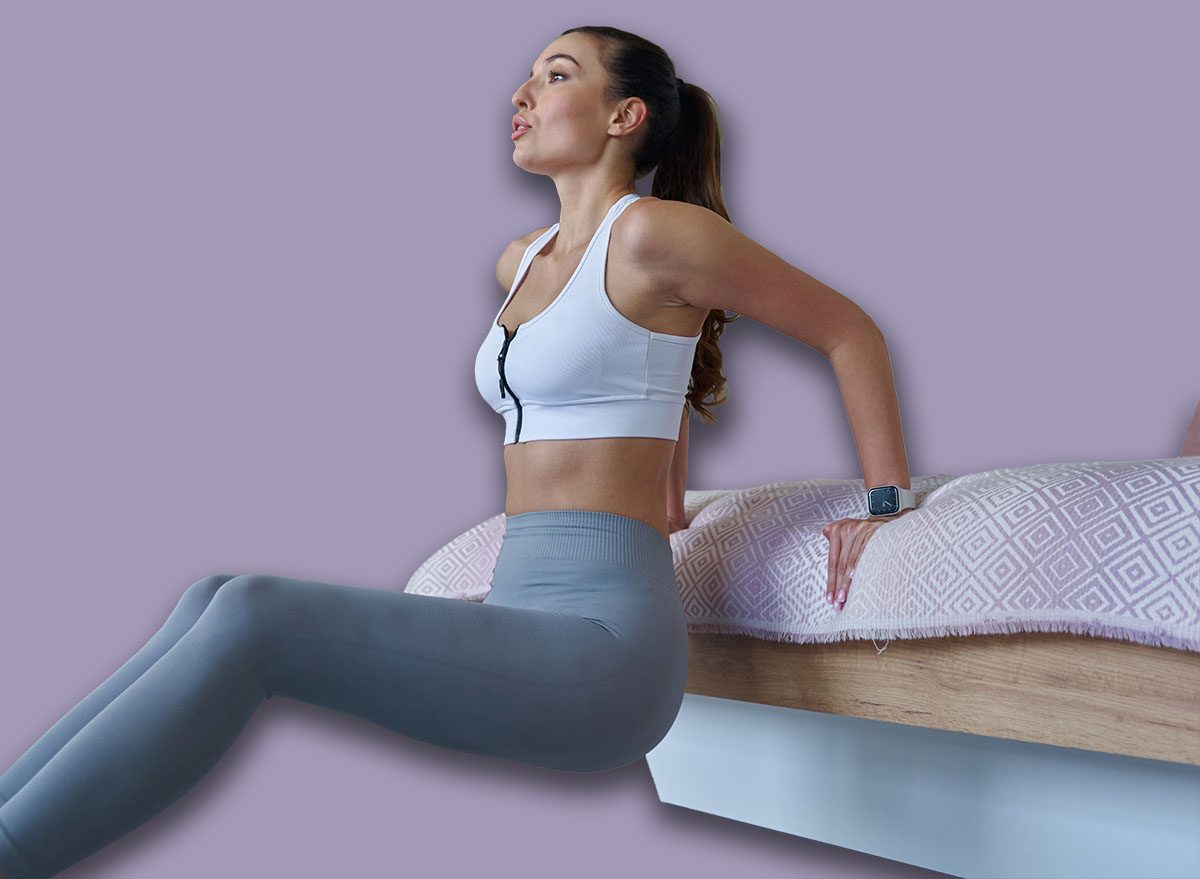
Bodyweight dips directly target the triceps, which play the biggest role in improving the firmness along the back of the arms. This movement strengthens the muscles responsible for elbow extension while also challenging your shoulders and upper chest to support it. I like starting here because most people immediately feel the working muscles engage, which helps reinforce good effort and consistency. Over time, stronger triceps create better arm definition and support the skin more effectively.
Muscles Trained: Triceps, anterior deltoids, pectorals, and core.
How to Do It:
- Sit on the edge of your bed with your hands placed beside your hips.
- Slide your hips forward off the bed while supporting your weight with your arms.
- Bend your elbows to lower your body toward the floor.
- Keep your chest lifted and elbows pointing behind you.
- Press through your palms to straighten your arms and return to the start.
- Repeat for the target number of reps.
Recommended Sets and Reps: Perform 3 sets of 10 to 12 reps. Rest for 60 seconds between each set.
Best Variations: Bent-knee dips, straight-leg dips, tempo dips.
Form Tip: Keep your shoulders down and away from your ears throughout each rep.
Incline Push-Ups
Incline push-ups strengthen the chest, shoulders, and triceps while reducing the load compared to floor push-ups. That makes them especially effective for adults over 55 who want strong upper body training with less joint stress. This movement also teaches your core to stay braced as your arms press, improving total-body control. I often program incline push-ups because they scale easily and deliver reliable upper-body activation.
Muscles Trained: Chest, triceps, anterior deltoids, and core.
How to Do It:
- Place your hands on the edge of your bed, slightly wider than shoulder width.
- Step back with your feet until your body forms a straight line.
- Brace your core and keep your neck neutral.
- Bend your elbows to lower your chest toward the bed.
- Press through your hands to return to the starting position.
- Repeat for the target number of reps.
Recommended Sets and Reps: Perform 3 sets of 8 to 12 reps. Rest for 60 seconds between each set.
Best Variations: Narrow grip incline push-ups, tempo incline push-ups, elevated feet push-ups.
Form Tip: Keep your body in one straight line from head to heels.
Incline Plank Hold
The incline plank hold builds deep core and shoulder stability, which supports stronger and more controlled arm movement. While it looks simple, this exercise teaches your upper body to maintain tension for extended periods, thereby improving muscular endurance in the arms and shoulders. I like using this with clients because it reinforces full-body stability while staying very joint-friendly. Stronger stabilizers help your arms look and feel firmer over time.
Muscles Trained: Core, shoulders, chest, and triceps.
How to Do It:
- Place your forearms on the edge of your bed.
- Step back with your feet until your body forms a straight line.
- Brace your core and lightly squeeze your glutes.
- Keep your shoulders stacked over your elbows.
- Hold the position while breathing steadily.
- Maintain tension for the full time interval.
Recommended Sets and Reps: Perform 3 sets of 20 to 30 seconds. Rest for 45 seconds between each set.
Best Variations: High plank on bed, longer hold plank, staggered stance plank.
Form Tip: Pull your ribs down and keep your hips level.
Incline Plank + Shoulder Taps
Adding shoulder taps to the incline plank increases the stability challenge and forces your arms and core to work harder together. This movement improves anti-rotation strength, which helps tighten and strengthen the muscles supporting your upper body. In my coaching experience, this is a great progression once basic planks feel solid. It builds coordination, control, and arm endurance in one efficient movement.
Muscles Trained: Core, triceps, shoulders, and chest.
How to Do It:
- Place your hands on the edge of your bed and step into a high plank position.
- Brace your core and keep your hips steady.
- Lift one hand and tap the opposite shoulder.
- Return your hand to the bed with control.
- Alternate sides while keeping your torso stable.
- Continue for the target number of reps.
Recommended Sets and Reps: Perform 3 sets of 10 to 16 taps total. Rest for 45 seconds between each set.
Best Variations: Slow shoulder taps, wider-stance taps, elevated-surface taps.
Form Tip: Minimize hip sway as you alternate each tap.
Best Daily Habits to Tighten Arms After 55

If you want firmer-looking arms, your training routine works best when it pairs with supportive daily habits. Muscle tone improves through consistent strength work, smart recovery, and steady nutrition practices. In my coaching experience, the clients who see the most visible changes focus on simple habits they can repeat week after week. Progress builds faster when your workouts and lifestyle pull in the same direction. Stay patient with the process and keep your efforts consistent. These strategies help reinforce the work you’re doing on the bed.
- Train your upper body at least three times per week: Frequent training helps maintain muscle firmness and endurance.
- Prioritize daily protein intake: Aim for 25-30 grams per meal to support muscle maintenance.
- Stay consistent with short workouts: Brief sessions performed regularly outperform occasional long workouts.
- Focus on controlled reps: Slower tempo increases time under tension through the arms.
- Support recovery with quality sleep: Muscles repair and strengthen during overnight recovery.
- Progress your movements gradually: Small increases in reps or difficulty help maintain steady improvement.
Stick with these exercises and habits, and many adults over 55 begin to notice stronger, tighter-feeling arms, along with improved upper-body confidence.
References
- Siparsky, Patrick N et al. “Muscle changes in aging: understanding sarcopenia.” Sports health vol. 6,1 (2014): 36-40. doi:10.1177/1941738113502296
- Krzysztofik, Michal et al. “Maximizing Muscle Hypertrophy: A Systematic Review of Advanced Resistance Training Techniques and Methods.” International journal of environmental research and public health vol. 16,24 4897. 4 Dec. 2019, doi:10.3390/ijerph16244897