5 Chair Exercises That Flatten Lower Belly Overhang After 60, According to a Trainer
Lower belly overhang can feel stubborn, especially after 60, when muscle mass, core strength, and daily activity levels tend to shift. The encouraging part is that you may already have the tools necessary to make meaningful progress. With the right movements and consistent effort, you can strengthen your core, improve posture, and support a leaner midsection from the comfort of a sturdy chair.
In my years of coaching clients, I’ve seen simple seated core work deliver outstanding results when it’s programmed correctly and performed with intent. I often use seated exercises in situations where the movement needs to meet someone exactly where they are. Sitting helps many people finally “find the core” because it reduces balance demands and better isolates the muscles that matter most. Many people overlook chair-based training, yet it often allows better control, safer positioning, and more focused core engagement. That combination becomes especially valuable if you want to train consistently without beating up your joints.
Below, you’ll find five targeted chair exercises that challenge your lower abs, improve trunk stability, and help tighten the muscles that support a flatter midsection. Perform them with focus and steady breathing, and you’ll build strength exactly where it counts.
Knee Tucks
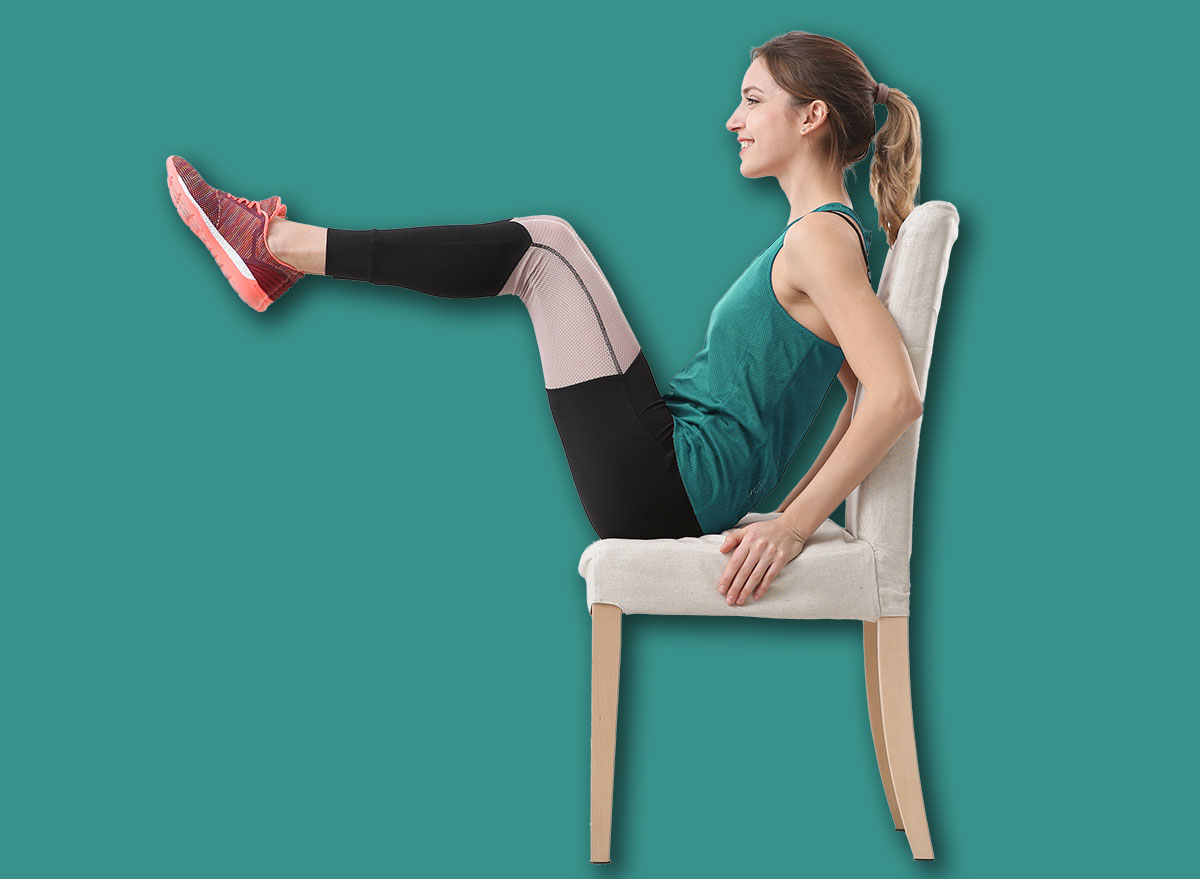
Knee tucks directly target the lower portion of your abdominal wall while also training hip flexor control and deep core stability. This move teaches your body to brace and move your legs without losing posture, which carries over to everyday activities like walking and getting up from a chair. When performed with control, knee tucks create serious tension through the lower abs. Over time, that added strength helps tighten and support the area where the lower belly overhang tends to settle.
Muscles Trained: Rectus abdominis, transverse abdominis, hip flexors, and obliques.
How to Do It:
- Sit tall on the front edge of your chair and place your hands beside your hips.
- Lean your torso back slightly while keeping your chest proud.
- Lift your feet off the floor and extend your legs forward.
- Pull your knees toward your chest while keeping your core braced.
- Extend your legs back out with control and maintain your posture.
- Repeat for the desired number of reps.
Recommended Sets and Reps: Perform 3 sets of 10 to 15 reps. Rest for 45 seconds between each set.
Best Variations: Single-leg knee tucks, alternating knee tucks, tempo knee tucks.
Form Tip: Keep your chest lifted and avoid rounding your lower back.
Flutter Kicks
Flutter kicks create constant tension through the lower abs while also challenging coordination and endurance. The alternating leg motion forces your core to stabilize your pelvis, which helps reinforce better control of the midsection. This exercise also builds muscular stamina in the hip flexors and deep abdominal muscles. When done consistently, flutter kicks help tighten and strengthen the area below the navel.
Muscles Trained: Lower abs, hip flexors, transverse abdominis, and quads.
How to Do It:
- Sit tall near the edge of your chair and place your hands beside your hips.
- Lean back slightly while keeping your core tight.
- Lift both legs off the floor and extend them forward.
- Alternate kicking your legs up and down in small controlled motions.
- Keep your torso steady and your breathing smooth.
- Continue for the target time or reps.
Recommended Sets and Reps: Perform 3 sets of 20 to 30 total kicks. Rest for 45 seconds between each set.
Best Variations: Low flutter kicks, high flutter kicks, timed flutter intervals.
Form Tip: Keep the movement small and controlled rather than fast and sloppy.
Scissor Kicks
Scissor kicks challenge the lower abs more than flutter kicks do, through a wider range of motion. The crossing pattern forces your core to resist rotation while maintaining pelvic control. This added demand improves deep core engagement and coordination. Over time, scissor kicks help build stronger lower abdominal muscles that support a tighter waistline.
Muscles Trained: Rectus abdominis, transverse abdominis, hip flexors, and inner thighs.
How to Do It:
- Sit upright on the edge of the chair and brace your core.
- Lean back slightly and lift your legs off the floor.
- Extend your legs forward and slightly separate them.
- Cross one leg over the other in a controlled scissor motion.
- Alternate which leg crosses on top while keeping your torso steady.
- Continue for the prescribed reps.
Recommended Sets and Reps: Perform 3 sets of 16 to 20 total crosses. Rest for 45 seconds between each set.
Best Variations: Slow tempo scissor kicks, low hold scissors, alternating pause scissors.
Form Tip: Keep your lower back stable while braced.
Seated Pallof Press
The seated Pallof press trains your core to resist rotation, a skill that plays a major role in building a firm, supportive midsection. Many people focus only on bending movements for abs, yet anti-rotation strength helps tighten the waist and improve posture. This exercise also reinforces bracing mechanics that protect your spine during daily movement. With consistent practice, it builds the deep core stability that supports a flatter appearance through the midsection.
Muscles Trained: Transverse abdominis, obliques, rectus abdominis, and shoulders.
How to Do It:
- Sit tall in your chair next to a cable machine or resistance band anchor.
- Hold the handle at your chest with both hands.
- Brace your core and press the handle straight out in front of you.
- Hold briefly while resisting any torso rotation.
- Pull the handle back to your chest with control.
- Repeat all reps, then switch sides.
Recommended Sets and Reps: Perform 3 sets of 10 to 12 reps per side. Rest for 45 seconds between each set.
Best Variations: Band Pallof press, overhead Pallof press, iso hold Pallof press.
Form Tip: Keep your shoulders square and avoid twisting toward the anchor.
Seated Dumbbell Chops
The seated dumbbell chop trains your core to stabilize while producing controlled rotational force. This pattern lights up the obliques and deep abdominal muscles, helping tighten the waistline and supporting the lower belly. It also improves coordination between your upper and lower body, which becomes increasingly valuable for everyday movement after 60. When performed with control, this exercise builds the kind of core strength that carries over to real life.
Muscles Trained: Obliques, transverse abdominis, rectus abdominis, and shoulders.
How to Do It:
- Sit tall on your chair while holding one dumbbell with both hands near one shoulder.
- Brace your core and keep your chest lifted.
- Move the dumbbell diagonally across your body toward the opposite hip.
- Rotate through your torso while keeping your lower body stable.
- Reverse the motion and return the dumbbell to the starting position.
- Complete all reps, then switch sides.
Recommended Sets and Reps: Perform 3 sets of 10 to 12 reps per side. Rest for 45 seconds between each set.
Best Variations: High-to-low chop, low-to-high chop, band-diagonal chop.
Form Tip: Rotate through your ribs and core, rather than lifting the weight solely with your arms.
The Best Daily Habits to Flatten Lower Belly Overhang After 60

Flattening the lower belly after 60 comes down to consistency, smart strength work, and supportive daily habits. Targeted exercises help build the muscle foundation, yet your everyday routines determine how quickly you see and feel progress. I’ve coached many clients through this phase, and the ones who improve the fastest usually tighten up their habits outside the workout. Focus on the fundamentals below, and you’ll give these chair exercises far more impact.
- Train your core consistently: Aim to perform focused core work at least three times per week to build and maintain strength.
- Prioritize daily walking: Regular walking supports calorie burn, circulation, and recovery between workouts.
- Dial in your protein intake: Adequate protein supports muscle maintenance, which becomes increasingly important after 60.
- Watch overall calorie balance: Fat loss around the lower belly responds best to steady, sustainable nutrition habits.
- Focus on posture throughout the day: Sitting and standing tall keeps your core lightly engaged and reinforces better movement patterns.
- Sleep 7 to 8 hours nightly: Quality sleep supports recovery, hormone balance, and body-composition goals.
Stay consistent, move with control, and give your body time to adapt. Done right, these simple chair exercises can become a powerful part of your long-term core strength plan.
References
- Klempel, Natalie et al. “The Effect of Chair-Based Exercise on Physical Function in Older Adults: A Systematic Review and Meta-Analysis.” International journal of environmental research and public health vol. 18,4 1902. 16 Feb. 2021, doi:10.3390/ijerph18041902
- Kang, Kwon-Young. “Effects of core muscle stability training on the weight distribution and stability of the elderly.” Journal of physical therapy science vol. 27,10 (2015): 3163-5. doi:10.1589/jpts.27.3163
- Zhong, Yuanji et al. “Effects of core training on balance performance in older adults: a systematic review and meta-analysis.” Frontiers in public health vol. 13 1661460. 9 Oct. 2025, doi:10.3389/fpubh.2025.1661460